Saint Christopher Medallion Necklace: 2026 Value & Budget Guide
Discover the true value of a Saint Christopher medallion necklace in 2026. Compare materials, pricing tiers, and avoid overpaying for your pendant.

The Anatomy of Value: Beyond the Saintly Icon
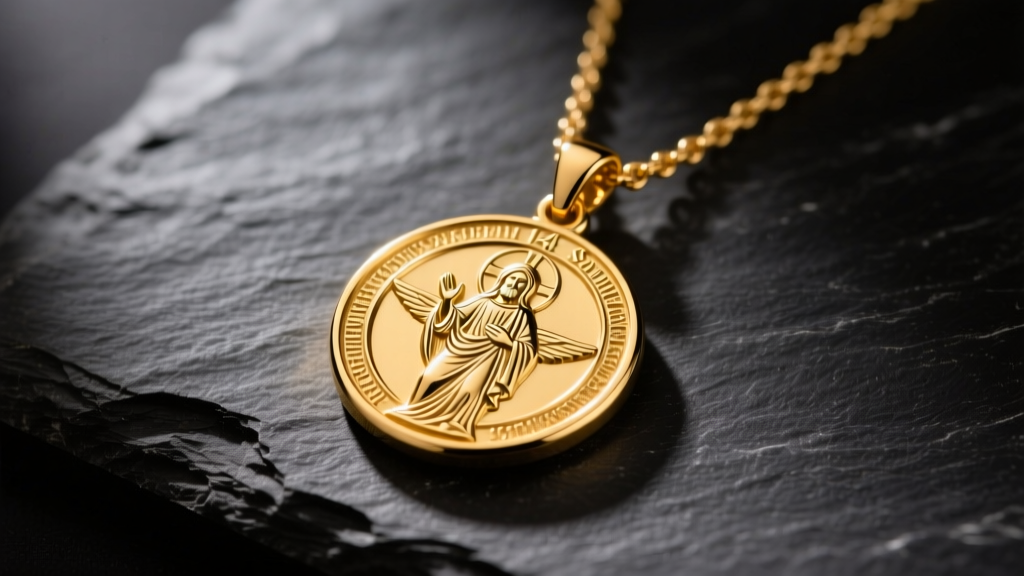
The Saint Christopher medallion necklace has transcended its origins as a mere talisman for travelers to become a staple of modern jewelry layering and personal expression. However, as precious metal markets fluctuate and manufacturing techniques evolve, determining the true value of these pendants in 2026 requires a discerning eye. Whether you are shopping for a budget-friendly sterling silver piece or an heirloom-quality solid gold medallion, understanding the intersection of metallurgy, craftsmanship, and hardware is essential to avoid overpaying. This comprehensive value assessment breaks down exactly what you should expect to pay, what materials offer the best longevity, and where the hidden cost traps lie in today's market.
Material Tiers: Where Your Money Actually Goes
The most significant variable in the pricing of any Saint Christopher medallion necklace is the base metal and its finishing. In 2026, the market is saturated with deceptive marketing terms like "gold-filled" or "heavy-plated," which often mask inferior core metals. To make a sound budget assessment, you must categorize pieces into three distinct tiers.
Tier 1: Base Metals and Flash Plating (The Budget Trap)
Pieces priced between $15 and $45 are typically crafted from brass, copper, or stainless steel, featuring a microscopic "flash" plating of gold or silver. While stainless steel offers decent durability, brass and copper bases will inevitably oxidize. Once the ultra-thin plating (often less than 0.5 microns) wears away—usually within three to six months of daily wear—the exposed base metal reacts with your skin's pH, leaving a green or black residue. From a value perspective, these are disposable accessories, not investments. If your budget is strictly under $50, opt for surgical-grade stainless steel over brass to ensure the piece at least survives contact with water and sweat without degrading.
Tier 2: Sterling Silver and Gold Vermeil (The Sweet Spot)
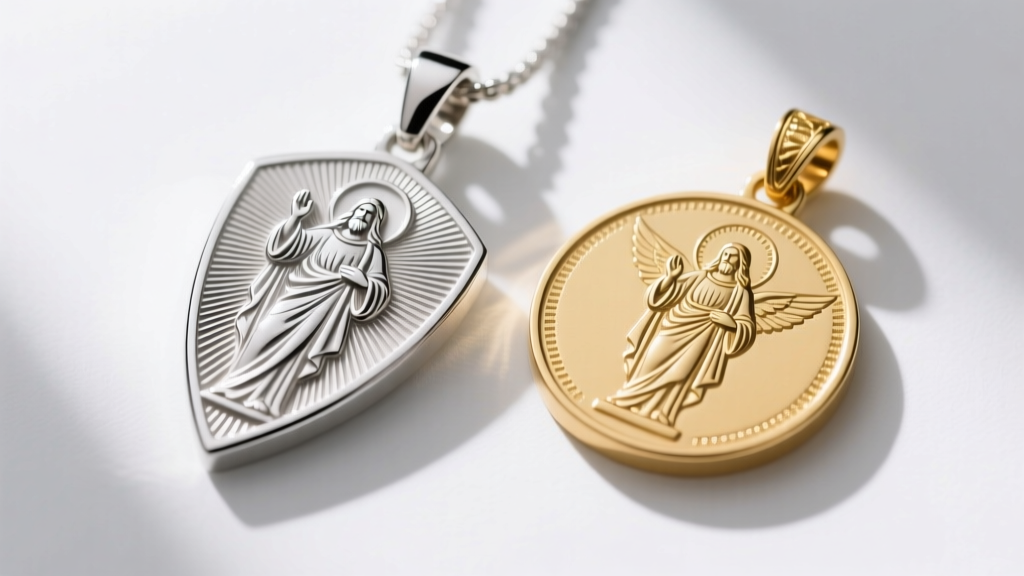
For budgets ranging from $80 to $250, sterling silver (925) and gold vermeil offer the best balance of aesthetic luxury and financial prudence. According to the FTC Jewelry Guides, true gold vermeil must consist of a sterling silver base coated with at least 2.5 microns of 10k, 14k, or 18k gold. This thickness ensures the gold layer can withstand 1 to 3 years of regular wear before requiring professional re-plating. A solid 925 sterling silver Saint Christopher medallion is arguably the best value proposition on the market; it possesses intrinsic scrap value, can be polished indefinitely, and develops a patina that many collectors find desirable. Expect to pay $90 to $150 for a high-quality, 22mm solid silver medallion.
Tier 3: Solid Gold (The Investment and Heirloom Tier)
Solid gold medallions (10k, 14k, and 18k) start around $450 and can easily exceed $2,500 depending on gram weight and diameter. When assessing value here, you are paying for the intrinsic melt value of the gold plus the artisan's labor premium. As detailed in GIA's guide on gold alloys, 14k gold (58.5% pure gold) is the optimal choice for medallions because the alloyed metals (like copper and zinc) provide the necessary tensile strength to resist bending and scratching. 18k gold offers a richer, warmer yellow hue but is softer, making it more prone to denting if the medallion is struck against a hard surface. When buying solid gold, always calculate the current spot price of gold, multiply it by the piece's exact gram weight, and ensure the retail markup does not exceed 40% to 60% for a fair market deal.
2026 Pricing Matrix: What You Should Actually Pay
To help you benchmark your purchases, the table below outlines the fair retail value ranges for standard 22mm to 25mm Saint Christopher medallions in the current 2026 market. Prices assume a standard cable or box chain inclusion; premium chains will add to the final cost.
| Material Composition | Average Gram Weight (22mm) | Fair Retail Price Range (2026) | Longevity & Value Retention |
|---|---|---|---|
| Stainless Steel (PVD Gold) | 8g - 12g | $35 - $65 | High durability, zero resale value |
| Solid 925 Sterling Silver | 6g - 10g | $90 - $160 | Excellent, retains intrinsic metal value |
| Gold Vermeil (2.5+ microns) | 6g - 10g | $140 - $240 | Moderate, requires eventual re-plating |
| Solid 10k Yellow Gold | 4g - 7g | $350 - $550 | High, tracks with gold spot market |
| Solid 14k Yellow Gold | 5g - 9g | $600 - $1,100 | Exceptional, heirloom-grade investment |
Craftsmanship: Laser Etching vs. Die-Striking
A critical, yet often overlooked, factor in assessing the value of a Saint Christopher medallion necklace is the method used to apply the iconic imagery of the saint carrying the Christ child across the river. Budget manufacturers rely on laser etching. While laser etching is precise, it is entirely superficial. The image is burned onto the surface, meaning it will eventually wear smooth with decades of friction against clothing and skin. Furthermore, laser-etched pieces lack the tactile, three-dimensional depth that characterizes fine jewelry.
Conversely, premium medallions are die-struck or cast using high-pressure molds. Die-striking compresses the metal, increasing its density and durability while forcing the metal into deep, intricate crevices of the master die. This results in sharp, deeply recessed lines that catch the light beautifully and will remain legible for generations. When inspecting a piece in person or reviewing high-resolution macro photos, look for deep shadows in the engraving lines. If the design looks flat or uniformly shallow, you are looking at a laser-etched piece and should adjust your budget expectations accordingly.
Chain Pairings and Hardware: The Hidden Failure Points
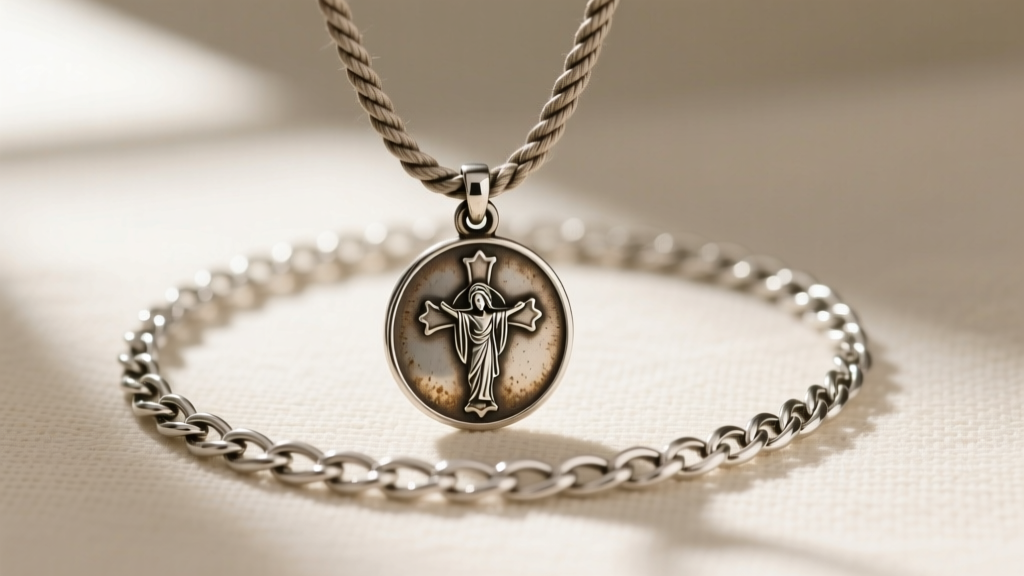
A medallion is only as secure as the chain and hardware supporting it. A common mistake buyers make is pairing a heavy, solid 14k gold medallion with a delicate, hollow 1.5mm cable chain to save money. This creates a severe mechanical imbalance. The bail (the loop connecting the pendant to the chain) will act as a saw, slowly wearing through the soft links of the chain, inevitably leading to the loss of the medallion.
For medallions weighing over 8 grams, you must invest in a chain with structural integrity. Rope chains, Figaro chains, or Cuban links with a minimum width of 3.5mm to 4.5mm are required to distribute the pendulum stress evenly. Additionally, scrutinize the clasp. Spring-ring clasps are cheap and prone to snapping under the dynamic weight of a swinging medallion. Insist on a lobster claw clasp with a reinforced soldered ring on the opposing end. Finally, check the bail itself; a hinged bail offers more mobility and reduces stress on the chain, whereas a rigid, soldered bail can cause the chain to kink and weaken over time.
Vintage vs. Modern Reproductions
The secondary market is flooded with vintage Saint Christopher medallions from the 1960s and 1970s, an era when Italian goldsmiths favored incredibly high-relief, hand-finished die-struck designs. These vintage pieces often offer superior artistic value and craftsmanship compared to modern, CAD-designed (Computer-Aided Design) reproductions, which can sometimes look sterile or overly digitized. When evaluating vintage pieces, factor in the cost of potential restoration, such as replacing worn bails or fixing weakened jump rings. However, securing a mid-century 18k Italian gold medallion at auction or from an estate jeweler often provides a higher dollar-to-gram value ratio than buying newly minted pieces from contemporary mall jewelers, whose overhead costs inflate the retail price significantly.
Final Verdict: Maximizing Your Budget
Ultimately, the value of a Saint Christopher medallion necklace in 2026 is dictated by your personal timeline. If you view jewelry as a seasonal trend, a PVD-coated stainless steel or gold vermeil piece offers immediate visual satisfaction at a low entry cost. However, if you view this specific pendant as a permanent fixture—a daily reminder of protection and a potential heirloom—bypass the plated options entirely. Allocate your budget toward a solid 14k gold or heavy-gauge sterling silver medallion, prioritize die-struck craftsmanship over laser etching, and ensure your chain hardware is engineered to support the pendant's exact weight. By applying these metallurgical and structural assessments, you will secure a piece that not only honors the tradition of the saint but also respects the value of your investment.