Standard Necklace Length Costs: A Value and Pricing Guide
Discover how standard necklace length impacts jewelry pricing. Learn cost-per-inch value, budget hacks, and which chain lengths offer the best ROI.

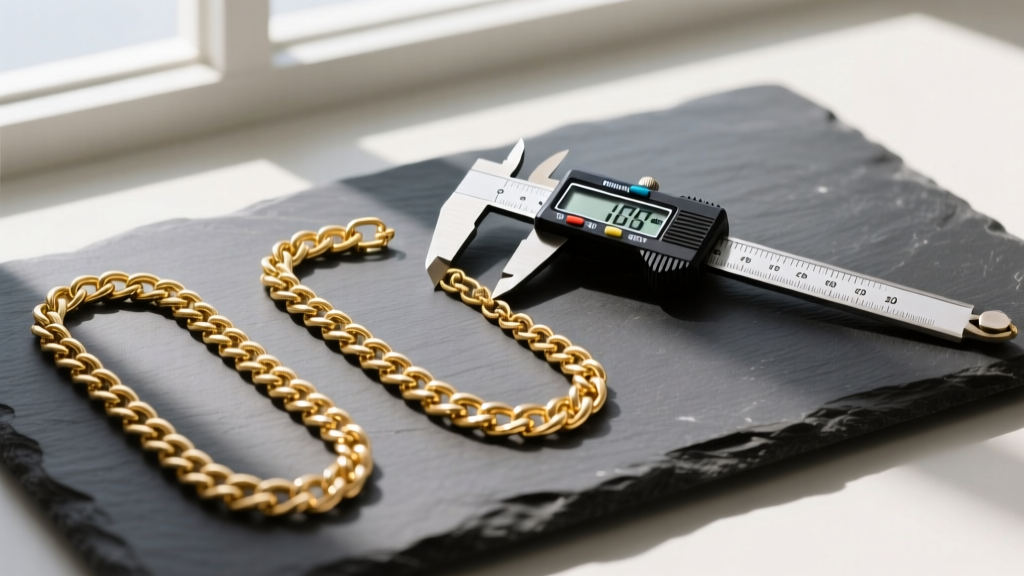
Most consumers focus heavily on the pendant, the gemstone, or the metal purity when shopping for jewelry, often ignoring the fundamental metric that drives up to 60% of the final price tag: the chain's physical dimensions. When evaluating a standard necklace length, understanding the cost-per-inch ratio and the hidden fabrication multipliers is the difference between a smart investment and an inflated retail trap. In the current market, where precious metal spot prices continue to fluctuate, assessing the true value of your necklace requires looking beyond the display case and into the mathematics of jewelry manufacturing.
The Economics of Chain: Why Standard Necklace Length Dictates Price
The pricing of precious metal chains is not arbitrary. It is fundamentally anchored to the daily spot price of the raw material, combined with a fabrication and retail markup. According to the Gemological Institute of America (GIA), the purity of the alloy (such as 14k vs. 18k gold) determines the base material cost, but it is the physical volume of the metal that dictates the final weight. Because a chain's width and gauge are usually consistent throughout its entirety, the weight—and therefore the raw material cost—scales linearly with length.
However, retail pricing introduces a non-linear variable: the fabrication multiplier. Shorter chains require the same number of manufacturing steps (casting links, soldering, polishing, and clasp attachment) as longer chains. Therefore, the 'cost-per-inch' is actually highest on the shortest standard lengths and drops as the chain gets longer, until you hit structural thresholds that require thicker gauges. Understanding this curve is essential for budget-conscious buyers looking to maximize their return on investment.
Cost-Per-Inch Breakdown: Assessing the Standard Necklace Length Spectrum
To truly assess value, we must break down the average retail pricing across the most common standard necklace lengths. The table below illustrates the estimated retail cost for a standard 1.5mm cable chain in both 14k yellow gold and sterling silver, alongside the calculated cost-per-inch. This data highlights the diminishing marginal cost of adding extra inches to a chain.
| Length | Style Category | Avg. 14k Gold Price (1.5mm) | Avg. Sterling Silver Price (1.5mm) | Gold Cost-Per-Inch |
|---|---|---|---|---|
| 14 Inches | Choker | $420 - $480 | $65 - $85 | $30.00 - $34.28 |
| 16 Inches | Collar | $490 - $540 | $75 - $95 | $30.62 - $33.75 |
| 18 Inches | Princess | $560 - $620 | $85 - $110 | $31.11 - $34.44 |
| 20 Inches | Matinee | $680 - $760 | $105 - $135 | $34.00 - $38.00 |
| 24 Inches | Opera | $890 - $980 | $140 - $180 | $37.08 - $40.83 |

As demonstrated by the data, the 18-inch Princess length represents the highest volume production tier for jewelers. Because it is the most universally purchased standard necklace length, manufacturers produce it in massive batches, keeping the fabrication markup at its lowest possible margin. Conversely, as you move into the 20-inch and 24-inch ranges, the cost-per-inch begins to climb again. This is because longer chains require heavier, more robust clasps and often a slight increase in wire gauge (e.g., moving from 1.2mm to 1.5mm) to prevent the chain from snapping under its own increased weight and the leverage of a swinging pendant.
Value Traps: Where You Overpay for Specific Lengths and Styles
Not all standard necklace lengths offer equal value. Certain sizes carry hidden premiums that budget-focused buyers should be aware of before making a purchase.
The Choker Tax (14 to 15 Inches)
While a 14-inch choker uses the least amount of raw gold or silver, it often carries a surprisingly high retail price. This is due to the 'Choker Tax.' Chains worn tightly against the neck experience high-tension friction and frequent pulling. To prevent failure, jewelers must equip these shorter lengths with heavier, more secure lobster clasps rather than standard spring rings, and they often reinforce the end-links. You are paying for structural engineering, not raw material weight.
The Opera Premium (28+ Inches)
Once a chain exceeds 24 inches, it enters the Opera or Rope category. At this length, the chain is highly susceptible to tangling and catching on clothing. To mitigate this, manufacturers often switch from simple cable or curb links to more complex, interlocking designs like box chains or mariner links. These complex links require significantly more machine time and manual polishing, driving the fabrication cost up by 30% to 50% compared to a standard chain of the same weight.
Budget Hacks: Maximizing ROI on Your Next Chain Purchase
If you want to optimize your jewelry budget without sacrificing the aesthetic of your desired standard necklace length, employ these specific purchasing strategies:
- The Extender Chain Hack: If you fluctuate between a 16-inch collar and an 18-inch princess length depending on your neckline, do not buy two separate chains. Purchase the 16-inch chain (which is lighter and cheaper) and invest in a high-quality 2-inch sterling silver or gold-filled extender chain. This costs roughly $10 to $15 at a local bench jeweler, saving you the $70 to $100 premium of buying a longer solid gold chain.
- Optimize the Clasp: When ordering a custom length from a direct-to-consumer jeweler, request a standard spring-ring clasp for chains under 20 inches and 1.5mm in thickness. Upgrading to a lobster clasp or a decorative toggle can add $30 to $80 to the final invoice, which is unnecessary for lightweight, everyday chains.
- Avoid Hollow Chains for Long Lengths: While electroformed hollow chains offer a thick look for a fraction of the gold weight, they are a poor value for lengths over 20 inches. The structural failure rate of hollow chains increases exponentially with length due to the added leverage and swing. A solid 1.2mm chain is a far better long-term investment than a 3.0mm hollow chain that will crush and kink within a year of daily wear.
Material Grade vs. Length: Adjusting Your Budget Strategy

Your budget strategy must adapt to the specific density and spot price of the metal you choose. The physical properties of the material should dictate the maximum standard necklace length you purchase.
High-Density Metals: Platinum and 18k Gold
Platinum is exceptionally dense (21.45 g/cm³), making it roughly 60% heavier than 14k gold for the exact same volume. An 18-inch platinum chain is already a significant financial commitment. Purchasing a 24-inch or 30-inch platinum chain is rarely a sound financial decision for the average consumer, as the sheer weight of the metal will push the price into the thousands of dollars, and the heavy chain can become physically uncomfortable to wear for long periods. For platinum and 18k gold, cap your standard necklace length at 18 inches to maintain both budget and physical comfort.
Low-Density Metals: Sterling Silver, Titanium, and Vermeil
Conversely, when working with sterling silver, titanium, or gold vermeil, the raw material cost is negligible. In these cases, you are almost entirely paying for the labor and design. This is where you should experiment with longer standard lengths like the 24-inch matinee or 30-inch rope. Because the cost-per-inch of silver is measured in mere cents rather than tens of dollars, you can achieve dramatic, fashion-forward layering and elongated silhouettes without triggering a massive spike in your overall jewelry budget.
Final Verdict on Necklace Value
Ultimately, assessing the value of a standard necklace length requires looking past the initial price tag and evaluating the cost-per-inch, the structural necessities of the chosen metal, and the fabrication multipliers applied by the retailer. By targeting the 18-inch mass-production sweet spot for precious metals, utilizing extender hacks for versatility, and matching the metal density to the appropriate physical length, you can build a high-quality, durable chain collection that maximizes every dollar of your jewelry budget.


