Expert Guide to Buying a Sterling Silver Ankh Necklace
Discover the technical details of buying a silver ankh necklace. Learn about silver grades, casting methods, proportional accuracy, and chain pairing.

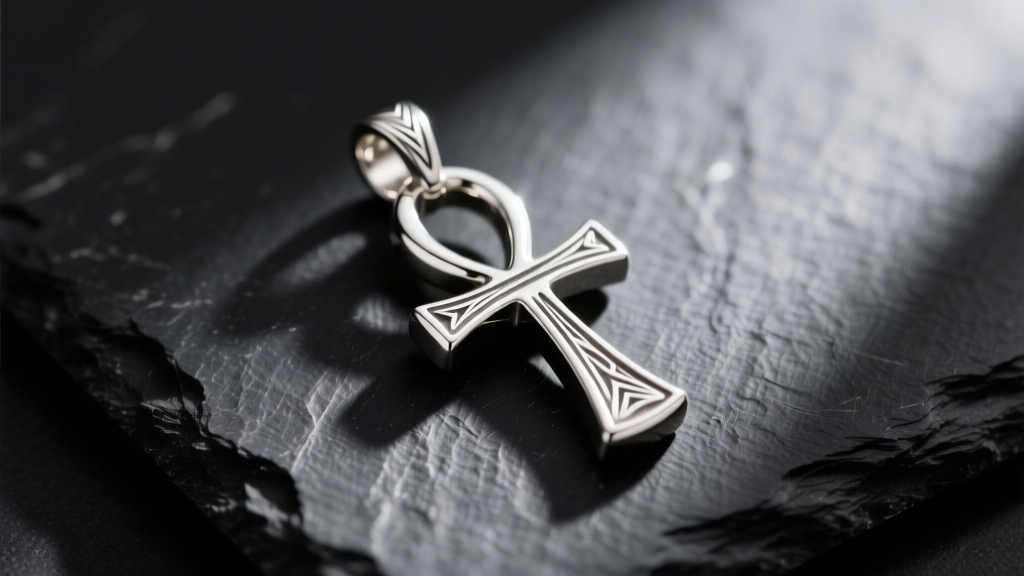
The Anatomy of an Authentic Ankh: Proportions and Symbolism
The ankh, historically known as the crux ansata (Latin for 'cross with a handle'), is an ancient Egyptian hieroglyph representing life and immortality. When evaluating a high-quality silver ankh necklace, historical and proportional accuracy is the first hallmark of expert craftsmanship. According to artifact archives at The Metropolitan Museum of Art, the traditional ankh does not feature a perfectly circular loop. Instead, the top loop should be a distinct teardrop or elongated oval, representing the sun rising over the horizon or a sandal strap, depending on the Egyptological interpretation.
The horizontal crossbar should sit slightly below the top third of the vertical shaft, not dead center. Mass-produced, low-tier jewelry often defaults to a perfect circle and symmetrical cross, stripping the piece of its historical authenticity. Furthermore, the edges of the shaft and crossbar in premium pieces are often slightly tapered or beveled, mimicking the hand-carved stone and faience amulets of the New Kingdom era.
Metallurgy Deep Dive: Silver Grades and Alloy Compositions
Not all silver is created equal. When investing in a silver ankh necklace, understanding the exact metallurgical composition is critical for longevity, tarnish resistance, and skin compatibility. The Gemological Institute of America (GIA) outlines several standard silver grades used in modern jewelry manufacturing.
| Alloy Type | Silver Content | Alloying Metals | Tarnish Resistance | Best Use Case |
|---|---|---|---|---|
| .999 Fine Silver | 99.9% | Trace elements | High | Wire wrapping, bezels (too soft for heavy cast pendants) |
| .925 Sterling | 92.5% | 7.5% Copper | Moderate | Standard cast ankhs, durable for daily wear |
| .935 Argentium | 93.5% | Copper, Germanium | Very High | Premium ankhs, low-maintenance daily wear |
| Coin Silver | 90.0% | 10.0% Copper | Low | Vintage or antique reproduction pieces |
Why .925 Sterling Remains the Benchmark
Standard .925 sterling silver provides the ideal balance of malleability for intricate lost-wax casting and structural rigidity to prevent the ankh's thin crossbar from bending. The 7.5% copper content is what gives the alloy its strength, but it is also the culprit behind silver sulfide tarnish. If you live in a high-humidity environment, seek out a silver ankh necklace crafted from Argentium silver. The addition of germanium creates a transparent, protective oxide layer that drastically slows down tarnishing without requiring rhodium plating, which can eventually wear off and obscure intricate detailing.
Manufacturing Techniques: Cast vs. Die-Struck
The manufacturing method dictates the depth, weight, and edge definition of your pendant.
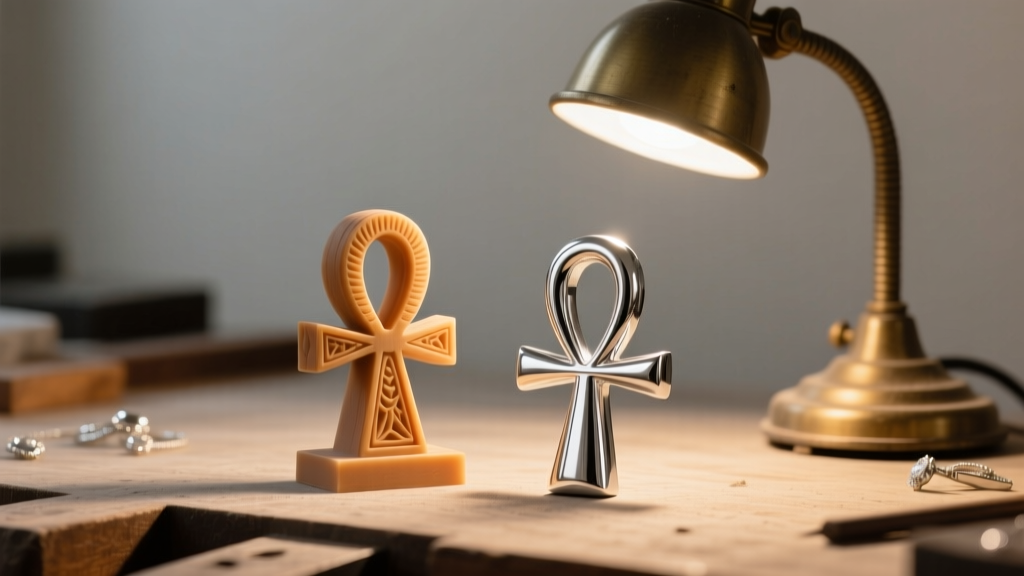
Lost-Wax Investment Casting
Premium silver ankh necklaces are almost exclusively produced via lost-wax casting. A jeweler carves or 3D-prints a wax model, encases it in a plaster-like investment, and burns out the wax in a kiln. Molten .925 silver is then centrifugally forced into the cavity. This method allows for deep, three-dimensional hieroglyphic engravings, undercuts, and varied surface textures (like matte sandblasted backgrounds with high-polish raised edges) that are impossible to achieve with other methods.
Die-Striking and Stamping
Cheaper alternatives are die-struck from flat silver sheet metal. While structurally dense, these ankhs lack 3D relief. They are flat, lightweight, and often feature laser-etched details rather than true carved depth. If a pendant feels unusually light for its size, it may be a hollow electroformed shell, which is highly prone to denting and cannot be easily repaired by a jeweler if crushed.
Chain Pairing: Bail Mechanics and Gauge Sizing
A common failure point in necklace styling is a mismatched bail and chain. The bail (the loop that connects the pendant to the chain) must be sized correctly to accommodate the chain's gauge and width without causing excessive friction or getting stuck.
- Standard Tube Bail (3mm - 4mm Inner Diameter): Pairs best with 1.5mm to 2.5mm chains. A 2.0mm silver rope chain or a 2.2mm wheat chain offers excellent tensile strength and complements the vertical lines of the ankh.
- Hidden Bail (Integrated Loop): Many cast ankhs feature a loop integrated directly into the top of the teardrop. These often have smaller inner diameters (2mm - 3mm). Use a 1.2mm to 1.8mm box chain or a slim snake chain to ensure it slides freely.
- Heavy Cuban or Curb Chains (4mm+): If you prefer a heavier chain, the ankh must feature an oversized, soldered jump-ring bail. Never force a thick chain through a small bail, as the friction will eventually wear through the silver loop, resulting in a lost pendant.
Expert Tip: Always check the solder point on the pendant's bail. A properly soldered bail will have a seamless joint. If you see a dark line or a gap, the silver was merely glued or poorly heated, which will fail under the kinetic stress of daily wear.
Hallmark Verification and Avoiding Counterfeits
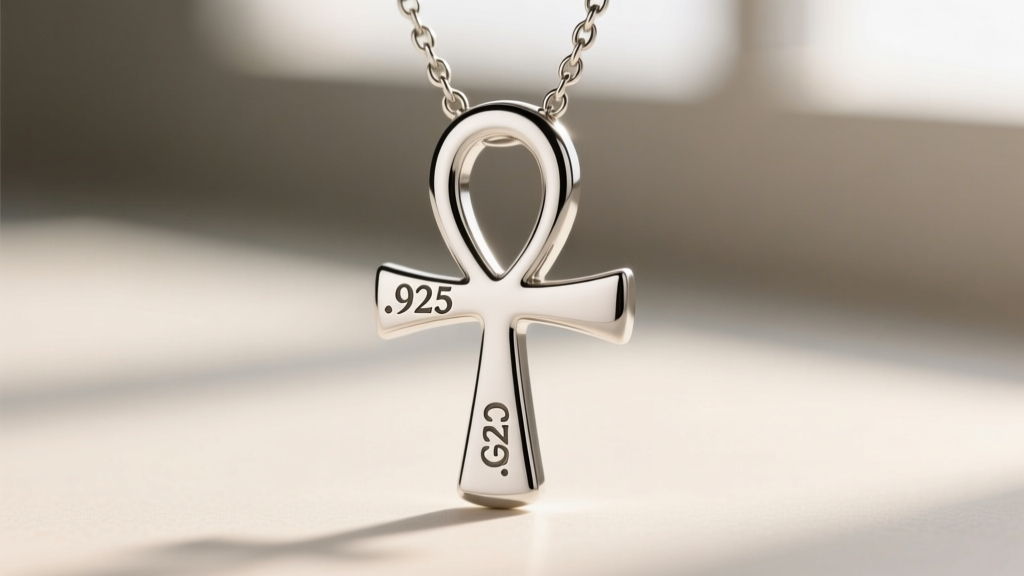
Authenticating a silver ankh necklace goes beyond looking for a stamped '.925'. Counterfeiters frequently stamp base metals or silver-pled brass with fake hallmarks. According to the London Assay Office, a full traditional hallmark consists of a sponsor's mark (maker), a fineness mark (e.g., 925), and an assay office mark. While US jewelers are only legally required to stamp the fineness and maker's mark, European and UK pieces will carry full assay marks.
For technical verification, jewelers use X-Ray Fluorescence (XRF) spectrometers to read the exact elemental breakdown of the metal without damaging the piece. If you are buying vintage or from an independent artisan, you can perform a non-destructive ice test: silver has the highest thermal conductivity of any common metal. An ice cube placed on a solid silver ankh will melt almost instantly, whereas it will melt slowly on stainless steel or plated brass.
Maintenance: Tarnish Chemistry and Intricate Cleanings
The intricate crevices of a cast silver ankh necklace make it a magnet for environmental sulfur and skin oils, leading to silver sulfide (tarnish) buildup in the recessed areas. Do not use harsh liquid silver dips on oxidized or antiqued ankhs, as these chemicals will strip the intentional dark patina from the crevices, leaving the piece looking flat and washed out.
Instead, use a specialized silver polishing cloth impregnated with micro-abrasives and anti-tarnish agents. For deep cleaning the recessed hieroglyphs, use a soft-bristled baby toothbrush with a few drops of mild dish soap and warm water. Dry the piece immediately with a microfiber cloth, and store it in an airtight anti-tarnish bag with a silica gel packet to control ambient humidity. By understanding the metallurgy, manufacturing, and mechanical nuances of your jewelry, you ensure that your silver ankh necklace remains a durable, historically resonant, and visually striking piece for decades.


