Sterling Silver Key Necklace: 925 Silver vs Other Metals
Discover why a sterling silver key necklace outperforms brass and steel. We compare 925 silver properties, tarnish rates, and casting details.

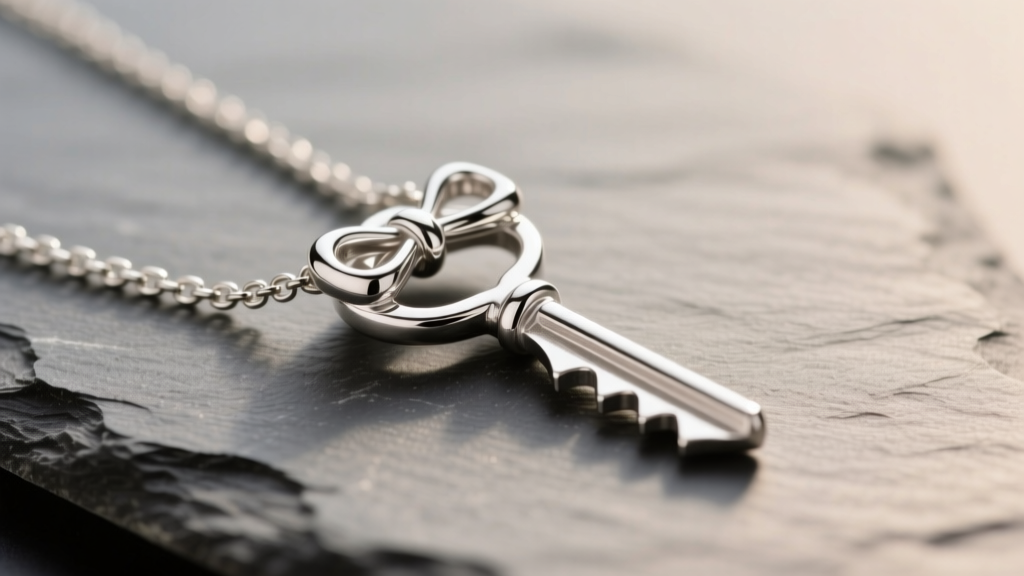
The symbolism of a key necklace—representing new beginnings, unlocked potential, or guarded secrets—makes it a timeless staple in jewelry wardrobes. However, the intricate geometry of a key pendant, with its delicate bow, long shank, and complex bit teeth, demands a metal that balances fluid casting properties with everyday durability. When shopping for a sterling silver key necklace, buyers are often confronted with a sea of alternatives, from budget-friendly brass to hypoallergenic stainless steel. As a metallurgical and jewelry design hub, Jewel Style Radar breaks down the exact material properties of 925 sterling silver to determine if it truly is the superior choice for intricate key pendants in 2026.
The Metallurgy of 925 Sterling Silver in Key Pendants
Pure silver (999 fine) is far too soft for daily wear; it would bend and warp under minimal pressure. To create a durable sterling silver key necklace, jewelers alloy 92.5% pure silver with 7.5% copper. This specific ratio, standardized as 925 silver, fundamentally alters the metal's crystalline structure. According to the Gemological Institute of America (GIA), the addition of copper increases the Vickers hardness (HV) of the metal from roughly 25 HV in its pure state to approximately 65 HV in its annealed state, and up to 110 HV when work-hardened.
This hardness is critical for key pendants. The 'bit' of a key (the part with the teeth) often features sharp, 0.5mm undercuts and deep grooves. 925 silver possesses exceptional molten fluidity, making it the ideal candidate for lost-wax casting. It captures microscopic details from the master wax model without the porosity issues that plague higher-melting-point metals like stainless steel. Furthermore, the copper alloy provides just enough tensile strength to prevent the delicate teeth of a skeleton key design from snapping during accidental impacts.
Material Comparison Chart: 925 Silver vs. Alternatives
To understand the market positioning of a sterling silver key necklace, we must compare it against common alternatives. Below is a technical breakdown of how 925 silver stacks up against brass, 316L stainless steel, and 14k solid gold regarding physical properties and market pricing.
| Material | Hardness (HV) | Tarnish Resistance | Casting Detail Resolution | Avg. Price Range (Pendant Only) |
|---|---|---|---|---|
| 925 Sterling Silver | 65 - 110 | Moderate (Requires care) | Excellent (Captures <0.5mm) | $45 - $120 |
| Jeweler's Brass | 80 - 120 | Poor (Oxidizes rapidly) | Very Good | $15 - $35 |
| 316L Stainless Steel | 150 - 200 | Excellent | Fair (Struggles with deep undercuts) | $20 - $50 |
| 14k Solid Gold | 120 - 160 | Excellent | Excellent | $350 - $800+ |
While stainless steel wins on sheer hardness and tarnish resistance, its high melting point and viscosity make it notoriously difficult to cast with the razor-sharp edges required for vintage skeleton key designs. Most steel key pendants are stamped or CNC-milled, resulting in flatter, less ornate profiles. Conversely, 925 silver offers the sweet spot of high-fidelity casting and accessible pricing.
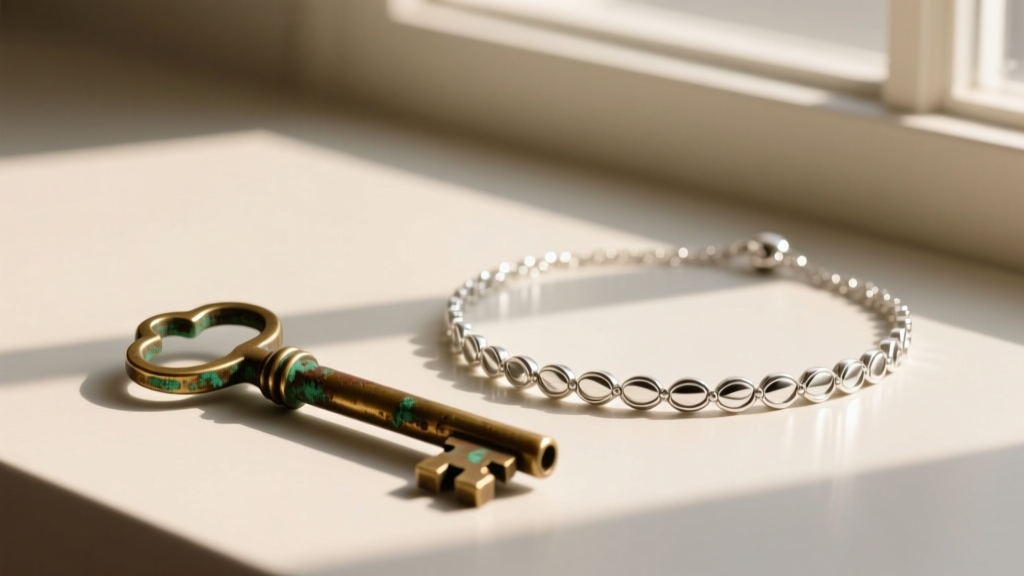
Tarnish, Patina, and the Copper Factor
The primary drawback of a sterling silver key necklace is its susceptibility to tarnish. The 7.5% copper in the alloy reacts with sulfur compounds in the air (and on the skin) to form silver sulfide, a dark, dull layer on the surface. Because key pendants feature deep grooves and intricate cutouts, tarnish tends to accumulate aggressively in these recesses.
Strategic Antiquing vs. Accidental Tarnish
Many high-end jewelry designers lean into this chemical property by intentionally applying liver of sulfur to oxidize the recesses of the key, then polishing the high points. This 'antiquing' creates a high-contrast, three-dimensional effect that makes the intricate teeth and bow of the key pop. If you purchase a pre-antiqued sterling silver key necklace, never use liquid silver dip cleaners. These harsh thiourea-based chemicals will strip the intentional patina from the grooves, leaving the pendant looking flat and artificially white.
"For routine cleaning of intricate 925 silver key pendants, use a soft horsehair detailing brush with a few drops of mild dish soap and warm water. Avoid abrasive polishing cloths on the recessed bit of the key, as this will remove the oxidized contrast." — Bench Jeweler Maintenance Guidelines
Rhodium Plating: The Modern Shield
To combat tarnish, many modern sterling silver key necklaces are flashed with a microscopically thin layer of rhodium. While this keeps the pendant bright and white indefinitely, it alters the aesthetic. Rhodium has a slightly darker, 'steely' reflectivity compared to the warm, moon-like luster of bare 925 silver. Furthermore, once the rhodium wears off the high-friction edges of the key bow, the piece will require professional re-plating.
Chain Selection: Matching the Pendant's Metallurgy
A common failure point in jewelry wear is mixing incompatible metals. If you thread a stainless steel or brass chain through the bail of a 925 sterling silver key pendant, you risk two issues: mechanical wear and galvanic corrosion. Steel chains are significantly harder than silver and will act like a microscopic file, slowly sawing through the silver bail loop over a year of daily wear.
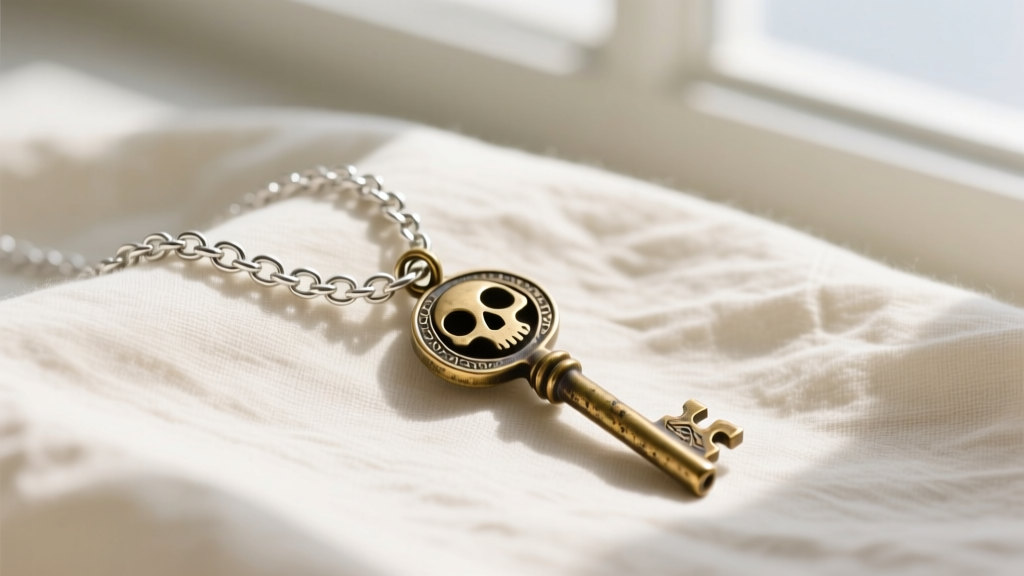
To preserve your pendant, always pair it with a 925 sterling silver chain. For key pendants, which typically weigh between 4 and 12 grams, a 1.2mm to 1.5mm rolo or cable chain is optimal. Rolo chains, with their uniform round links, offer excellent tensile strength and resist kinking, ensuring the heavy key pendant lays flat against the sternum without twisting the chain links out of shape.
Real-World Failure Modes of Intricate Key Pendants
Understanding how a sterling silver key necklace fails in the real world allows you to inspect vintage or new pieces for structural integrity. When evaluating a piece, look out for the following metallurgical and design flaws:
- Porosity in the Shank: If the long stem of the key was cast at an incorrect temperature, microscopic gas bubbles (porosity) can form inside the metal. This creates a weak point where the shank can snap cleanly in half if caught on clothing.
- Sprue Mark Weakness: The sprue is the channel where molten silver enters the mold. On poorly finished key pendants, the sprue is cut off the edge of the key's bit, leaving a rough, structurally compromised divot that is prone to cracking.
- Bail Friction Wear: The bail (the loop connecting the key to the chain) experiences constant friction. High-quality pendants feature a reinforced, thicker-gauge bail or a hidden jump ring to distribute the wear away from the delicate top of the key's bow.
Expert Verdict: Is 925 Silver the Best Choice?
When prioritizing intricate design, historical authenticity, and material value, a sterling silver key necklace remains the undisputed champion in its price tier. While stainless steel offers a maintenance-free alternative for minimalist, geometric key shapes, it simply cannot replicate the deep, ornate undercuts of a vintage skeleton key. By understanding the 925 alloy's casting advantages and committing to proper, non-abrasive maintenance, a sterling silver key pendant will retain its structural integrity and symbolic weight for generations. For further reading on precious metal standards and alloy compositions, consult the Silver Institute's comprehensive metallurgical database.


