How to Style the Necklace Main Characters in Your Collection
Learn how to style the necklace main characters in your collection with our step-by-step guide on scale, hardware, and neckline pairing.


Every jewelry collection has its supporting cast—the delicate chains, the simple studs, the subtle layers that quietly hold an outfit together. But then there are the statement pieces. When we talk about the necklace main characters of your jewelry box, we are referring to the bold, unapologetic, gravity-defying pieces that demand attention and dictate the entire mood of your look. In 2026, the trend has shifted away from hyper-minimalism toward intentional, architectural maximalism. However, wearing a massive sculptural collar or a heavy, gemstone-laden pendant isn't as simple as just throwing it on. It requires a strategic approach to scale, hardware integrity, and neckline geometry.
This step-by-step guide will teach you how to properly style, balance, and maintain the necklace main characters in your collection, ensuring they look deliberate rather than overwhelming.
Defining the Necklace Main Characters
What elevates a piece from a standard accessory to a "main character"? It comes down to three metrics: visual weight, physical mass, and focal dominance. A true statement necklace typically weighs over 35 grams, features a pendant drop longer than 40mm, or utilizes a chain width exceeding 4mm. These pieces are designed to be the absolute focal point of your torso. Because they carry so much visual gravity, they require specific styling frameworks to prevent them from clashing with your clothing or causing physical discomfort.
Step 1: Calibrating Scale to Neckline and Anatomy
The most common mistake people make with heavy statement necklaces is pairing them with the wrong neckline, which results in a cluttered, suffocating look. The goal is to frame the piece, not compete with it.
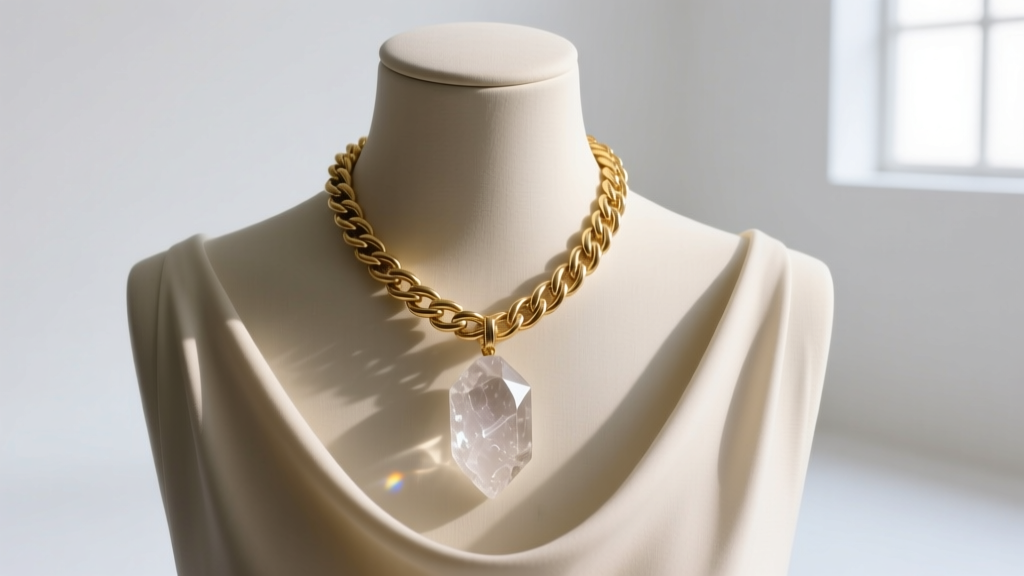
The V-Neck and Plunge Framework
Deep V-necks and plunge necklines are the ideal canvas for long, heavy pendants (24 to 28 inches). The geometric lines of the V draw the eye downward, perfectly mirroring the drop of a massive pendant. Pro Tip: Ensure the pendant sits at least one inch above the apex of the V-neck to avoid looking tangled in the fabric.
The Crewneck and Collarbone Strategy
For high crewnecks and turtlenecks, long pendants will look lost. Instead, opt for rigid collar necklaces or heavy chokers (14 to 16 inches) that sit flush against the collarbone. A thick, 5mm solid brass or gold vermeil Cuban link collar resting over a black turtleneck creates a striking, high-contrast silhouette that anchors the outfit.
Off-Shoulder and Boatneck Balancing
When the shoulders are exposed, you have a wide canvas of skin. Avoid long, swinging chains that will slap against your bare skin. Instead, choose a wide, rigid bib necklace or a multi-strand statement piece that sits horizontally across the collarbones, mimicking the horizontal line of the neckline.
Step 2: Material Integrity and Weight Limits
The necklace main characters of your collection are heavy. If you buy cheap, thinly plated materials, the structural integrity will fail. According to the Gemological Institute of America (GIA), understanding metal purity and plating thickness is crucial for longevity, especially for pieces subjected to high tensile stress.
| Material Type | Best For | Weight Limit / Durability | Maintenance Required |
|---|---|---|---|
| 18k Gold Vermeil | Everyday luxury statements | High (if base is sterling silver & plating is >2.5 microns) | Polish gently; avoid water |
| Solid Brass / Bronze | Chunky, architectural collars | Very High (solid metal won't snap) | Requires regular polishing to prevent patina |
| Sterling Silver (925) | Heavy chain links and pendants | High (but soft; can stretch over time) | Store flat to prevent link warping |
| Hollow Tube Gold | Illusion of mass without weight | Low (prone to denting and crushing) | Never sleep in; avoid pressure |
For heavy pendants, always ensure the chain is solid rather than hollow. Hollow chains will dent under the lever-action weight of a heavy pendant bail.
Step 3: Hardware and Clasp Mechanics
A massive pendant is only as secure as its weakest hardware link. The jewelry industry standard for heavy pieces requires specific clasp mechanics. Standard 5mm spring-ring clasps are rated for lightweight chains and will fail under the dynamic movement of a 40-gram pendant. Experts at Rio Grande, a leading jewelry supply and education resource, emphasize that tensile strength and jump-ring soldering are critical for heavy jewelry fabrication.
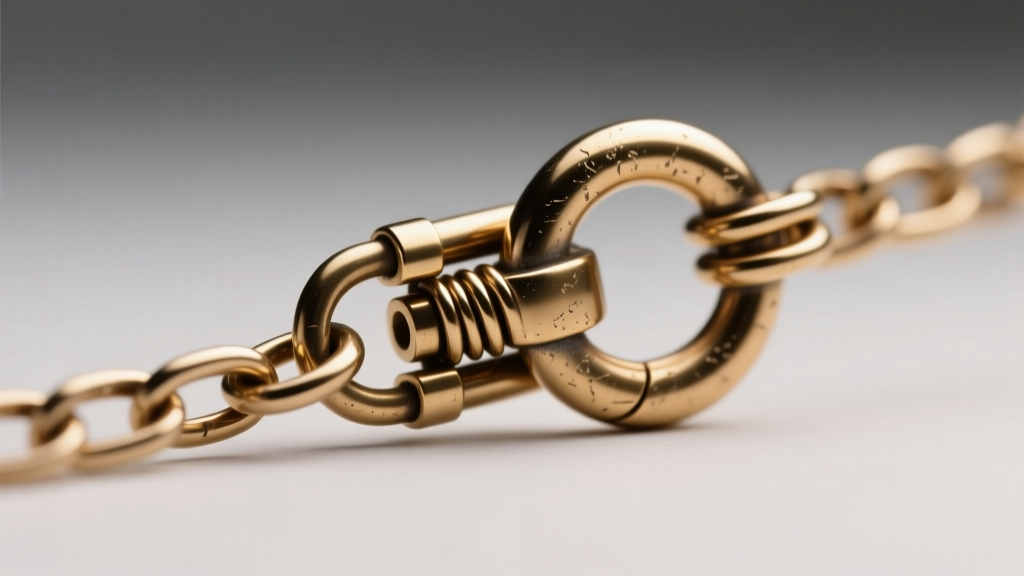
Upgrade Your Clasps
- Lobster Clasps (12mm - 15mm): The minimum requirement for chains over 3mm thick. The larger internal spring mechanism can handle the torque of a heavy pendant swinging.
- Box Clasps with Safety Catches: Ideal for multi-strand statement necklaces or heavy collar pieces. The box mechanism locks into place, and the safety catch (a small figure-8 wire) provides a backup if the primary latch fails.
- Soldered Jump Rings: The jump ring connecting the clasp to the chain must be soldered shut. If it is merely pushed together, the weight of a heavy pendant will eventually pull the gap open, resulting in a lost piece.
Chain Gauge Sizing
Do not hang a 50-gram pendant on an 18-gauge (1.02mm) chain. The bail will act as a saw, eventually cutting through the soft metal. For pendants weighing between 30g and 60g, use a chain that is at least 12-gauge (2.05mm) to 10-gauge (2.59mm) in thickness.
Step 4: Strategic Solo Styling vs. Layering
The golden rule of the necklace main characters is that they rarely share the stage well. If your statement piece features a pendant larger than 40mm or a chain thicker than 4mm, wear it solo. Layering a massive pendant with delicate 1mm chains creates a visual hierarchy that confuses the eye and diminishes the impact of the main piece.
If you absolutely must layer, use the "Anchor and Echo" technique. Let the main character necklace be the longest layer (e.g., 24 inches), and use a simple, ultra-thin 14-inch choker as an anchor. Skip the middle lengths entirely to create deliberate negative space on the chest.
Troubleshooting Common Statement Necklace Failures
Even well-made statement pieces come with functional quirks. Here is how to troubleshoot the most common issues:
- The Clasp Creep: Heavy pendants pull the chain downward, causing the lighter clasp at the back of the neck to slide forward to the collarbone. Solution: Attach a small, decorative silicone clasp stopper or a secondary weighted charm near the clasp to act as a counterbalance.
- The Pendant Flip: Large, flat pendants often flip backward, showing the hollow back against your shirt. Solution: Have a jeweler add a small drop of clear resin or a tiny metal weight to the bottom back edge of the pendant to alter its center of gravity.
- Chain Kinking: Heavy weight on thin chains causes herringbone or snake chains to permanently kink. Solution: Avoid these weaves entirely for heavy pendants. Stick to structural weaves like Curb, Rope, or Box chains, which distribute weight evenly across interlocking links.
Mastering the necklace main characters in your collection is about respecting the physics and geometry of the pieces. By matching the scale to your neckline, investing in proper hardware, and allowing the piece the negative space it deserves, you transform a heavy piece of metal into a masterclass in personal style.


