Sunshine Necklace Gold: An Expert Guide to Craft & Metallurgy
Explore the technical craftsmanship, gold purity grades, and structural durability of the classic sunshine necklace gold pendant for everyday wear.

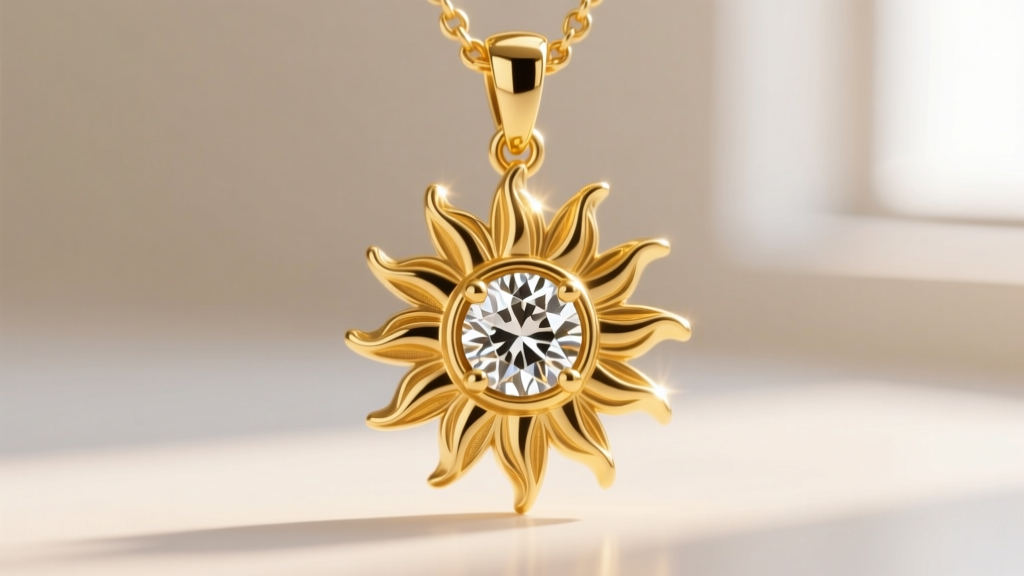
The Metallurgy of Sunburst Motifs: 14k vs. 18k vs. 22k Gold
The sunshine necklace gold pendant is a masterclass in balancing delicate aesthetics with structural endurance. The defining feature of any sunburst or sunshine motif is the array of protruding, often razor-thin rays extending from a central medallion. From a metallurgical standpoint, these rays represent significant structural vulnerabilities. The choice of gold purity—measured in karats—directly dictates the pendant's lifespan when subjected to the micro-impacts of daily wear.
Pure 24k gold possesses a Vickers Hardness (HV) of roughly 25, making it entirely unsuitable for intricate ray designs; the rays would bend or snap under minimal lateral pressure. 22k gold (HV ~70) offers a richer color but remains too malleable for long, unsupported geometric protrusions. According to metallurgical standards outlined by the Gemological Institute of America (GIA), 18k gold (75% pure gold, alloyed with copper, silver, and sometimes zinc) achieves an optimal HV of 120-135. This provides a luxurious hue while maintaining enough tensile strength to resist casual deformation.
However, for a sunshine necklace gold design featuring exceptionally long, filigree-style rays, 14k gold (58.3% purity) is the superior engineering choice. The higher proportion of alloying metals (typically a precise ratio of silver to copper, occasionally with trace zinc to prevent oxidation during casting) elevates the Vickers Hardness to 150+. This increased density ensures that the 1mm-wide rays can withstand snagging on textiles without permanent deformation.
Manufacturing Techniques: Die-Striking vs. Lost-Wax Casting
The manufacturing method employed to create the pendant fundamentally alters its internal grain structure, which in turn dictates its failure modes.
Lost-Wax Casting and Porosity Risks
Most modern artisanal sunshine pendants are created via lost-wax casting. Molten gold is forced into a plaster investment mold under vacuum or centrifugal force. While this allows for complex, three-dimensional sunburst designs with varying ray thicknesses, it introduces the risk of shrinkage porosity. As the gold cools, it contracts. If the sprue (the channel through which the gold enters) is not properly positioned to feed molten metal into the thinnest sections—the very tips of the sun rays—microscopic gas pockets form. These pockets act as internal fracture points. A cast ray with undetected porosity will snap cleanly if caught on a collar or zipper.

Die-Striking for Maximum Density
Conversely, die-striking involves stamping a sheet of gold between two hardened steel dies under immense hydraulic pressure (often exceeding 50 tons). This process compresses the gold's molecular structure, aligning the grain flow and eliminating internal porosity entirely. A die-struck sunshine necklace gold pendant will feature rays that are up to 30% denser and significantly more resistant to bending than their cast counterparts. The trade-off is a limitation in design complexity; die-struck sunbursts are typically flatter and rely on surface engraving rather than deep 3D relief to create the illusion of radiant light.
Structural Vulnerabilities: Ray Breakage and Bail Mechanics
The bail—the loop connecting the pendant to the chain—is the critical pivot point. Sun pendants are inherently top-heavy or wide, which creates unique kinetic challenges. A standard soldered loop bail often causes the pendant to flip upside down, placing asymmetric torque on the delicate upper rays where the bail is attached.
| Bail Type | Load Distribution | Recommended Chain Gauge | Friction Wear Risk |
|---|---|---|---|
| Standard Soldered Loop | Poor (High Flip Rate) | 0.8mm - 1.0mm | High |
| European / Tapered Bail | Excellent (Wide Base) | 1.1mm - 1.5mm | Low |
| Hidden / Integrated Bail | Moderate (Flush Mount) | 0.9mm - 1.2mm | Moderate |
| Tube Bail with Jump Ring | Good (Swivel Action) | 1.0mm - 1.2mm | Low |
For wide sunburst medallions exceeding 20mm in diameter, a European bail (also known as a tapered or saddle bail) is mandatory. This bail wraps over the top edge of the pendant and is soldered at two distinct points on the back plate, distributing the kinetic load across a wider surface area and preventing the upper rays from bearing the brunt of the pendant's swinging momentum.
Enamel and Gemstone Inlays: Thermal Expansion Risks
High-end sunshine necklace gold pieces frequently incorporate vitreous enamel or guilloché (engine-turned patterns beneath translucent glass) to mimic the vibrant colors of a sunrise or sunset. The technical challenge here lies in the coefficient of thermal expansion (CTE). Gold and vitreous enamel expand and contract at different rates when exposed to temperature fluctuations.
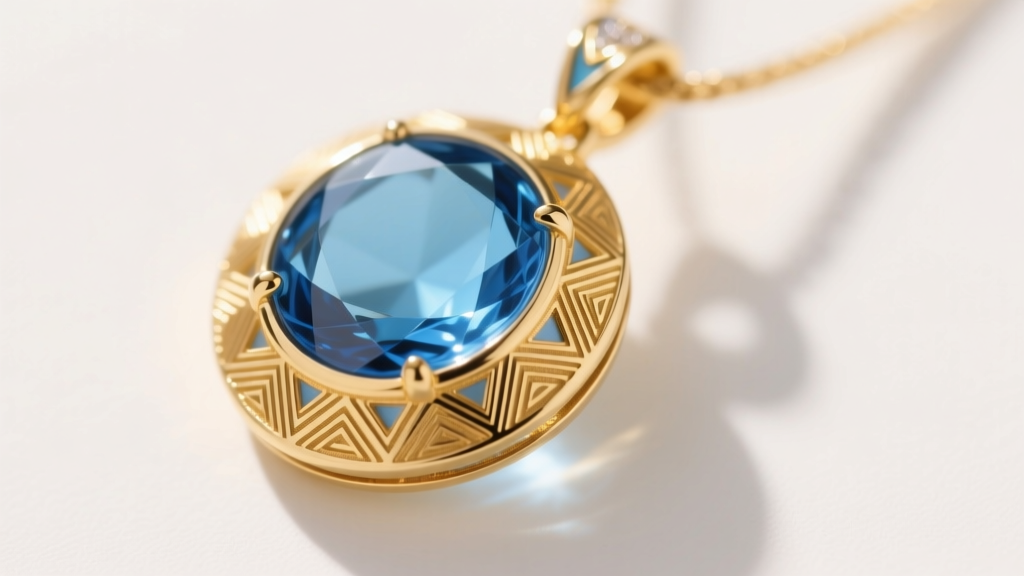
If the gold alloy is not precisely formulated to match the CTE of the enamel, the glass will develop a network of micro-fractures known as 'crazing' over time. Master enamelists mitigate this by using specialized high-silica enamels and firing the piece in a kiln at exactly 780°C to 820°C. Cold enamel (a two-part epoxy resin), often found in lower-priced sun pendants, avoids thermal shock but is highly susceptible to UV degradation, turning yellow and brittle after 3 to 5 years of continuous sun exposure. Furthermore, if the center of the sun features pavé-set diamonds, the prongs must be burnished with extreme precision; the vibration from setting stones after enameling can shatter the glass inlay.
Chain Pairing: Gauge and Link Styles for Sun Pendants
Pairing the correct chain with a sunshine necklace gold pendant is not merely an aesthetic choice; it is a matter of mechanical preservation. The interior of the bail acts as a friction surface against the chain.
- Box Chains (0.9mm - 1.2mm): While popular, the sharp 90-degree interior edges of a box chain act like a microscopic file against the gold bail. Over 2-3 years of daily wear, a box chain can easily saw through a soft 18k gold bail.
- Wheat / Spiga Chains (1.0mm - 1.5mm): The woven, rounded links of a wheat chain provide a smooth, rolling friction surface that drastically reduces bail wear. This is the optimal choice for heavy, solid gold sunburst pendants.
- Cable Chains (0.8mm - 1.0mm): Suitable only for lightweight, die-struck 14k sun pendants. The oval links distribute wear evenly but lack the tensile strength to support heavy cast medallions without stretching.
According to durability guidelines from the World Gold Council, matching the karat of the chain to the pendant is also crucial. An 18k chain rubbing against a 14k pendant bail will result in the softer 18k chain links wearing down prematurely due to galvanic and mechanical friction.
Maintenance and Ultrasonic Cleaning Warnings
The intricate geometry of a sunburst pendant creates numerous 'shadow zones' where skin oils, lotions, and environmental dust accumulate, dulling the reflective surfaces of the rays. While ultrasonic cleaners are the industry standard for diamond jewelry, they pose a severe threat to complex sunshine pendants.
The high-frequency acoustic cavitation generated by an ultrasonic bath can easily dislodge pavé diamonds set in the sun's center, as the vibrations loosen the delicate prongs. More catastrophically, if the pendant features any form of enamel, plique-à-jour (stained-glass effect), or oxidized detailing in the ray grooves, the ultrasonic waves will shatter the enamel and strip the intentional antiquing. For a sunshine necklace gold piece, the only safe cleaning protocol involves a soft-bristled baby toothbrush, a few drops of pH-neutral dish soap, and lukewarm water, gently agitating the bristles along the grain of the sun rays to lift debris without applying lateral pressure to the delicate tips.


