Swan Gold Necklace Anatomy: Alloys, Casting & Chain Guide
Discover the technical anatomy of a swan gold necklace. We analyze gold alloys, casting methods, chain pairings, and clasp mechanics for fine jewelry.

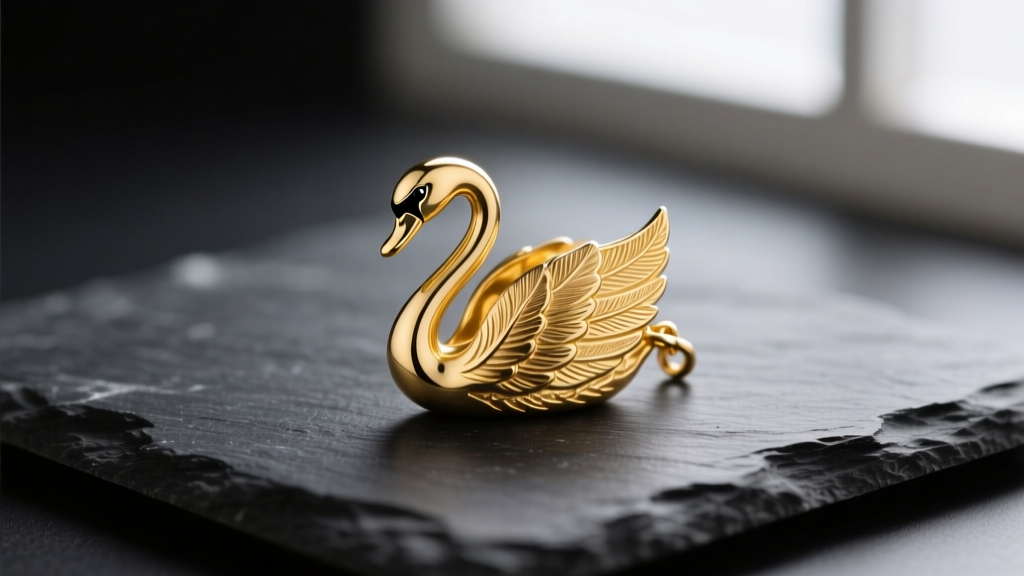
The swan gold necklace remains one of the most enduring motifs in figurative fine jewelry, symbolizing grace, fidelity, and elegance. However, translating the fluid, S-curved neck and delicate, layered wings of a swan into a durable metal pendant presents unique metallurgical and structural challenges. Unlike simple geometric pendants, a figurative swan requires precise weight distribution, strategic spruing during the casting process, and careful alloy selection to prevent the slender neck from bending or the wingtips from snagging. In this expert deep dive, we deconstruct the technical anatomy of the swan gold necklace, examining the material science, casting mechanics, and chain integration required to produce a master-level piece.
The Metallurgy of Swan Pendants: 14k vs. 18k vs. 22k Gold
The structural integrity of a swan pendant relies heavily on the gold alloy used. According to the Gemological Institute of America (GIA), pure 24k gold is far too malleable for intricate figurative work. When evaluating a swan gold necklace, the karatage dictates the Vickers Hardness (HV) and yield strength of the piece, which is critical for the swan's notoriously fragile neck.
14k Gold (58.3% Pure Gold)
With a Vickers Hardness ranging from 120 to 150 HV, 14k gold is the most durable option for everyday wear. The higher concentration of alloying metals (typically copper, silver, and zinc) provides exceptional tensile strength. For a swan pendant with a slender, elongated neck (often cast at just 1.5mm to 2.0mm in thickness), 14k gold offers the necessary rigidity to resist bending if the pendant is caught or pulled. However, the lower gold content slightly diminishes the rich, warm luster that collectors often seek in luxury animal motifs.
18k Gold (75% Pure Gold)
18k gold (approx. 110-130 HV) is the luxury standard for fine swan pendants. It offers a superior color saturation and hypoallergenic profile. To compensate for its slightly lower yield strength compared to 14k, master jewelers will often increase the cross-sectional thickness of the swan's neck by 0.2mm or incorporate a hidden structural rib along the back of the S-curve. This ensures the pendant maintains its delicate visual profile while surviving the mechanical stresses of daily wear.
22k Gold (91.6% Pure Gold)
While highly prized in certain global markets for its rich yellow hue, 22k gold (approx. 60-70 HV) is a structural liability for figurative pendants. A 22k swan gold necklace is highly susceptible to deformation; even the weight of a heavy chain can slowly warp the swan's neck over time. Unless the design is exceptionally compact and stylized, 22k should be avoided for realistic swan silhouettes.
Casting Techniques: Lost-Wax and Spruing Strategy
The creation of a high-definition swan pendant begins long before the gold is melted. The World Gold Council notes that advanced casting techniques are vital for capturing the micro-textures of avian feathers. Today, the industry relies on two primary methods: traditional hand-carved wax and 3D-printed castable resins.
Resolution and Surface Porosity
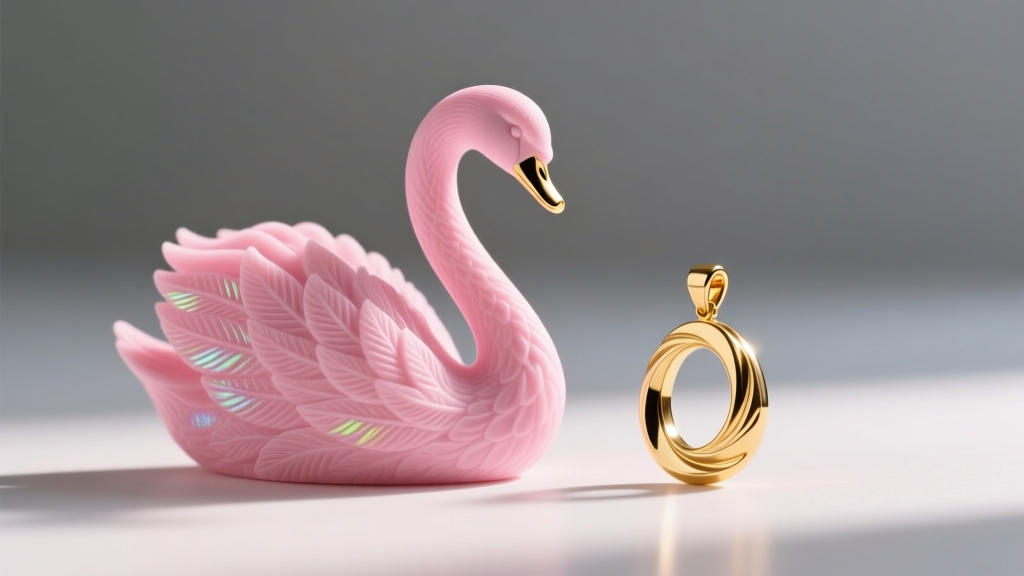
While traditional lost-wax casting yields excellent results, 3D-printed castable resins (such as Phrozen Wax or Formlabs Castable Wax 40) allow for microscopic feather barbs that would be impossible to carve by hand. During the burnout cycle, the resin must be heated to exactly 700°C–750°C to ensure zero ash residue. Any leftover carbon will cause surface pitting on the gold, requiring aggressive polishing that destroys the fine feather details.
The Spruing Strategy for Figurative Shapes
The most common failure mode in swan casting is shrinkage porosity, particularly in the transition zone between the heavy body and the thin neck. If a jeweler incorrectly places the main sprue (the channel through which molten gold flows) on the wingtip, the metal will cool too quickly, leaving a void in the swan's body. A technically sound spruing strategy places the main feed at the thickest mass (the lower body) and uses secondary micro-sprues to feed the neck and head, ensuring a dense, porosity-free casting that requires minimal post-cast polishing.
Center of Gravity: Bail Mechanics and Chain Integration
A beautifully cast swan is useless if it hangs upside down or tilts awkwardly on the chest. The physics of the pendulum swing dictates that the bail (the loop connecting the pendant to the chain) must be positioned directly above the pendant's center of mass. Because a swan has a heavy, rounded body and a long, protruding neck, the center of gravity is naturally shifted forward.
If a standard loop bail is soldered to the top of the swan's back, the heavy neck will pull the pendant downward, causing it to flip. To counteract this, expert jewelers utilize a hidden horizontal tube bail soldered across the upper wings, or a custom-milled bail placed slightly toward the rear of the swan's back. This shifts the pivot point backward, allowing the swan to rest perfectly parallel to the wearer's sternum.
Weight-to-Chain Ratio Matrix
Pairing the correct chain is vital to prevent premature wear on the clasp and chain links. Below is the technical matrix for matching swan pendant weights with appropriate chain gauges.
| Pendant Weight | Recommended Chain Width | Optimal Chain Style | Tensile Requirement |
|---|---|---|---|
| 2.0g - 4.0g (Petite) | 0.9mm - 1.2mm | Cable or Bead Chain | Low (approx. 2-3 kg) |
| 4.1g - 8.0g (Standard) | 1.2mm - 1.5mm | Rope or Box Chain | Medium (approx. 4-6 kg) |
| 8.1g - 15.0g (Statement) | 1.8mm - 2.5mm | Wheat or Figaro Chain | High (approx. 8-12 kg) |
For standard swan pendants (4-8g), a 1.2mm to 1.5mm rope chain is highly recommended. The intertwined links of a rope chain provide superior tensile strength and resist kinking, which is a common failure point in box chains when subjected to the pendulum motion of a heavy figurative pendant.
Clasp Mechanics and Snag Prevention
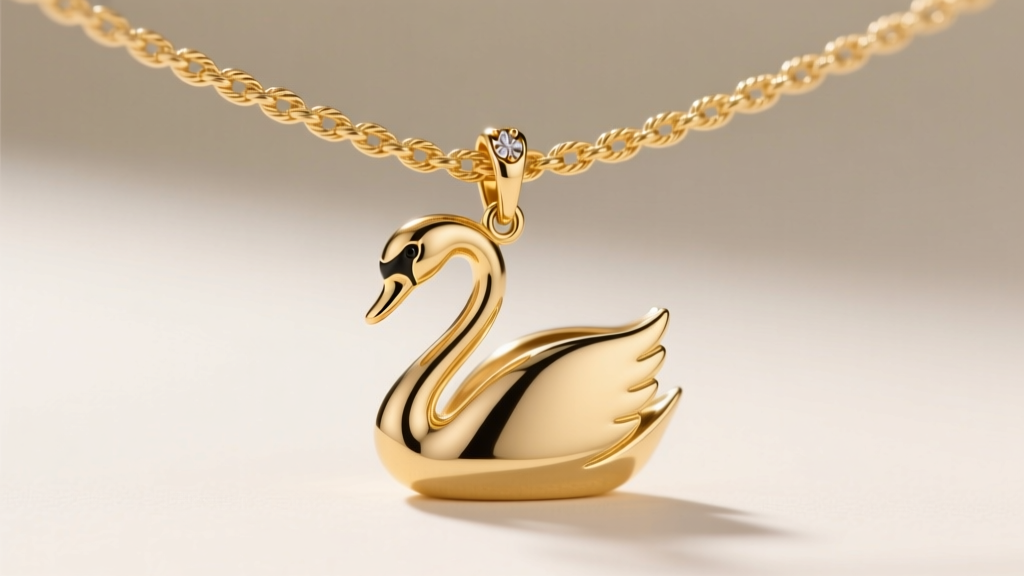
The hardware securing a swan gold necklace must balance security with aesthetics. Standard spring-ring clasps are notoriously unreliable for fine chains; the tiny internal spring frequently fails, and the lever mechanism can easily catch on the swan's wings when taking the necklace off. A micro-lobster clasp is the minimum acceptable standard, offering a self-closing mechanism and a higher weight tolerance. For high-end pieces, a custom S-clasp or a hidden box clasp integrated into the chain provides a seamless look while eliminating mechanical failure points entirely.
Wingtip and Beak Snagging: A Real-World Troubleshooting Guide
The most frequent complaint from owners of figurative bird jewelry is snagging on silk blouses, fine knits, and hair. The swan's beak and the terminal edges of the primary wing feathers act as microscopic hooks. During the finishing process, a master jeweler will use a high-speed rotary tool equipped with a rubber abrasive burr to gently round the micro-edges of the beak and wingtips. This process, known as micro-bezeling or edge-softening, removes the sharp 90-degree casting angles without altering the visual silhouette of the bird.
Maintenance of Micro-Pave Wings
Many luxury swan gold necklaces feature micro-pave diamond accents along the wings to simulate light catching the feathers. Owners must avoid ultrasonic cleaners. The high-frequency vibrations can easily loosen the tiny beads of gold securing the 1.0mm melee diamonds. Instead, clean the pendant using an ionic jewelry cleaner or a simple solution of warm water and mild dish soap, agitating gently with a soft-bristled baby toothbrush to remove sebum and lotion buildup from beneath the swan's body.
'The true mark of a master jeweler is not just in the design of a figurative pendant, but in the invisible engineering that allows it to hang perfectly, endure daily friction, and resist deformation over decades of wear.'
Ultimately, investing in a high-quality swan gold necklace requires looking past the initial aesthetic appeal. By scrutinizing the alloy hardness, evaluating the casting resolution, and ensuring the bail is engineered for the pendant's specific center of gravity, you secure a piece of jewelry that is as structurally sound as it is visually poetic.


