Expert Guide: Evaluating a Necklace JCPenney Sells
Discover how to evaluate a necklace JCPenney sells with our expert technical guide on metal grades, diamond clarity, and chain construction.

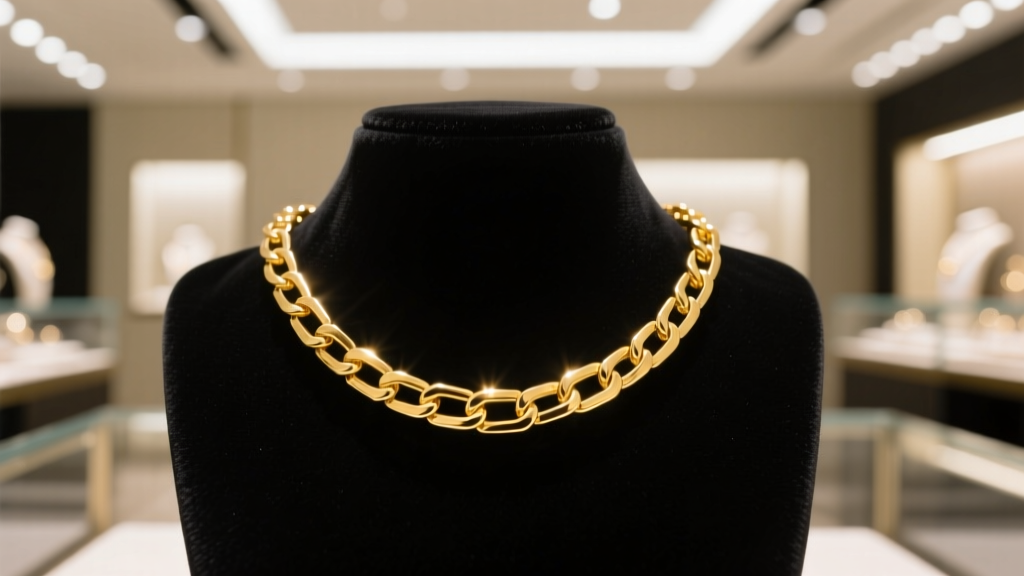
The Anatomy of Department Store Jewelry
Walking into a mid-tier department store in 2026 presents a fascinating intersection of mass-market accessibility and complex metallurgical realities. When evaluating a necklace JCPenney offers, consumers are often confronted with a dizzying array of price points, ranging from $19.99 fashion pieces to $1,500 fine jewelry pavilion items. Understanding the technical specifications behind these price tags is crucial for making an informed purchase. This expert deep dive dissects the material grades, gemological realities, and mechanical engineering of department store necklaces, providing you with a professional framework for assessment.
Decoding Metal Alloys and Plating Thickness
The foundation of any pendant or chain lies in its base metal and surface treatment. Department stores typically segment their inventory into three distinct metallurgical tiers: fashion, bridge, and fine.
Fashion and Bridge Tiers: The Science of Plating
Brands like Arizona or Worthington utilize brass or zinc-alloy bases. According to the Federal Trade Commission Jewelry Guides, a piece can be legally marketed as "gold plated" if the gold layer is at least 0.175 microns thick (roughly 7 millionths of an inch). However, many budget-friendly necklaces utilize "flash plating," which can be as thin as 0.05 microns. This ultra-thin layer wears off rapidly against the skin's natural pH and friction, exposing the brass underneath and leading to rapid oxidation (tarnish) and skin discoloration.
Bridge-tier jewelry often upgrades to a 925 sterling silver base. When plated with gold, this is technically classified as "gold vermeil" (provided the gold is at least 10k and 2.5 microns thick). Vermeil offers vastly superior longevity compared to brass-based flash plating, as the silver substrate is hypoallergenic and resists the greenish corrosion associated with copper-heavy brass alloys.
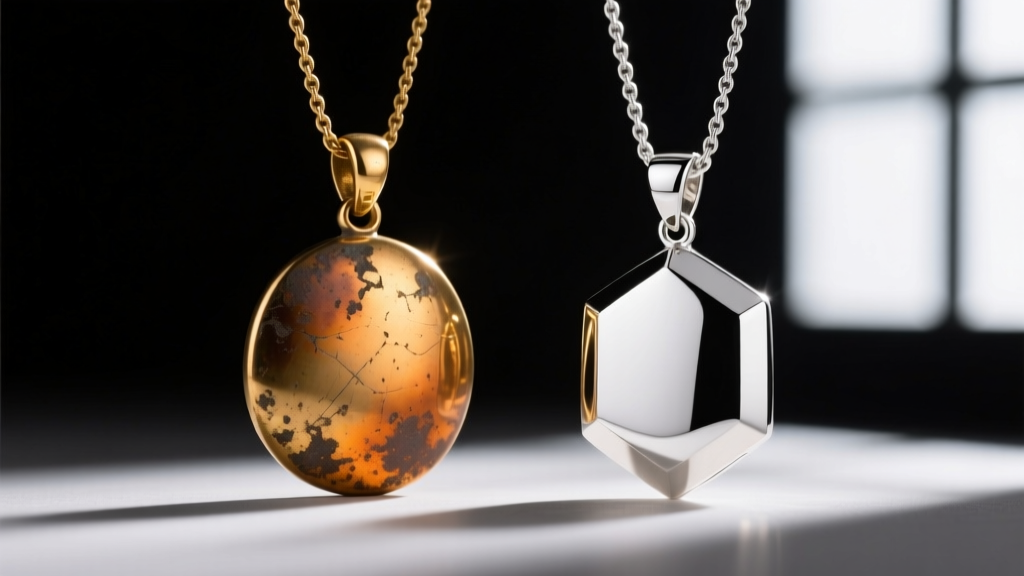
The Fine Jewelry Pavilion: Solid Alloys
In the locked glass cases, you will encounter solid 10k (41.7% pure gold) and 14k (58.5% pure gold) alloys. 10k gold is heavily favored in mall-level fine jewelry due to its high tensile strength and lower price point, but it contains a higher percentage of copper and zinc, making it slightly more brittle and prone to a paler yellow hue compared to 14k or 18k alternatives.
Gemstone and Diamond Grading Realities
The most significant value discrepancy in department store jewelry lies in gemological grading. Promotional diamond pendants—often advertised with aggressive discounts—rely on specific clarity and color tiers to maintain margins.
The I1-I2 Clarity Spectrum
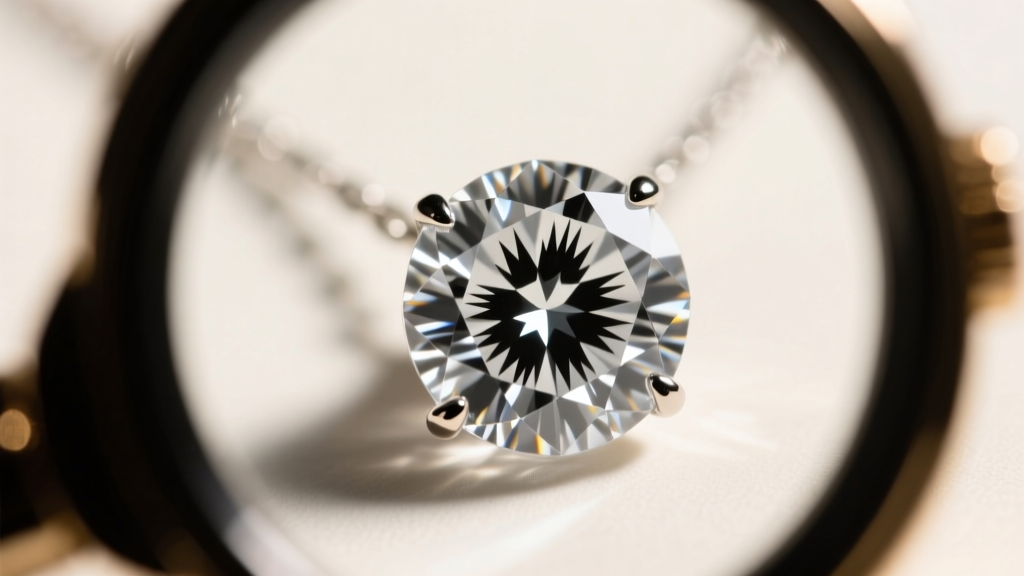
According to the Gemological Institute of America (GIA), diamonds graded I1, I2, or I3 (Included) contain inclusions that are obvious under 10x magnification and often visible to the naked eye. In a typical 1/2 carat total weight (CTW) solitaire pendant found in a mall jeweler, an I2 clarity grade means the stone may have visible carbon spots or internal feathers. More critically, large feathers near the girdle can compromise the stone's structural integrity, making it susceptible to chipping if struck against a hard surface.
The "CTW" Marketing Metric
Always scrutinize the abbreviation CTW (Carat Total Weight). A necklace tagged as "1.00 CTW Diamond" might feature a 0.25-carat center stone surrounded by 0.75 carats of microscopic melee diamonds (often 0.01 carats each). Melee diamonds are significantly cheaper per carat than larger, single stones. Therefore, a 1.00 CTW cluster pendant holds vastly less intrinsic and resale value than a single 1.00-carat solitaire of the same color and clarity.
Treated vs. Created Gemstones
When evaluating colored gemstones, technical disclosure is paramount. Many genuine rubies and emeralds sold at this retail level are heavily treated. Rubies are frequently fracture-filled with lead glass to improve apparent clarity, while emeralds are heavily oiled. In 2026, lab-created (hydrothermal or flux-grown) gemstones offer superior clarity and color saturation at the same price point, as they bypass the need for invasive structural treatments.
Chain Weaves and Clasp Engineering
A pendant is only as secure as the chain and clasp supporting it. The mechanical engineering of these components is often overlooked by consumers but is a primary failure point in daily wear.
Chain Tensile Strength
- Cable and Box Chains: These feature simple, uniform links or square interlocking segments. A 1.0mm 14k box chain offers excellent tensile strength and resists kinking, making it ideal for heavier pendants (5+ grams).
- Rope and Herringbone Chains: While visually striking, herringbone chains consist of flat, interlocking links that easily kink if bent backward. Once kinked, the structural memory of the metal is compromised, leading to inevitable snapping.
- Wheat (Spiga) Chains: Woven from four strands of twisted oval links, wheat chains offer the highest durability-to-weight ratio and are highly resistant to tangling and snapping.
Clasp Mechanics: Spring Ring vs. Lobster
Fashion necklaces almost exclusively use spring ring clasps. These feature a tiny internal tension spring that degrades rapidly with daily use, often resulting in a clasp that fails to close completely. Fine jewelry pieces should utilize a cast lobster claw clasp. A high-quality lobster clasp features a solid internal swivel mechanism and a heavier gauge lever, providing a secure lock that can support the pendulum swing of a heavy pendant without accidental release.
Price-to-Value Matrix (2026 Benchmarks)
Use the following technical matrix to benchmark the retail pricing of department store necklaces against their actual material and manufacturing costs.
| Category | Base Metal / Purity | Plating Thickness | Typical Gemstone Grade | Retail Price Range |
|---|---|---|---|---|
| Fashion (e.g., Arizona) | Brass / Zinc Alloy | 0.1 - 0.5 microns (Flash) | Cubic Zirconia / Glass | $15 - $45 |
| Bridge (e.g., Liz Claiborne) | 925 Sterling Silver | 1.0 - 2.5 microns (Vermeil) | AAA Synthetic / Treated | $60 - $150 |
| Fine Jewelry Pavilion | 10k or 14k Solid Gold | N/A (Solid Alloy) | I1-I2 Natural Diamonds | $250 - $1,200 |
The Expert Inspection Checklist
Before finalizing your purchase, run the piece through this rigorous technical checklist:
- Check the Stamp: Look for "925", "10k", "14k", or "PLAT". If the stamp is missing or reads "GP" (Gold Plated) on a high-priced item, reassess the value.
- Inspect the Prongs: Use your fingernail to gently test the prongs holding the center stone. If they catch on fabric or feel loose, the casting is poorly finished and requires immediate jeweler intervention.
- Evaluate the Clasp Swivel: A premium lobster clasp should swivel 360 degrees smoothly at the base. If it is rigidly soldered, the chain will twist and eventually snap from torsional stress.
- Demand the Disclosure: Ask the associate for the gemstone treatment disclosure. If a ruby is fracture-filled, it cannot be cleaned in an ultrasonic machine without risking total stone destruction.
"The true cost of a necklace is not just its retail price, but its metallurgical longevity and the structural integrity of its settings. A $400 promotional diamond pendant with I2 clarity and flash-plated prongs is a liability, not an asset." — Senior Gemological Appraiser
By applying these technical frameworks, you can confidently navigate the display cases, separating genuine metallurgical value from clever visual merchandising. Whether you are buying a daily-wear sterling silver piece or a milestone diamond solitaire, understanding the engineering beneath the sparkle ensures your investment endures.


