Tourmaline Bead Necklace Buying Guide: Quality & Pricing
Discover how to evaluate a tourmaline bead necklace with our expert buying guide. Learn about color grades, stringing, and pricing tiers.

The Gemological Complexity of Tourmaline Beads
When shopping for a tourmaline bead necklace, you are not just buying a piece of jewelry; you are investing in one of the most mineralogically complex gemstones on earth. Tourmaline is a boron silicate mineral that boasts a massive spectrum of colors, often within a single crystal. Unlike faceted gemstones where the cutter can manipulate light return, beads are constrained by their spherical or faceted-round geometry. This means the lapidary must carefully orient the bead along the crystal's c-axis to manage pleochroism—the phenomenon where the stone displays different colors when viewed from different angles. A poorly oriented tourmaline bead will look muddy or overly dark, while a masterfully cut bead will radiate vibrant, saturated color.
According to the Gemological Institute of America (GIA), tourmaline's chemical complexity allows for trace elements like copper, manganese, iron, and vanadium to create entirely distinct color varieties. Understanding these varieties is the first critical step in evaluating the quality and price of any tourmaline bead strand.
Decoding Tourmaline Color Varieties in Beads
Not all tourmaline beads are created equal, and the market prices them strictly by color variety. Here is what you need to look for when assessing the color profile of a necklace:
Rubellite and Chrome: The Premium Tiers
Rubellite (manganese-rich) ranges from deep pink to purplish-red. In bead form, true rubellite is exceptionally rare because most clean, saturated rough is reserved for high-value faceted stones. Beads labeled as rubellite often carry heavy inclusions. Chrome tourmaline, colored by vanadium and chromium, offers a rich, forest-green hue that rivals tsavorite garnet. Chrome tourmaline bead necklaces are scarce and command top-tier pricing.
Indicolite and Watermelon: The Collector's Choices
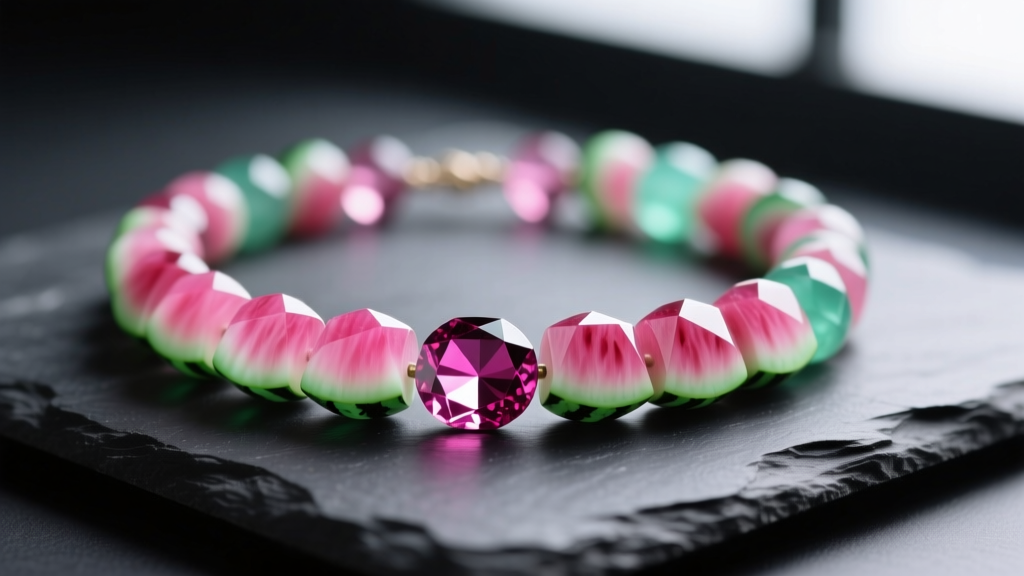
Indicolite (blue tourmaline) is notoriously dark. In beads, lapidaries often cut them slightly smaller (4mm to 6mm) to allow light penetration, preventing the necklace from looking like a strand of black onyx. Watermelon tourmaline features a pink core and a green rind. In high-quality bead strands, you want to see sharp, distinct color zoning rather than a muddy brown transition area between the pink and green.
The Grading Framework: What to Look For
Evaluating a tourmaline bead necklace requires a different grading framework than faceted stones. Because beads are typically cut from lower-grade rough, clarity expectations must be adjusted. Use this grading chart to assess potential purchases:
| Quality Grade | Color Saturation | Clarity & Inclusions | Drill Hole Quality | Estimated Strand Price (16-inch) |
|---|---|---|---|---|
| Commercial | Moderate, visible zoning or muddiness | Heavy inclusions, visible fractures, opaque patches | Uneven, chipped edges, off-center | $40 - $120 |
| Good | Strong color, minor pleochroic dark spots | Moderate inclusions, some internal silk (rutile needles) | Symmetrical, minor micro-chipping | $150 - $450 |
| Fine | Vibrant, highly saturated, excellent orientation | Eye-clean to slightly included, high translucency | Perfectly centered, clean edges | $600 - $1,500+ |
| Premium (Rubellite/Chrome) | Neon or deep velvet hues, masterfully oriented | Minimal inclusions, exceptional luster | Micro-drilled, perfectly symmetrical | $2,000 - $8,000+ |
Stringing Materials and Hardware: Hidden Failure Points
A common mistake buyers make is focusing entirely on the beads while ignoring the stringing material. Tourmaline ranks between 7 and 7.5 on the Mohs hardness scale. While this makes it durable enough for everyday wear, it also means the beads are hard enough to abrade softer stringing materials over time, and the sharp inner edges of the drill holes can act like tiny saws.
The Necessity of Knotting
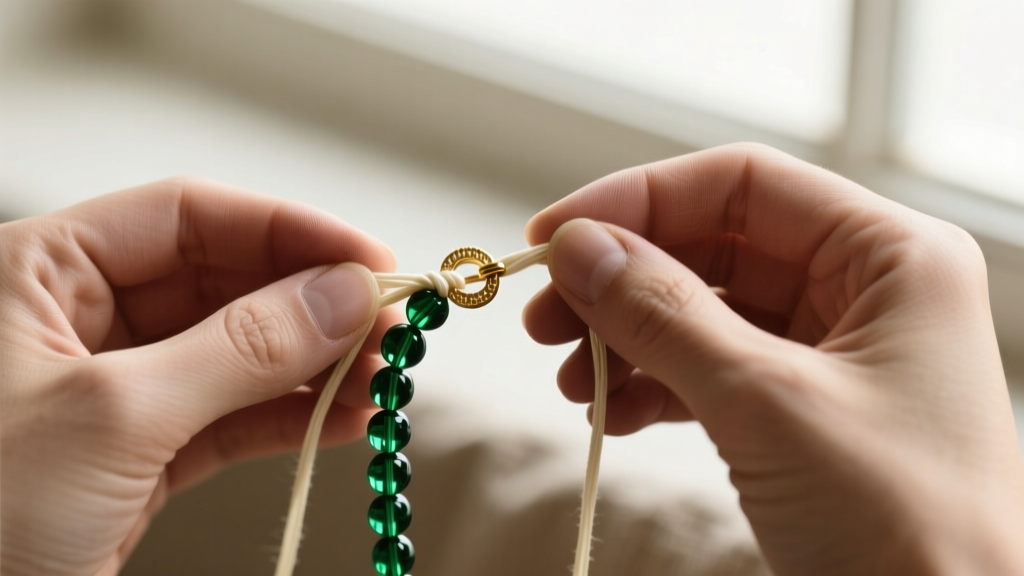
Never buy a fine tourmaline bead necklace strung on unknotted synthetic wire or cheap nylon. If the strand breaks, you will lose the entire necklace. Furthermore, without knots, the beads will grind against each other with every movement, creating tourmaline dust and gradually enlarging the drill holes. High-end strands are knotted using Griffin silk cord (typically Size 4 or 6 for 6mm-8mm beads) or high-tensile synthetic silk alternatives like Beadalon. The knots protect the beads from impact damage and prevent total loss if the cord snaps.
Treatments and Enhancements: The Disclosure Imperative
The Mindat mineral database notes that tourmaline's complex crystal structure often results in internal stress fractures. To make lower-grade rough viable for bead cutting, the industry employs several treatments. As a buyer, you must know what to ask the seller:
- Heat Treatment: Commonly used on rubellite and pink tourmaline to remove brownish undertones and improve color saturation. This is generally stable and widely accepted in the trade, provided it is disclosed.
- Fracture Filling: Because tourmaline beads frequently feature surface-reaching fractures, they are often treated with colorless oils, epoxies, or resins to improve apparent clarity and structural integrity. Warning: Fracture-filled beads must never be cleaned in ultrasonic cleaners or exposed to steam, as the heat and vibrations will shatter the stone or melt the filler.
- Irradiation: Sometimes used to darken pale pink tourmaline into a richer red. However, irradiated colors can be unstable and may fade when exposed to prolonged sunlight or heat.
Pricing Tiers and Market Realities
When evaluating a tourmaline bead necklace, pricing should align with the bead diameter, color rarity, and clarity. Here is a realistic breakdown of what to expect in the current market:
- Multi-Color 'Rainbow' Strands (6mm - 8mm): Ranging from $80 to $250. These are highly popular and feature a mix of indicolite, rubellite, chrome, and yellow tourmaline. They offer excellent value but usually feature moderate to heavy inclusions.
- Uniform Pink/Green Strands (8mm - 10mm): Ranging from $300 to $800. The price jumps significantly when a strand is matched for uniform color rather than multi-color, as it requires sorting through thousands of beads to find matches.
- Gem-Grade Rubellite or Chrome (6mm - 8mm): Ranging from $1,500 to over $5,000. These are investment-grade pieces. The beads will exhibit high translucency, and the drill holes will be micro-drilled to preserve as much carat weight as possible.
Expert Verification and Final Care Tips
Because glass and synthetic imitations exist, always request a gemological report for any tourmaline bead necklace priced over $1,000. A reputable lab will confirm the natural origin and disclose any fracture filling or irradiation.
"Tourmaline is highly susceptible to thermal shock. The internal liquid and gas inclusions that give beads their unique character can expand under sudden temperature changes, causing the bead to fracture along its c-axis. Always clean your tourmaline bead necklace with warm water, a mild dish soap, and a soft brush—never use ultrasonic or steam cleaners."
By understanding the gemological nuances of color orientation, demanding proper knotting techniques, and verifying treatment disclosures, you can confidently invest in a tourmaline bead necklace that is both structurally sound and breathtakingly beautiful.


