Tibetan Necklace Troubleshooting: Repairs, Cords & Fakes
Learn how to troubleshoot common Tibetan necklace issues, from restringing broken cords and cleaning porous stones to identifying fake turquoise and dzi beads.


The Anatomy of a Traditional Tibetan Necklace
Tibetan necklaces are far more than simple adornments; they are wearable archives of Himalayan culture, spirituality, and trade routes. A genuine antique or high-quality reproduction piece typically features a central Gau (an amulet or prayer box), flanked by etched agate Dzi beads, and accented with the sacred triad of turquoise, red coral, and lapis lazuli. However, because these necklaces are heavy, structurally complex, and highly counterfeited, owners frequently encounter a specific set of problems. Whether you are dealing with a snapped stringing cord, a stuck macrame closure, or the sinking realization that your "turquoise" is actually dyed howlite, this guide provides expert-level troubleshooting to restore and verify your jewelry.
Troubleshooting Material Authenticity: Fakes vs. Reals
The market is saturated with mass-produced imitations marketed as "Tibetan Silver" and "genuine Himalayan stones." Identifying these materials is the first step in troubleshooting the long-term wearability and safety of your necklace.
The "Tibetan Silver" Trap
One of the most pervasive issues in this niche is the misnomer "Tibetan Silver." In 95% of commercial jewelry, this material contains absolutely zero silver. It is typically a base-metal alloy known as Paktong or Bai Tong, composed of copper, nickel, and zinc. While it mimics the oxidized look of aged silver, it poses two major problems: high nickel content triggers severe contact dermatitis in sensitive wearers, and cheaper vintage alloys have been found to contain dangerous levels of lead or arsenic. If your necklace leaves a green or black stain on your skin, or if it lacks a "925" or "900" stamp, you are dealing with a base-metal alloy. Solution: Apply a clear jewelry shield or micro-crystalline wax to the back of metal components that touch your skin to prevent oxidation and allergic reactions.
Turquoise, Coral, and Dzi Bead Substitutes
Authentic Tibetan turquoise is highly porous and prized for its matrix (the host rock webbing). Fakes are usually dyed howlite or magnesite. According to the Gemological Institute of America (GIA), natural turquoise has a specific gravity of 2.6 to 2.9 and a Mohs hardness of 5 to 6. Dyed howlite is softer (Mohs 3.5) and will often reveal white scratch marks if gently tested with a steel needle in an inconspicuous area. Similarly, genuine red coral is increasingly rare and expensive; most modern "coral" beads are actually dyed shell or Gilson (synthetic) coral. The GIA Coral Guide notes that dyed shell will show concentric banding under magnification, whereas true coral exhibits a distinct wood-grain or cross-hatch structure.
| Material | Authentic Traits | Common Fakes | Troubleshooting Quick-Test |
|---|---|---|---|
| Turquoise | Mohs 5-6, porous, natural matrix | Dyed Howlite, Magnesite, Plastic | Acetone on a Q-tip (removes dye from fakes); scratch test (howlite scratches white). |
| Red Coral | Wood-grain structure, SG 2.6-2.7 | Dyed Shell, Glass, Resin | Magnification (look for cross-hatching); touch test (glass feels colder and heavier). |
| Dzi Beads | Etched agate, internal banding | Laser-etched glass, Resin, Ceramic | Weight and temperature (agate is heavier and stays cool longer than resin or glass). |
| Tibetan Silver | Rarely actual silver; usually alloy | Paktong, Nickel-Silver, Lead alloys | Magnet test (weakly magnetic if high nickel); skin reaction (green/black stain). |
Fixing Broken Cords and Knots
Traditional Tibetan necklaces are incredibly heavy. A full strand of 20mm turquoise and agate beads can easily exceed 250 grams. When strung on traditional hand-spun cotton, yak leather, or low-grade silk, the cord inevitably rots from sweat acidity or snaps from friction against the sharp drill holes of the stones.
Choosing the Right Stringing Material
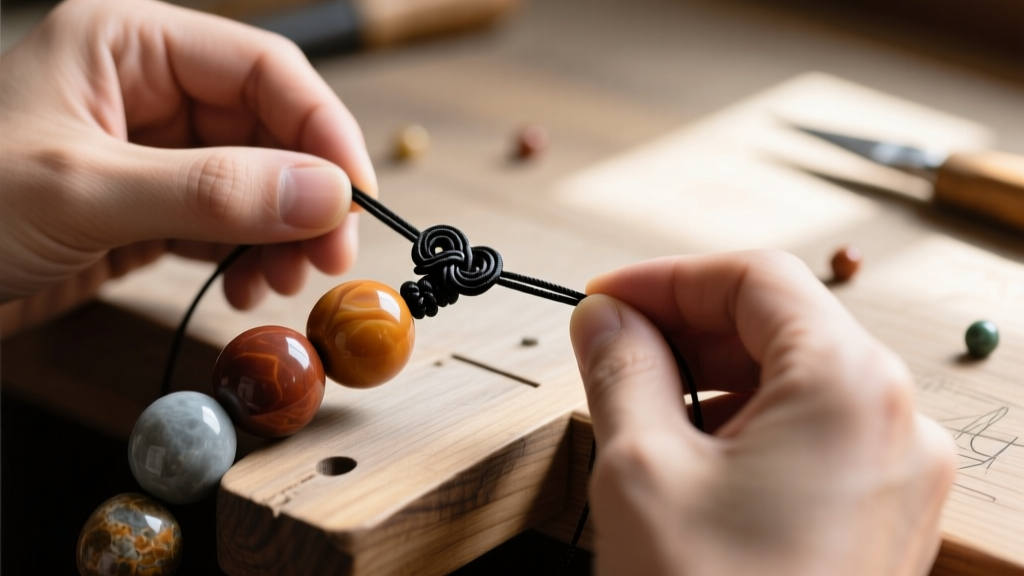
If your necklace has broken, do not restring it with standard silk thread. While Fire Mountain Gems and other suppliers offer beautiful Griffin silk cords, silk degrades rapidly when exposed to the lactic acid in human sweat and the sheer weight of Himalayan stones. The Expert Solution: Use C-Lon nylon cord (Size D or AA, approx. 0.9mm to 1.2mm thickness) or PowerPro braided fishing line (30-50 lb test). Nylon is impervious to sweat acidity and offers immense tensile strength. If you demand the traditional aesthetic of silk, you must use a heavy-duty size (Griffin Size 6 or higher) and knot the cord between every single bead to prevent total loss if a strand breaks.
Addressing Bead Drill Hole Friction
Many authentic antique beads were hand-drilled, resulting in rough, jagged interior channels that act like saw blades against stringing material. Before restringing, use a diamond-coated bead reamer to gently smooth the interior of the drill holes. Alternatively, insert microscopic sterling silver or copper eyelets (tube crimps) into the holes of the heaviest beads to protect the cord from abrasion.
Cleaning and Maintenance Without Damaging Porous Stones
The most catastrophic troubleshooting failures occur when owners attempt to clean their Tibetan necklaces using standard jewelry methods. Turquoise, coral, and lapis lazuli are all highly porous, organic, or chemically sensitive materials.
- NEVER use ultrasonic cleaners: The high-frequency vibrations will shatter the internal matrix of natural turquoise and strip any wax or resin stabilization treatments.
- NEVER use ammonia or silver dip: Chemical silver cleaners will instantly turn porous turquoise black or green as the stone absorbs the toxic liquids. Ammonia will dissolve the calcium carbonate structure of red coral.
- Safe Metal Cleaning: Use a dry Sunshine polishing cloth to gently rub the oxidized "Tibetan Silver" or sterling components. Keep the cloth strictly away from the stones.
- Safe Stone Cleaning: Wipe the turquoise and coral beads with a barely damp, lint-free microfiber cloth. If the stones look dull and chalky, they may have lost their natural oils. Rub a microscopic drop of pure jojoba oil or unscented mineral oil into the stones with your fingers to restore their luster and protect them from drying out and cracking.

Adjusting Traditional Macrame Sliding Knots
Many Tibetan necklaces forego metal clasps in favor of an "endless knot" or sliding macrame closure made from a separate 1mm nylon or leather cord. Over time, these knots can become permanently seized due to accumulated skin oils, dust, and friction.
Troubleshooting a Stuck Sliding Knot:
- Do not pull with brute force, as this will stretch and weaken the structural cord inside the knot.
- Take a standard sewing needle and gently work the tip under the outermost loop of the macrame knot to create slack.
- Apply a minuscule drop of jojoba oil or beeswax to the friction point where the cords slide against one another.
- Massage the knot laterally (side-to-side) rather than pulling it longitudinally. This breaks the microscopic debris lock and allows the knot to glide smoothly again.
Preserving Your Wearable History
A genuine Tibetan necklace is an investment in both artistry and geology. By upgrading your stringing materials to modern high-tensile nylons, avoiding chemical cleaners on porous stones, and accurately identifying the metallurgical reality of your metal components, you can ensure your necklace survives for another generation. Regularly inspect the cord near the clasp and the heaviest beads for signs of fraying, and re-oil your turquoise annually to maintain its structural integrity and vibrant color.


