How to Travel With Necklaces: Destination Gift Packing Guide
Learn how to travel with necklaces meant for destination gifting. Discover TSA-safe packing, anti-tangle tricks, and the best travel-ready jewelry gifts.

The High-Stakes Reality of Destination Gifting
Gifting fine jewelry is a profound gesture, but presenting that gift at a destination wedding, an overseas anniversary, or during a surprise proposal abroad introduces a layer of logistical anxiety. Learning how to travel with necklaces intended as high-value gifts requires more than just tossing them into a carry-on bag. Between the risk of lost luggage, aggressive security screenings, and the notorious tendency of fine chains to tangle into unbreakable knots, transporting delicate pendants and chains across the globe demands a strategic approach.
In 2026, with airlines enforcing stricter carry-on weight limits and airports utilizing advanced CT scanners that require fewer items to be removed from bags, the mechanics of packing jewelry have shifted. Whether you are carrying a $10,000 diamond solitaire pendant for a proposal in Lake Como or gifting a durable titanium chain to a frequent-flying partner, this guide provides the exact protocols for secure transport, anti-tangle packing, and destination presentation.
Navigating TSA and Security with High-Value Pendants
The golden rule of traveling with fine jewelry is absolute: never place high-value necklaces in checked luggage. Baggage handling systems are notorious for misrouting, and airline liability limits for lost jewelry are notoriously low, often capping out around $3,500 regardless of the item's appraised value. Always keep destination gifts in your personal item or carry-on.
When passing through security checkpoints, you generally do not need to remove fine jewelry. However, bulky metal pendants or thick, heavy chain necklaces (like solid 14k gold Cuban links over 10mm in width) may trigger the body scanner or metal detector. If a TSA agent asks you to remove the necklace, request a private screening. This prevents you from having to unclasp a valuable pendant in a crowded, high-traffic security bin area where drops and thefts frequently occur. For comprehensive rules, always consult the official TSA guidelines on traveling with jewelry before your flight.
Anti-Tangle Packing Methods for Delicate Chains
Nothing ruins the romance of a destination gift reveal quite like spending twenty minutes in a hotel room desperately trying to untangle a delicate chain. The likelihood of tangling depends heavily on the chain's link structure. Herringbone and snake chains are notoriously prone to kinking and tangling because their flat, interlocking links lack a central axis of rotation. Conversely, cable, rope, and wheat chains are highly flexible and resist knotting.
Comparing Packing Techniques
| Method | Best For | Pros | Cons |
|---|---|---|---|
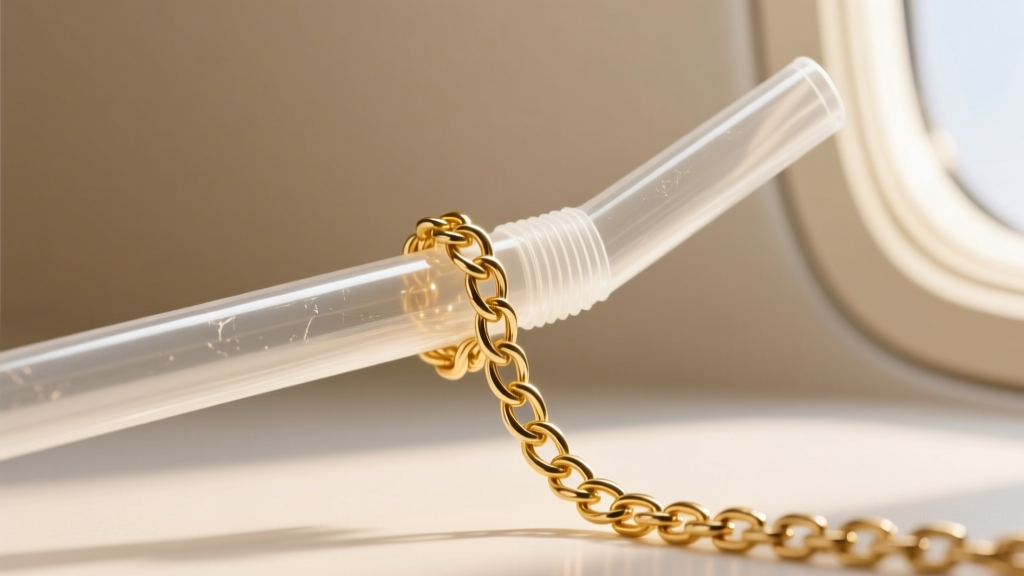
| The Straw Trick | Delicate cable & box chains | Zero cost, completely prevents knots | Only works for chains under 18 inches; clasps must be small |
| Press-and-Seal Wrap | Herringbone, snake, & wide pendants | Immobilizes flat chains, prevents kinks | Can leave adhesive residue on porous gems if not careful |
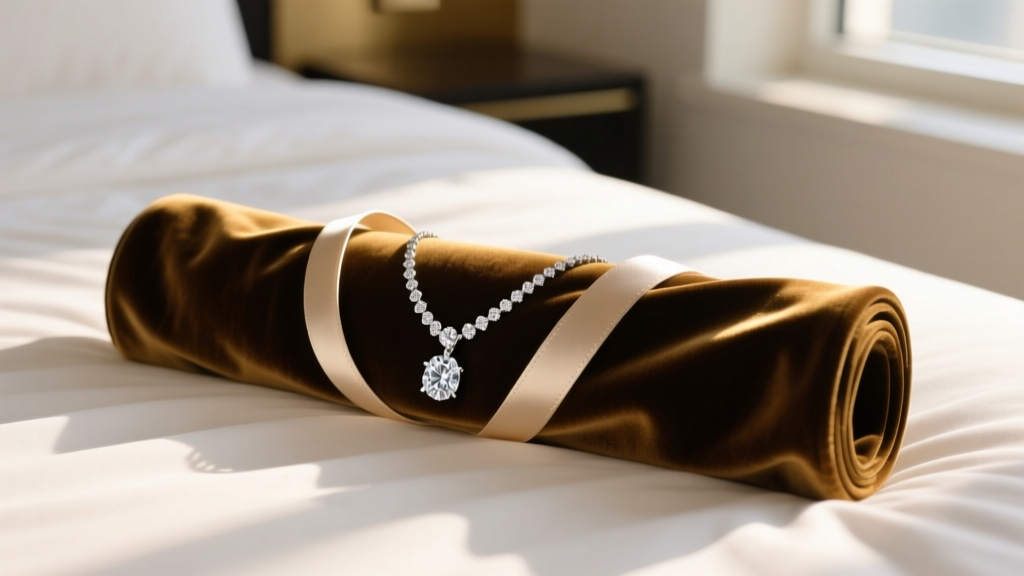
| Velvet Jewelry Roll | Multiple necklaces, high-value gifts | Professional presentation, padded protection | Bulky; takes up valuable carry-on space |
| Pill Organizer | Short chokers, stud pendants | Crush-proof hard shell, separates items | Only accommodates very short, compact pieces |
Pro-Tip: For the straw trick, thread one end of the necklace through a standard plastic drinking straw and clasp it shut. The rigid plastic prevents the chain from folding in on itself, making it physically impossible to tangle during transit.
Gifting the Jet-Setter: Best Travel-Ready Necklace Gifts
Sometimes, the occasion isn't about bringing a gift to a destination; it is about gifting a necklace to someone who lives out of a suitcase. If your recipient is a digital nomad, a frequent business traveler, or an adventure seeker, the jewelry you choose must survive the rigors of the road. Here is how to select a travel-ready necklace based on material science and structural integrity.
1. Clasp Mechanics: Lobster vs. Spring Ring
Never gift a frequent traveler a necklace with a spring ring clasp. Spring rings rely on a microscopic internal coil spring that is highly susceptible to failure from temperature fluctuations, minor impacts, or snagging on clothing. Instead, opt for a lobster claw clasp. Lobster clasps feature a solid internal lever mechanism that is vastly more secure and easier to operate with one hand in the cramped confines of an airplane lavatory or a moving taxi.
2. Material Grades: Solid vs. Plated
Travel exposes jewelry to varying humidity levels, chlorinated hotel pools, and acidic sweat. Gold-plated or vermeil necklaces will quickly wear down to the base metal (usually brass or sterling silver) under these conditions. For a travel-ready gift, invest in solid 14k or 18k gold, or highly durable platinum and titanium. According to GIA guidelines on gemstone care and durability, selecting the right metal setting is just as critical as the stone itself when the piece will be subjected to active, on-the-go wear.
3. Pendant Settings: Bezel vs. Prong
Prong settings catch on silk scarves, sweater threads, and seatbelts. For the jet-setting recipient, a bezel setting (where a rim of metal completely encircles the gemstone) is the ultimate travel-friendly choice. It protects the girdle of the stone from impact and ensures a completely smooth profile that glides over clothing.
Destination Presentation: Unboxing Away from Home
When traveling with a surprise gift, the traditional hinged jewelry box is a massive liability. It is bulky, it screams 'valuable contents' to anyone glancing into your open hotel room door, and it takes up precious space in your luggage.
Instead, utilize a discreet, high-quality velvet or suede jewelry pouch. These pouches offer a luxurious tactile experience when the recipient opens them, but they look entirely innocuous when sitting on a restaurant table or a hotel nightstand. If you are executing a surprise proposal or anniversary reveal at a public venue, keep the pouch in an interior jacket pocket or a secure cross-body bag until the exact moment of presentation. Never leave the gift unattended in a hotel room safe if the safe is small enough to be physically removed from the wall by a bad actor; instead, keep it on your person until the reveal.
Material Survival Guide: Humidity, Saltwater, and Altitude
If the necklace you are traveling with features organic or porous gemstones, you must account for the environmental shifts inherent to air travel and destination climates.
- Opals and Cabin Pressure: Opals contain up to 20% water. The extremely dry, recycled air inside an airplane cabin, combined with pressure changes, can cause opals to lose moisture and 'craze' (develop a network of fine cracks). If traveling with an opal pendant, keep it in a sealed plastic bag with a slightly damp cotton ball to maintain ambient humidity.
- Pearls and Tropical Humidity: Pearls are highly sensitive to acids and chemicals. If you are gifting a pearl necklace in a humid, tropical destination, remind the recipient to apply sunscreen, perfume, and insect repellent before putting the necklace on. The chemicals will rapidly degrade the pearl's nacre, causing it to lose its luster.
- Sterling Silver and Saltwater: If the destination involves ocean swimming, avoid gifting sterling silver chains. Saltwater accelerates the oxidation process, causing silver to tarnish and blacken almost immediately. Stick to marine-grade stainless steel, platinum, or solid gold for beach-bound gifts.
By mastering the logistics of jewelry transport, you ensure that the emotional impact of your destination gift remains entirely focused on the occasion, rather than the stress of the journey.


