Troubleshooting Your Triquetra Necklace: Snags, Tarnish, and Repairs
Is your triquetra necklace snagging, tarnishing, or bent? Learn expert troubleshooting tips to clean intricate Celtic knotwork and fix damaged loops.

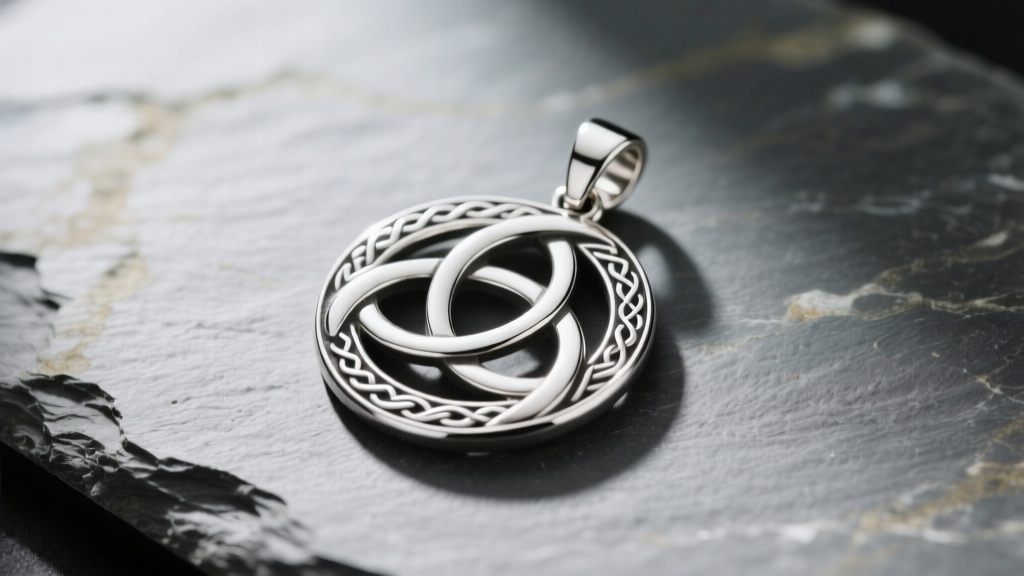
The triquetra, often called the trinity knot, is a masterpiece of continuous geometric design. Comprising three interlocking vesicae piscis, this ancient Celtic symbol represents eternity and interconnectedness. However, from a jewelry design and metallurgical perspective, the very features that make a triquetra necklace visually stunning—open loops, overlapping wire nodes, and deep recessed grooves—also make it a magnet for structural and maintenance issues. Whether you are dealing with a chain hopelessly tangled in the open knotwork, severe tarnish trapped in antiqued crevices, or a bent wire loop, troubleshooting these pieces requires specific technical knowledge.
This comprehensive guide addresses the most common failure modes of triquetra pendants and provides actionable, professional-grade solutions to restore your jewelry to its original condition.
The Anatomy of a Triquetra Pendant: Where Failures Occur
Before attempting any repairs, it is crucial to understand how your pendant was manufactured. Triquetra necklaces are generally produced in two ways: cast or die-struck/wire-woven. Cast pendants, made by pouring molten metal into a mold, are solid but can suffer from porosity, making the thin crossing points brittle. Die-struck or hand-fabricated wire pendants are more malleable but are prone to metal fatigue at the nodes where the wires overlap.
The most common failure points include:
- The Bail Loop: The connector at the top experiences the most friction and lateral stress.
- The Outer Nodes: The three outer points of the knot are highly susceptible to impact deformation.
- The Center Intersections: Where the wires cross in the middle, dirt accumulates, and structural weakness can lead to micro-fractures.
Troubleshooting Chain Snags in Open Celtic Knotwork
The open spaces within the triquetra design act like a net for your necklace chain. If you are constantly untangling your chain from the pendant's loops, the issue is almost always a mismatch between the chain link size and the bail design.
The Bail Sizing Rule
A standard tube bail or a poorly sized jump ring allows the chain to slide laterally, dropping links directly into the open vesicae of the knot. To solve this, the inner diameter of the bail must be strictly regulated. If you are wearing a 2.0mm box chain or rope chain, the bail's inner diameter should not exceed 3.5mm. This restricts lateral movement and prevents the chain links from aligning with the open gaps in the pendant.
The Fix: Take your necklace to a jeweler and request a "soldered closed jump ring bail" or a "hidden integrated bail" that is sized precisely to your chain's outer width. According to the Jewelers of America, properly matched bails reduce chain wear and tear by over 60%, preventing the abrasive friction that eventually snaps delicate chains.
Deep Cleaning Recessed Silver and Oxidized Knots
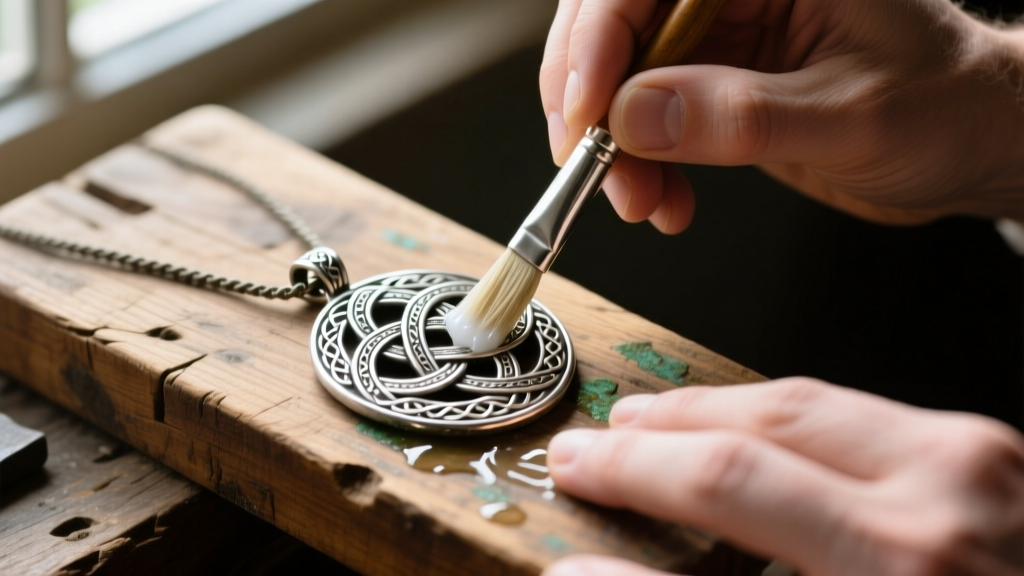
To give the triquetra its signature three-dimensional depth, jewelers often apply an oxidized finish (using liver of sulfur) to darken the recessed grooves while polishing the high points. Cleaning these necklaces requires extreme caution; the wrong method will strip the intentional patina in seconds.
What to Avoid
Never use chemical silver dips (which contain thiourea) or ultrasonic cleaners on an oxidized triquetra necklace. Ultrasonic cavitation will physically blast the dark patina out of the grooves, leaving you with a flat, uniform, and overly bright pendant that loses its intricate contrast. Furthermore, the Gemological Institute of America (GIA) warns that prolonged exposure to harsh chemical dips can cause micro-pitting in sterling silver alloys.
The Safe Cleaning Protocol
- Preparation: Mix warm distilled water with two drops of mild, phosphate-free dish soap (like Dawn) in a glass bowl.
- Agitation: Submerge the pendant for exactly three minutes to loosen sebum and cosmetic buildup.
- Mechanical Action: Using an extra-soft baby toothbrush, gently brush only the raised, polished surfaces of the knot. Avoid scrubbing the darkened recesses.
- Drying: Rinse under lukewarm water and immediately dry with a microfiber cloth. Do not air dry, as water spots will form on the polished nodes.
Straightening Bent Wire Loops Without Snapping
Because the triquetra relies on continuous curves, a crushed or bent outer loop disrupts the entire symmetry of the piece. Attempting to bend it back into shape with standard steel-jaw pliers will result in marring the metal and, more importantly, work-hardening the silver or gold to the point of fracture.
Metal Memory and Gauge Thresholds
The repairability of a bent loop depends heavily on the wire gauge used by the manufacturer. An 18-gauge (1.02mm) wire is the industry standard for durable knotwork. However, many mass-produced pendants use 20-gauge (0.81mm) wire to save on metal costs, which bends easily upon impact.
| Wire Gauge | Thickness | Malleability | Repair Strategy |
|---|---|---|---|
| 16-Gauge | 1.29mm | Highly Rigid | Requires annealing with a torch before bending to prevent snapping. |
| 18-Gauge | 1.02mm | Moderate | Can be cold-bent using nylon-jaw pliers with steady, even pressure. |
| 20-Gauge | 0.81mm | Very Soft | Highly prone to metal fatigue; requires minimal manipulation and immediate reinforcement. |
The Fix: Use nylon-jaw pliers to gently coax the wire back into its original radius. If the metal resists or feels "springy" (indicating severe work-hardening), stop immediately. Forcing it will cause a clean break. A professional jeweler will apply localized heat to anneal the metal, relaxing the crystalline structure before reshaping the knot.
Soldering Micro-Joints: When to Call a Professional
If one of the overlapping wires in the center of your triquetra necklace has snapped, DIY glues like cyanoacrylate (Super Glue) or epoxy will fail. The surface area at a wire intersection is too small to support adhesive bonds, and glues will degrade when exposed to skin oils and temperature changes.
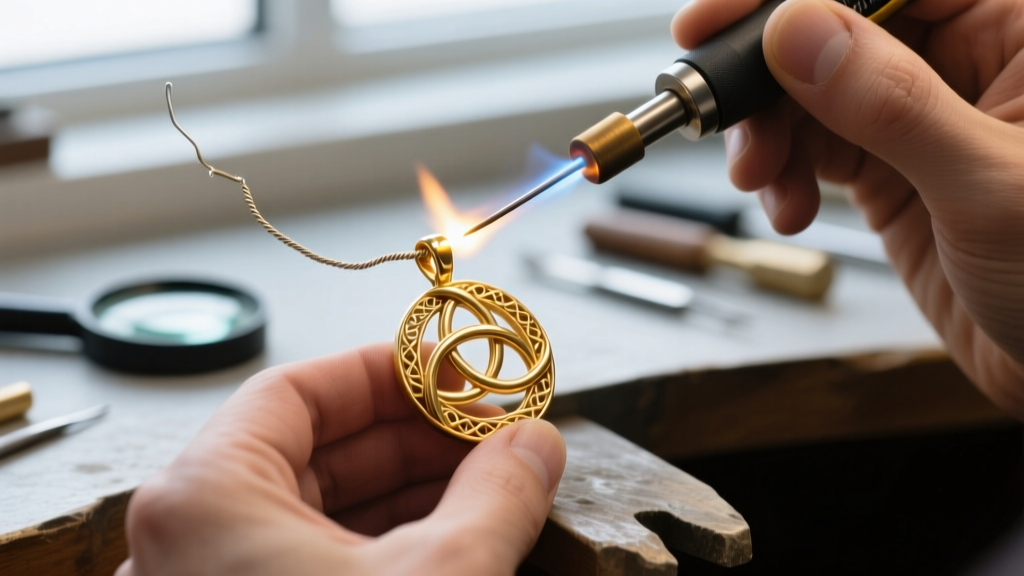
Repairing a broken node requires soldering, but traditional torch soldering on a triquetra is incredibly risky. The heat required to melt the solder will rapidly travel down the thin wires, potentially melting adjacent sections of the knot or ruining the oxidized finish.
The 2026 Laser Welding Advantage
As of 2026, desktop laser welders have become standard equipment in most reputable jewelry repair shops. Laser welding uses a highly focused beam of light to fuse metal in a fraction of a millisecond. This allows a jeweler to weld a fractured node on a triquetra pendant without heating the surrounding wires, completely eliminating the risk of thermal distortion or melting. When seeking a repair, specifically ask your jeweler if they utilize laser welding for micro-joints on intricate Celtic knotwork.
Preventative Maintenance for Daily Wear
To prevent future troubleshooting, adopt a proactive maintenance routine. Store your triquetra necklace flat in a tarnish-resistant treated flannel pouch to prevent the loops from catching on other jewelry. Remove the necklace before swimming in chlorinated pools, as chlorine reacts with the copper in sterling silver alloys, causing irreversible stress corrosion cracking at the delicate solder joints of the knot. By understanding the structural vulnerabilities of this beautiful design, you can ensure your triquetra necklace remains an unbroken symbol of eternity for decades to come.


