How to Stop Your Chevron Necklace From Flipping and Tangling
Is your chevron necklace constantly flipping or tangling? Discover expert troubleshooting tips, chain replacements, and styling fixes to keep it centered.

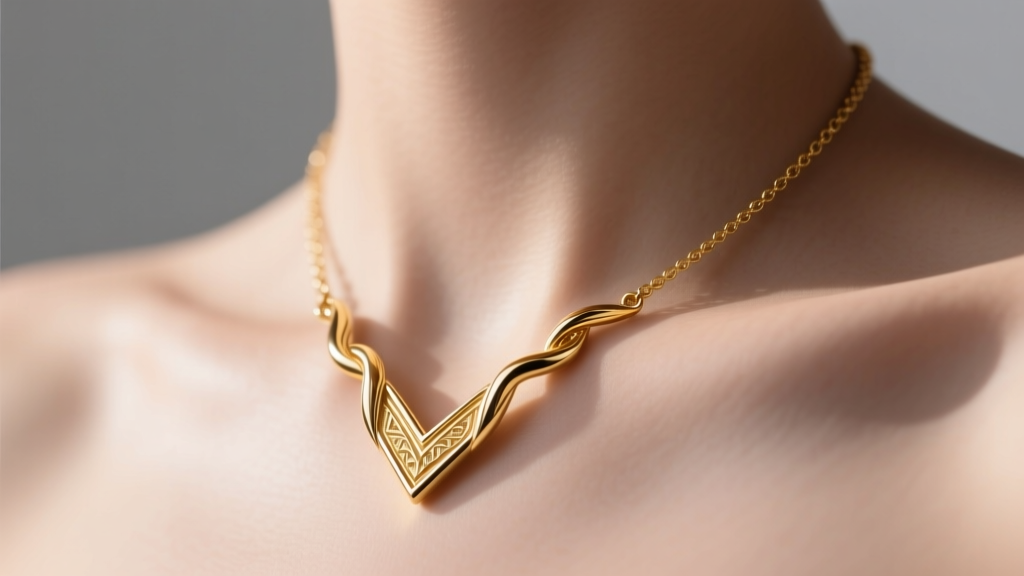
The Physics of the Chevron Flip
There are few jewelry frustrations more persistent than the "chevron flip." You spend time carefully positioning the V-shaped pendant in the hollow of your throat, only to look in the mirror ten minutes later and find the chevron necklace pointing upside down toward your chin. This is not a defect in your specific piece; it is a matter of basic physics.
A chevron pendant is essentially an inverted triangle. The horizontal "wings" of the V are significantly wider—and therefore heavier—than the bottom vertex. When suspended from a single, freely moving pivot point (like a standard jump ring bail) on a low-friction chain, gravity continuously pulls the heavier wings downward. As you walk, breathe, and shift your posture, the pendant rotates 180 degrees to find its lowest center of mass. To solve this, we must manipulate either the pivot point, the chain friction, or the posterior weight distribution.
Hardware Solutions: Bails and Chain Swaps
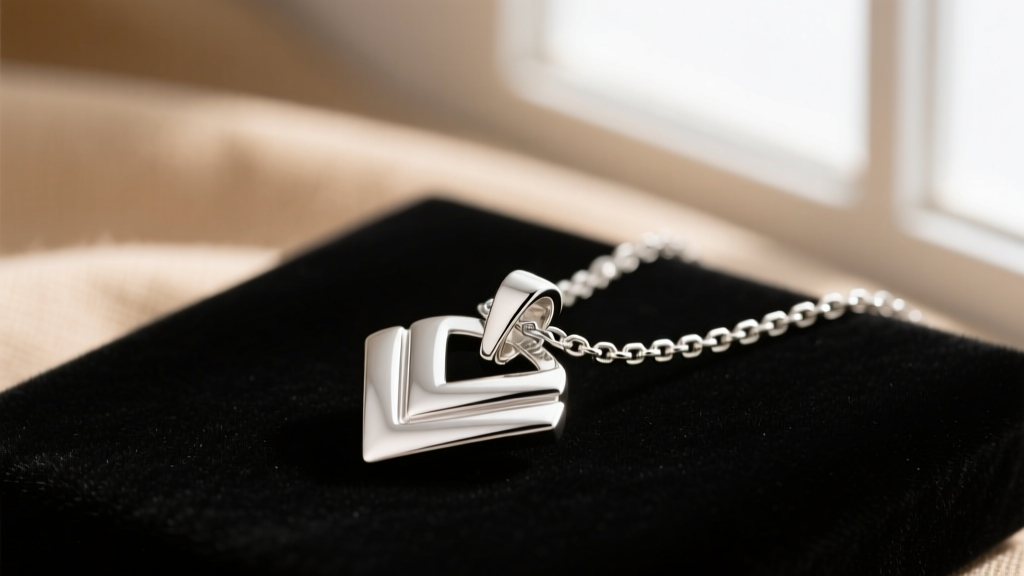
The most common culprit behind a flipping chevron is the bail—the loop that connects the pendant to the chain. Standard jump rings allow for 360-degree rotation. If your chevron necklace features a moving bail, take it to a local bench jeweler and request a soldered fixed bail or a European V-bail. A fixed bail restricts the pendant's movement, forcing it to remain rigid relative to the chain links.
Equally critical is your chain selection. As we navigate the layered jewelry trends of 2026, ultra-slick chains remain popular, but they are the enemy of top-heavy pendants. Snake chains and herringbone chains feature flush, interlocking links that act like a conveyor belt, offering zero friction to stop a heavy pendant from sliding and flipping.
Chain Friction Comparison Chart
| Chain Type | Friction Level | Flip Tendency | Expert Recommendation |
|---|---|---|---|
| Snake Chain | Very Low | Extreme | Avoid completely for chevrons |
| Herringbone | Low | High | Avoid; prone to kinking and sliding |
| Box Chain (1.2mm - 1.5mm) | Medium-High | Low | Excellent; right angles catch the bail |
| Rolo Chain (1.5mm+) | Medium | Medium | Good; round links provide friction nodes |
| Standard Cable Chain | Low-Medium | High | Fair; requires a heavier gauge to work |
Upgrading to a 1.2mm or 1.5mm solid box chain provides microscopic "teeth" at every 90-degree angle. These angles catch the bail, creating enough resistance to keep the chevron centered throughout the day.
The Counterweight Method: A Jeweler's Secret
If you are attached to your current chain and cannot swap the bail, you can use a counterbalancing technique favored by master jewelers. The goal is to shift the center of gravity of the entire necklace backward, anchoring the front pendant in place.
"A chevron pendant is essentially an asymmetrical pendulum. To defeat gravity without altering the pendant itself, you must manipulate the necklace's posterior weight."
The Fix: Thread a small, 2mm to 3mm solid gold or silicone-lined bead onto the chain, positioning it about one inch away from the clasp at the back of your neck. This tiny addition of weight acts as an anchor. When the heavy wings of the chevron try to slide down the front of your neck, the counterweight at the nape of your neck pulls back, creating a tension equilibrium that locks the V-shape perfectly in the suprasternal notch (the hollow of your throat).
Troubleshooting the "Green Neck" at the V-Point
Beyond flipping, chevron necklaces present a unique dermatological troubleshooting issue: skin discoloration. The bottom point of the chevron rests precisely in the suprasternal notch, an area of the body with a high density of sebaceous (sweat) glands.
If your chevron necklace is crafted from gold vermeil or gold-plated brass, the constant friction combined with the acidic pH of trapped sweat will rapidly wear away the microscopic gold layer. Once the copper or brass core is exposed, it reacts with the chlorides and lactic acid in your sweat to create copper chloride—resulting in the dreaded green or black stain on your skin.
To prevent this, the Gemological Institute of America (GIA) recommends understanding your metal alloys. If you are buying vermeil, ensure it is stamped with a minimum of 2.5 microns of 18k gold over a sterling silver base, not brass. Sterling silver will not turn your skin green, even if the gold plating eventually wears thin. For a permanent, maintenance-free solution, upgrade to solid 14k gold. 14k gold (58.5% pure gold alloyed with silver and copper) offers the ideal balance of rich color and structural hardness required to withstand the friction of the neckline without degrading.
Styling and Layering Without the Tangle
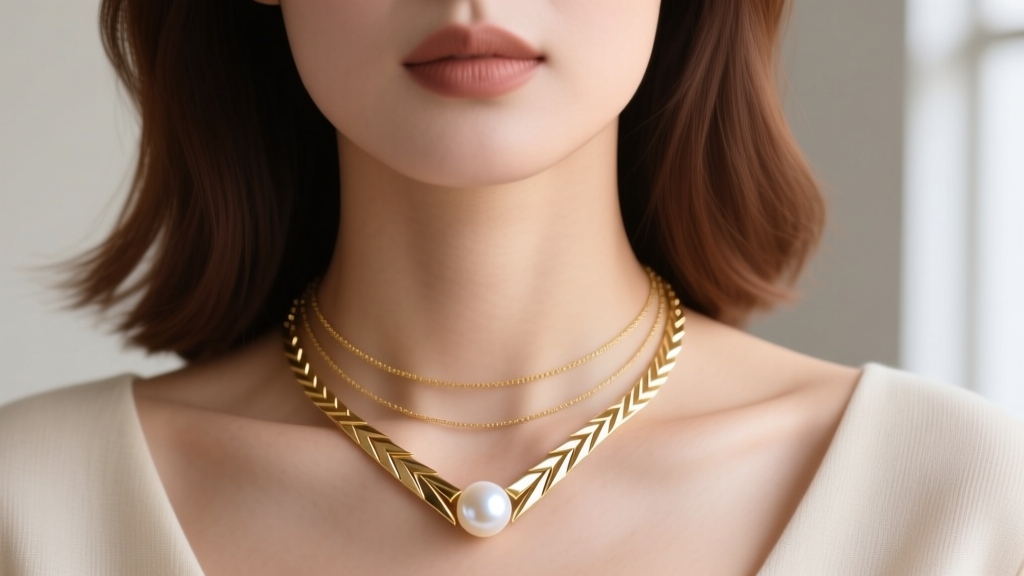
The chevron shape is geometrically aggressive. In a layered necklace stack, the inward-pointing V acts as a "catcher's mitt," easily hooking the jump rings, clasps, or delicate chains of your other necklaces. This leads to severe tangling and can snap delicate cable chains.
The 2-Inch Rule for Layering
To troubleshoot layering tangles, apply the 2-inch rule. The chevron necklace must never be the "middle" chain in a stack. It should either be the shortest piece (e.g., a 15-inch choker length) sitting high on the collarbone, or the longest piece (e.g., a 20-inch or 22-inch matinee length) hanging well below the other pendants.
According to guidelines from Jewelers of America, maintaining a minimum two-inch length gap between layered chains prevents the clasps from migrating into the center of the chest where they can become trapped in the chevron's vertex. Furthermore, if your chevron features a high-polish finish, pair it with matte or textured chains (like a beaded chain or a hammered link) to reduce the surface-level friction that causes chains to twist around one another.
Final Maintenance Checklist
- Inspect the Bail: Check for wear grooves where the chain rubs against the metal loop. Replace the bail if the metal is thinning to prevent the pendant from snapping off.
- Clean the Vertex: Use a soft-bristled baby toothbrush and mild dish soap to clean the sharp inner angles of the V, where lotion and dead skin cells accumulate and dull the metal.
- Store Flat: Never ball up a chevron necklace. The sharp points can easily scratch softer gemstones in your jewelry box. Store it flat in a dedicated anti-tarnish pouch.
By addressing the physics of the pendant, upgrading your chain's friction profile, and respecting the geometry of the V-shape during layering, you can transform your chevron necklace from a frustrating fidget into a flawless, everyday staple.


