How to Fix, Authenticate, and Care for a Chunky Jade Necklace
Is your chunky jade necklace breaking or losing its luster? Learn expert troubleshooting for restringing heavy beads, spotting fakes, and safe cleaning.

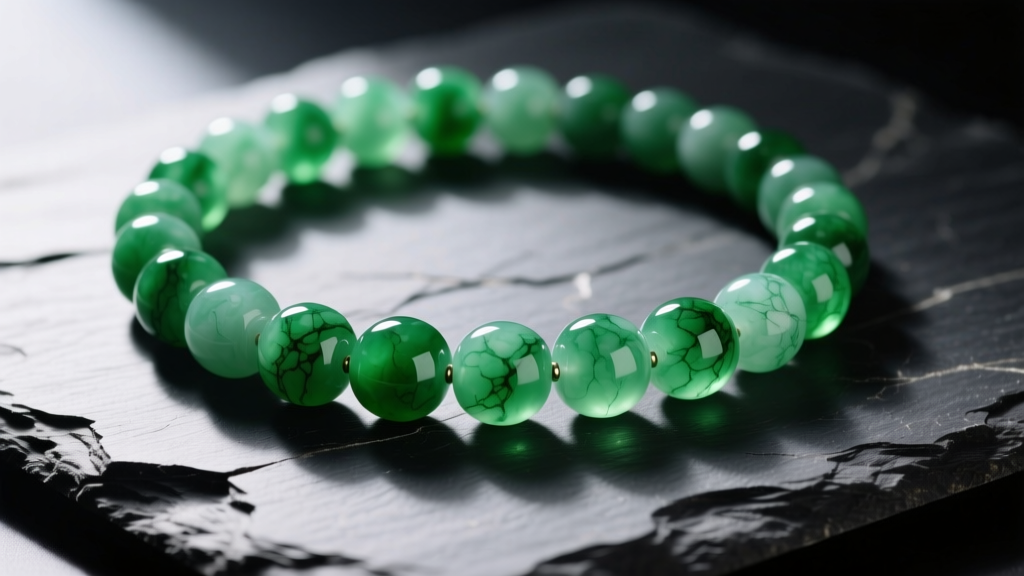
A chunky jade necklace is a bold, luxurious statement piece, but its substantial weight and the complex gemological nature of jade create unique structural and maintenance challenges. Whether you are dealing with a snapped string, a failing clasp, or suspicions about the stone's authenticity, troubleshooting these issues requires specialized knowledge. This guide provides deep, technical solutions for maintaining, repairing, and authenticating heavy jadeite and nephrite bead necklaces.
The Weight Problem: Why Your Chunky Jade Necklace Keeps Breaking
Jadeite has a specific gravity of 3.30 to 3.38, making it significantly denser than quartz or glass. A single 15mm round jadeite bead can weigh over 4 grams. A standard 18-inch necklace featuring 40 of these chunky beads will carry a static load of over 160 grams, not including the metal hardware. This immense weight creates severe tensile stress on the stringing material.
Troubleshooting Stringing Materials
If your necklace has snapped, the culprit is likely traditional silk thread. While silk is historically accurate and drapes beautifully, it is highly susceptible to stretching, moisture degradation, and eventual snapping under loads exceeding 50 grams. Conversely, using rigid beading wire (like 49-strand micro-braided steel) can cause the wire to act like a saw against the interior of the jade bead holes, eventually fracturing the stone from the inside out.
- The Expert Fix: Use a high-test braided polyethylene line (such as 50lb test Power Pro) or a flexible, nylon-coated stainless steel wire (like Beadalon 49-strand in 0.018-inch gauge).
- Abrasion Prevention: You must use French wire (gimp) or wire protectors at the clasp connection points. The metal-on-metal friction between a heavy clasp and the stringing material will sever the line over time without this protective barrier.

Clasp Failures: Upgrading Hardware for Heavy Loads
Standard lobster clasps and spring rings are entirely inadequate for a chunky jade necklace. The lateral torque applied when the necklace shifts on the neck will eventually bend the lever or snap the jump ring. When troubleshooting a failing clasp, you must upgrade to hardware engineered for high-tensile loads.
| Clasp Type | Max Weight Capacity | Security Rating | Best Use Case |
|---|---|---|---|
| Standard Lobster | Up to 40g | Low | Lightweight pendants only |
| Locking Lobster | Up to 80g | Medium | Medium-sized bead necklaces |
| Magnetic Tube | Up to 60g | Low-Medium | Easy-on/off (Not for chunky jade) |
| Screw Barrel | Up to 150g | High | Heavy stone strands |
| Bayonet (Push-Pull) | 200g+ | Very High | Chunky jade and large gem beads |
For necklaces exceeding 150 grams, a stainless steel or 18k gold bayonet clasp is the only reliable choice. The internal locking mechanism relies on a spring-loaded pin that engages a groove, making it physically impossible for lateral neck movement to unfasten the clasp.
Authentication Troubleshooting: Spotting Treated and Fake Jade
The market is flooded with dyed quartz, serpentine, and glass masquerading as high-quality jadeite. Furthermore, genuine jade is frequently subjected to harsh chemical treatments. According to the Gemological Institute of America (GIA), jade is categorized into three distinct types based on treatment:
- Type A: Completely untreated, natural jadeite (except for traditional plum wax polishing).
- Type B: Acid-bleached to remove brown/yellow impurities, then vacuum-impregnated with polymer resin to improve translucency.
- Type C: Chemically dyed to enhance or create green/lavender colors.
The Hydrostatic Weighing Test
If you suspect your chunky beads are glass or quartz, perform a hydrostatic specific gravity (SG) test. Glass typically has an SG of 2.4 to 2.8, while quartz is 2.65. Genuine jadeite will consistently test between 3.30 and 3.38. Because chunky beads are large, the margin of error on a digital pocket scale is minimized, making this a highly reliable at-home troubleshooting step.
Thermal Conductivity and UV Fluorescence
Glass and plastic fakes will feel warm to the touch almost immediately, whereas genuine jade acts as a thermal sink, remaining cool against the skin for an extended period. To troubleshoot for Type B polymer treatments, examine the beads under long-wave (365nm) ultraviolet light. According to the International Gem Society (IGS), the epoxy resins used in Type B jade often exhibit a chalky, bluish-white fluorescence under UV light, whereas Type A natural jadeite is generally inert.

Surface Damage and Cleaning: What NOT to Do
A common troubleshooting scenario involves a chunky jade necklace that has suddenly lost its luster or developed a cloudy, pitted surface. This is almost always the result of improper cleaning methods.
The Ultrasonic Cleaner Disaster
Never place a jade necklace in an ultrasonic cleaner. The high-frequency vibrations can cause internal fractures in natural jadeite (Type A) to propagate and shatter the bead. More disastrously, if the jade is Type B, the ultrasonic waves will literally shatter the polymer resin matrix holding the acid-bleached stone together, turning a translucent bead into an opaque, crumbling mess.
The Safe Cleaning Protocol
- Mix a solution of lukewarm distilled water and a few drops of pH-neutral dish soap.
- Submerge the necklace for no more than 3 minutes.
- Use an extra-soft baby toothbrush to gently agitate dirt from around the drill holes and knotting.
- Rinse thoroughly with distilled water (tap water contains chlorine and hard minerals that can leave a film).
- Pat dry with a microfiber cloth and allow it to air dry completely flat before storing.
Step-by-Step Restringing Guide for Heavy Jade Beads
If your troubleshooting reveals compromised stringing, you must restring the necklace immediately to prevent a catastrophic drop. Follow this professional framework for heavy beads:
- Prep the Hardware: Thread a 2mm sterling silver or gold-filled wire protector onto your braided line, then attach the bayonet clasp jump ring. Crimp the wire using a 2x2mm tube crimp and a micro-crimping tool.
- Stringing Sequence: Thread the beads in your desired pattern. For chunky beads, do not use traditional knots between every bead if the drill holes are smaller than 2mm, as the knots will not pass through. Instead, use 1mm soft silicone spacers between the beads to prevent stone-on-stone friction.
- Tension Management: As you string, periodically drape the necklace in a U-shape. There should be no visible gaps in the stringing material between the beads, but the strand must be flexible enough to curve without buckling.
- Finishing: Secure the second end with a crimp bead and a French wire guard, ensuring the total length accounts for the depth of the bayonet clasp mechanism.
By understanding the mechanical stresses and gemological vulnerabilities inherent to heavy jade, you can transform a problematic, fragile piece into a secure, heirloom-quality garment that will endure for generations.


