Troubleshooting Common Gold Sun Pendant Necklace Flaws
Is your gold sun pendant necklace tarnishing or tangling? Discover expert troubleshooting tips for chain knots, bail repairs, and textured gold care.


The Allure and the Aggravation of Sunburst Jewelry
The gold sun pendant necklace has remained a powerful symbol of vitality, enlightenment, and timeless style for decades. From vintage 1970s yellow gold sunburst designs to modern minimalist geometric rays, these pieces command attention. However, the very features that make a sun pendant visually striking—protruding rays, deep facial engravings, and textured matte finishes—are exactly what make them uniquely prone to physical damage, tangling, and accelerated wear.
As a jewelry specialist, I frequently see clients frustrated by tarnished crevices, snapped bails, and hopelessly knotted chains. Troubleshooting a gold sun pendant necklace requires an understanding of metallurgy, chain mechanics, and the specific vulnerabilities of cast and die-struck jewelry. This guide dives deep into the most common structural and aesthetic failures of sun pendants and provides actionable, expert-level solutions to restore and protect your piece.
Problem 1: Tarnishing and Discoloration in Sunburst Crevices
One of the most frequent complaints regarding a gold sun pendant necklace is the appearance of dark, tarnished spots deep within the engraved sun rays or the central face. Pure gold does not tarnish, but jewelry is rarely pure gold. Understanding the alloy composition is the first step in troubleshooting this issue.
Identifying the Metal Grade and Oxidation Risks
According to the Federal Trade Commission Jewelry Guides, the karatage of your gold dictates its alloy makeup. A 14k gold sun pendant contains 58.5% pure gold and 41.5% alloy metals, typically copper, silver, and zinc. Copper is highly reactive to oxygen, sulfur, and the acids in human sweat. When a sun pendant rests against the skin, sweat pools in the deep engraved lines of the sunburst, accelerating copper oxidation and leaving dark green or black residue.
| Metal Grade | Composition | Tarnish Risk in Crevices | Troubleshooting Solution |
|---|---|---|---|
| 10k Gold | 41.7% Gold, 58.3% Alloy | High (Copper/Silver heavy) | Weekly mild soap baths; avoid sulfur-rich environments. |
| 14k Gold | 58.5% Gold, 41.5% Alloy | Moderate | Use a soft baby toothbrush to clear trapped sebum from rays. |
| 18k Gold | 75.0% Gold, 25.0% Alloy | Low | Wipe with a microfiber cloth; rarely requires deep chemical cleaning. |
| Gold Vermeil | Sterling Silver base, 2.5µm Gold | Extreme (Base metal bleed) | Never use ultrasonic cleaners; replating required once rays show silver. |
If your pendant is gold vermeil, the high-friction points on the tips of the sun rays will wear through the 2.5-micron gold layer first, exposing the sterling silver beneath. Silver sulfide tarnish is black and will quickly spread into the textured grooves. The only permanent fix for a vermeil sun pendant with exposed rays is professional replating by a jeweler using a minimum 3-micron thickness for durability.
Problem 2: The Intricate Ray Tangle (Chain Snags)

The geometry of a sun pendant is a mechanical nightmare for certain chain types. The protruding rays, often tapering to points just 1mm to 2mm wide, act as micro-hooks. If you pair a gold sun pendant necklace with a rope chain, box chain, or herringbone chain, you are almost guaranteed to experience severe tangling. The open links and high-surface-friction textures of these chains easily catch on the ray tips, creating dense, seemingly impossible knots.
Safe Detangling and Prevention Framework
When your sun pendant becomes hopelessly tangled in its chain, never pull the knot tight. Instead, employ the following jeweler-approved detangling method:
- Lubrication: Lay the necklace flat on a glass or ceramic surface. Apply a generous amount of baby powder or a single drop of extra virgin olive oil directly to the knot. This reduces the friction coefficient between the gold links.
- Tool Selection: Do not use metal tweezers or safety pins, which will scratch the high-polish edges of the sun rays. Use two wooden toothpicks or plastic flossers to gently tease the center link of the knot outward.
- The Push-Pull Method: Push the chain links toward the center of the knot to create slack, rather than pulling the ends away from each other.
Prevention: To permanently solve the snagging issue, swap your chain. The ideal chain for a gold sun pendant necklace is a flat cable chain or a flat curb chain, sized between 1.2mm and 1.5mm. These chains feature flush, soldered links that offer no mechanical catch-points for the sun rays to hook onto.
Problem 3: Bail Stress and Structural Breakage
The bail—the loop that connects the pendant to the chain—is the most critical failure point on any heavy necklace. Sun pendants, particularly those ranging from 20mm to 30mm in diameter, carry significant weight. A solid 14k gold sun pendant measuring 25mm across can weigh between 6 and 9 grams.
Expert Insight: Standard jump-ring bails (often 4mm or 5mm with a visible split seam) are fundamentally unsuited for heavy, wide-diameter pendants. The lateral swinging motion of a sun pendant creates a pendulum effect, concentrating immense shear stress on the split seam of a cheap jump ring, eventually causing it to pull apart and drop your pendant.
Upgrading the Bail Hardware
If your sun pendant necklace frequently slips off the chain or the bail looks warped, you must upgrade the hardware. Take the piece to a bench jeweler and request one of the following structural upgrades:
- The Soldered Loop Bail: The jeweler will remove the split jump ring and solder a seamless, heavy-gauge (16-gauge or 14-gauge) wire loop. Soldering eliminates the weak split seam entirely.
- The Cast V-Bail: For pendants with a top ray that can be modified, a V-bail (or hidden bail) is cast directly into the top of the pendant. This distributes the weight across a wider surface area of the gold, rather than concentrating it on a single wire loop.
- The Pinch Bail: If your sun pendant features a central gemstone (like a lapis lazuli or turquoise cabochon) with a top-drilled hole, a 14k solid gold pinch bail with threaded pegs and jeweler's epoxy provides a secure, mechanically locked attachment.
Problem 4: Loss of Detail in Engraved Sun Faces
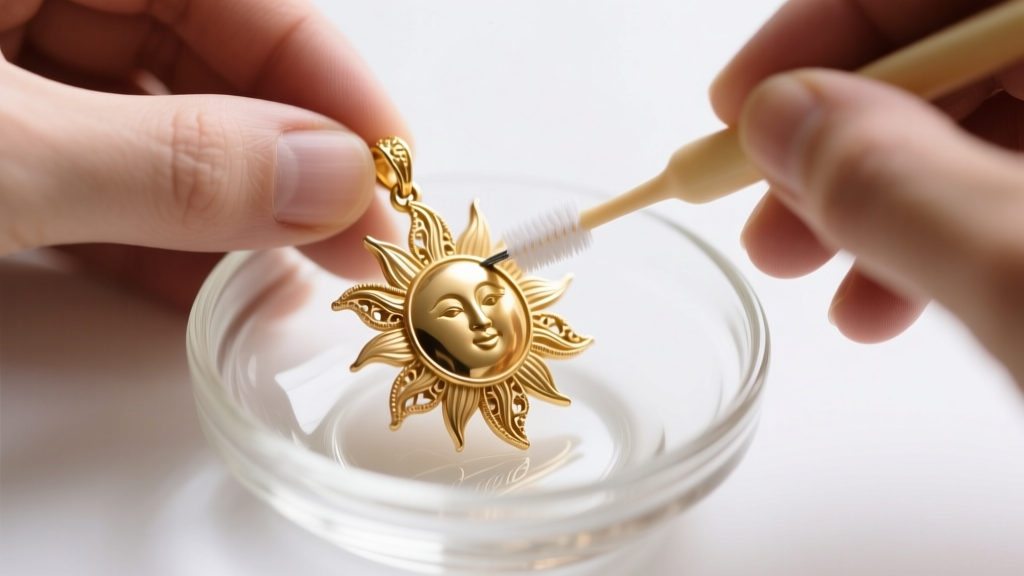
Many vintage and artisan gold sun pendant necklaces feature intricate matte finishes, sandblasted textures, or hand-engraved facial details in the center of the sunburst. A catastrophic mistake owners make is taking these pieces to a mall kiosk for a 'quick polish' or dropping them into an at-home ultrasonic cleaner.
Why Ultrasonics and Polishing Rouges Destroy Sunbursts
Ultrasonic cleaners operate using high-frequency sound waves (typically 40,000 Hz) to create microscopic cavitation bubbles in a liquid solvent. While excellent for diamond solitaires, the Gemological Institute of America (GIA) warns against using ultrasonics on jewelry with fracture-filled stones, porous cabochons, or delicate matte textures. The violent microscopic implosions can literally blast away the delicate sandblasted matte finish on a sun pendant's rays, leaving them shiny and uneven.
Similarly, a jeweler's polishing wheel loaded with red rouge (iron oxide) will aggressively round off the sharp, defined edges of hand-engraved sun rays. Over just two or three professional polishes, a highly detailed sun face can become a smooth, featureless blob of gold.
The Correct Cleaning Protocol for Textured Gold
To clean a textured gold sun pendant necklace without erasing its history, follow this strict protocol:
- The Solvent: Mix lukewarm distilled water with two drops of mild, phosphate-free dish soap (like Dawn). Avoid ammonia-based cleaners, which can cause stress-corrosion cracking in lower-karat gold alloys.
- The Agitation: Submerge the pendant for exactly three minutes to loosen sebum and cosmetic buildup. Use a brand-new, extra-soft baby toothbrush to gently sweep along the grain of the sun rays, never in aggressive circles.
- The Drying: Never rub a matte-finished sun pendant with a towel. Use a blast of compressed air (held at least 6 inches away) or a hair dryer on the 'cool' setting to evaporate the water from the deep crevices without leaving lint behind.
Conclusion: Preserving the Light
A gold sun pendant necklace is more than just an accessory; it is a piece of wearable art that requires specific, informed care. By understanding the metallurgical realities of gold alloys, the mechanical hazards of chain friction, and the structural limits of pendant bails, you can transition from frustrated owner to expert curator. Swap out snag-prone rope chains for flat cables, upgrade split jump rings to soldered loops, and banish ultrasonic cleaners from your jewelry care routine. With these targeted troubleshooting techniques, your sunburst pendant will continue to shine with its original, intricate brilliance for generations to come.


