Vertical Gold Bar Necklace: Technical Guide to Sizing & Purity
Master the mechanics of the vertical gold bar necklace. Explore gold purity, dimensional tolerances, chain tensile strength, and bail engineering.

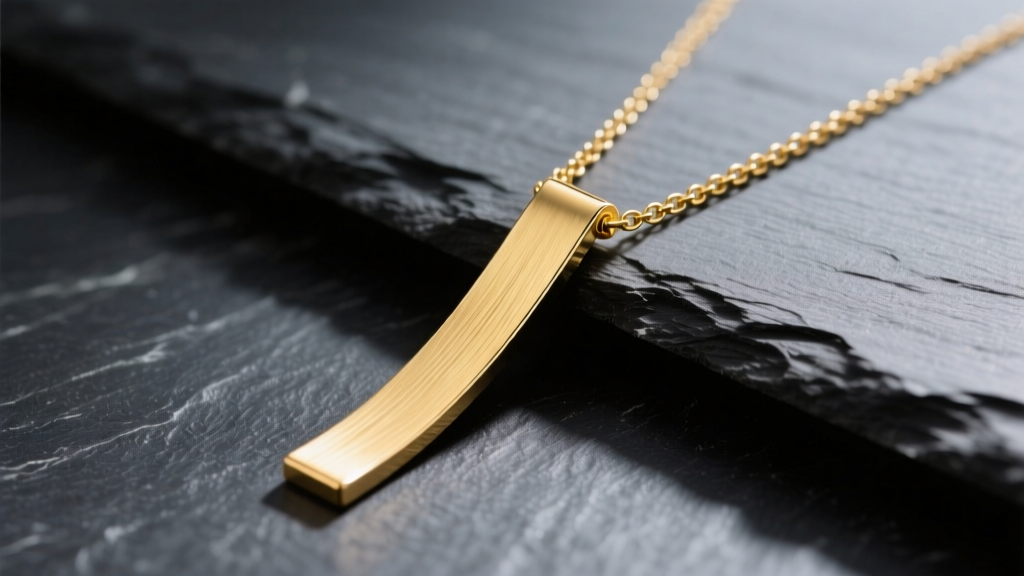
The Engineering of a Vertical Silhouette
The vertical gold bar necklace is a masterclass in geometric minimalism, but beneath its sleek exterior lies a complex study in physics and metallurgy. Unlike horizontal pendants that rest flat against the sternum, a vertical bar acts as a plumb line. It relies on gravity to maintain its orientation, meaning the center of mass must be perfectly calibrated. If the bail (the loop connecting the pendant to the chain) is not precisely centered, or if the bar's weight distribution is uneven, the pendant will continuously flip or tilt. For jewelry designers and informed collectors, understanding the technical specifications of a vertical gold bar necklace is essential to ensuring both structural longevity and optimal drape.
Gold Purity vs. Structural Integrity
When selecting a vertical gold bar necklace, the karatage of the gold directly dictates the pendant's structural integrity. A vertical bar is essentially a lever; if it catches on a garment or is subjected to lateral pressure, softer metals will permanently warp. According to metallurgical data published by the Gemological Institute of America (GIA), the alloy mix (typically copper, silver, and zinc) determines the Vickers Hardness (HV) of the final piece.
| Karat | Gold Purity | Vickers Hardness (HV) | Bend Risk (50mm Bar) | Best Use Case |
|---|---|---|---|---|
| 10k | 41.7% | 160-180 | Very Low | Ultra-thin bars, daily wear |
| 14k | 58.5% | 140-160 | Low (Optimal) | Standard lengths, high durability |
| 18k | 75.0% | 120-130 | Moderate | Shorter bars (<35mm), luxury |
| 22k | 91.6% | 90-110 | High | Not recommended for vertical bars |
For a vertical bar exceeding 40mm in length, 14k gold is the engineering sweet spot. It provides the rich color of gold while maintaining enough tensile strength to resist bending. An 18k gold bar of the same dimensions will require a significantly thicker cross-section to achieve the same rigidity.
Dimensional Tolerances and Weight Distribution
The aesthetics of a vertical gold bar necklace are governed by strict dimensional tolerances. The industry standard width-to-length ratio often hovers around 1:10 (e.g., a 3mm wide bar is typically 30mm long, while a 5mm wide bar is 50mm long). However, the most critical dimension is the thickness.
The 1.2mm Minimum Rule
Many mass-market jewelers produce 'paper-thin' bars at 0.5mm or 0.8mm thickness to reduce gram weight and lower costs. A vertical bar thinner than 1.0mm is highly susceptible to torsion warping. For any bar over 35mm in length, a minimum thickness of 1.2mm is required to ensure the pendant survives daily wear without developing a permanent curve. A properly milled 4mm x 40mm x 1.5mm 14k gold bar will weigh approximately 3.8 grams, providing a substantial, premium feel without overloading delicate chains.
Bail and Soldering Mechanics
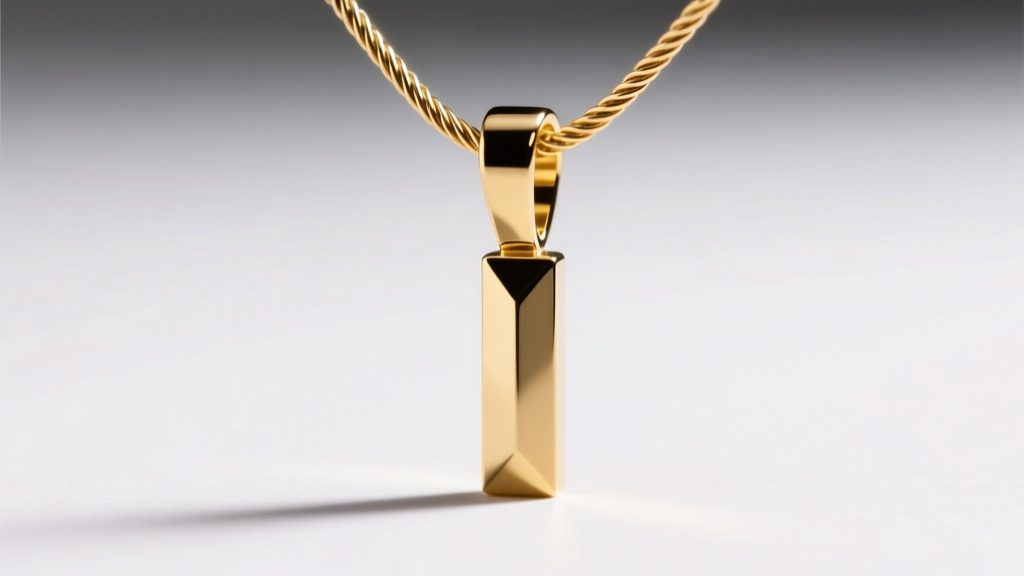
How the chain attaches to the vertical bar fundamentally alters the pendant's visual continuity and structural weak points. There are two primary bail engineering methods used in high-end vertical bars:
- Top-Drilled Bail: A hole is drilled directly through the top 2mm of the bar. While cost-effective, this removes structural material from the highest stress point and disrupts the continuous front silhouette.
- Laser-Welded Hidden Bail: A small, semi-circular loop is laser-welded to the top-center rear of the bar. Laser welding concentrates intense heat in a microscopic area, preventing thermal damage to the surrounding gold while creating a bond with tensile strength matching the base metal. This preserves the unbroken front geometry and distributes pendulum stress across a wider surface area on the back.
Chain Pairing: Tensile Strength and Drape
A vertical gold bar necklace requires a chain that complements its linear geometry while supporting its specific gram weight. The pendulum effect of a vertical bar places repetitive micro-stress on the chain links directly adjacent to the bail. According to care and structural guidelines from Jewelers of America, matching chain tensile strength to pendant weight prevents premature stretching.
Recommended Chain Profiles
- Box Chains (1.0mm - 1.5mm): The geometric, square links of a box chain perfectly mirror the clean lines of a vertical bar. A 1.2mm box chain offers excellent structural rigidity and resists kinking.
- Cable Chains (1.0mm - 1.2mm): A classic choice, but ensure the links are soldered shut. Unsoldered cable chains will stretch and ovalize under the continuous downward pull of a heavy vertical bar.
- Rope Chains (1.5mm+): Best reserved for heavier, wider bars (over 5 grams). The twisted links provide high tensile strength but can visually compete with minimalist bar designs.
Expert Tip: Always pair the pendant with a chain featuring a lobster clasp rather than a spring ring. The added weight of a vertical bar can easily pull a lightweight spring ring open if caught on a collar.
Pricing Tiers and Manufacturing Methods

The manufacturing method of the vertical gold bar necklace heavily influences its edge crispness, surface porosity, and final price point.
Die-Stamping vs. Investment Casting
Die-stamped bars are cut from sheets of rolled gold using high-pressure hydraulic presses. This process compresses the gold molecules, resulting in a denser, harder metal with razor-sharp, perfectly straight edges. Stamped bars are typically less expensive and highly durable. Conversely, investment casting involves pouring molten gold into a plaster mold. Cast bars often have slightly softer, rounded edges and may contain microscopic porosity if not properly pressurized during cooling. While casting allows for intricate textures (like hammered or bark finishes), a high-polish, mirror-finish vertical bar should always be die-stamped for optimal light reflection.
When evaluating a high-polish vertical gold bar necklace, inspect the lateral edges under a loupe. Stamped bars will exhibit a sharp, 90-degree edge transition, whereas cast bars will show a slight convex rounding where the metal flowed into the mold.
Care and Maintenance of Linear Pendants
Maintaining the pristine geometry of a vertical gold bar necklace requires specific care protocols. Because the front surface is a flat, continuous plane, it acts as a canvas for micro-scratches. Never use a rotary polishing wheel with a heavy rouge compound, as this will round the sharp corners and create a 'wavy' surface reflection. Instead, use a soft microfiber cloth and a mild, non-abrasive jewelry dip for routine cleaning. For deep scratches, a jeweler must use directional sanding papers (moving strictly from 400 to 1200 grit) in a single linear direction parallel to the bar's length to preserve its architectural integrity.


