Vintage Carnelian Necklace Buying Guide: What to Look For
Discover how to authenticate, evaluate, and buy a vintage carnelian necklace. Learn era-specific traits, dye detection, and fair 2026 pricing.

The Enduring Appeal of Antique Carnelian
The market for estate and antique jewelry has shifted dramatically over the last decade, with collectors moving away from mass-produced contemporary pieces toward historically significant artifacts. Among the most sought-after treasures is the vintage carnelian necklace. Prized for its rich, fiery orange-red hues and deep historical roots dating back to ancient Egypt and Rome, carnelian experienced massive revivals during the Victorian, Art Deco, and Mid-Century eras. However, navigating the secondary market requires a trained eye. Because carnelian is a variety of chalcedony colored by iron oxide impurities, it is frequently confused with dyed agate or synthetic glass. This comprehensive buying guide will equip you with the gemological knowledge, structural inspection techniques, and market pricing data necessary to make an informed acquisition in 2026.
Gemological Profile: Natural vs. Treated Stones
Before evaluating the metalwork, you must authenticate the stone. According to the Gemological Institute of America (GIA), natural carnelian ranges from a pale, translucent orange to a deep, opaque brownish-red. Its Mohs hardness sits between 6.5 and 7, making it durable but susceptible to chipping if subjected to hard knocks.
The Historical Heat Treatment Factor
When buying vintage, it is crucial to understand that heat treatment is not a modern deception. In the 18th and 19th centuries, lapidaries routinely baked carnelian to enhance its color. Historical texts document stones being baked in bread dough or buried in hot ashes to oxidize the iron impurities, shifting the color from muddy brown to vibrant red. This traditional heat treatment is universally accepted in the gemological community and does not diminish the value of an antique piece. However, modern chemical dyeing is a red flag.
Spotting Dyed Agate: The Acetone and Loupe Tests
Approximately 70% of the 'carnelian' bead necklaces sold on online auction sites are actually gray agate dyed with iron salts or synthetic red dyes. To protect your investment, employ these two diagnostic methods:
- The Loupe Test: Using a 10x jeweler's loupe, examine the surface of the beads or cabochons. Natural carnelian exhibits a cloudy, uneven color distribution with subtle, natural banding. Dyed stones will show 'spiderwebbing'—dark concentrations of dye pooled in microscopic surface fractures and pits.
- The Acetone Test: Dip a cotton swab in pure acetone (nail polish remover) and rub it vigorously on an inconspicuous area of the stone, preferably near the drill hole. If the swab turns red or orange, the stone is chemically dyed and its value is negligible.
Decoding the Eras: A Buyer's Timeline
The design, metal pairing, and cut of the stones will tell you exactly when a vintage carnelian necklace was crafted. As noted by the historians at Lang Antiques University, understanding these stylistic hallmarks is vital for accurate dating and valuation.
| Era | Years | Typical Metal Pairings | Stone Cut & Design Hallmarks |
|---|---|---|---|
| Victorian | 1837–1901 | 9k to 15k Rose/Yellow Gold, Silver | Smooth cabochons, intaglio carvings, repoussé metalwork, mourning jewelry pairings with black enamel. |
| Art Deco | 1920–1939 | Platinum, White Gold, 14k Yellow Gold | Geometric step-cuts, calibré-cut stones, high-contrast pairings with onyx or diamonds, filigree settings. |
| Retro / Mid-Century | 1940–1960 | 14k Yellow Gold, Gold-Filled, Vermeil | Large faceted stones, chunky link chains, graduated bead necklaces, bold sculptural clasps. |
Structural Integrity: Inspecting Settings and Hardware
A beautiful stone is worthless if the antique setting is compromised. When evaluating a vintage carnelian necklace, the hardware provides both structural security and historical provenance.
Bezel vs. Prong Settings
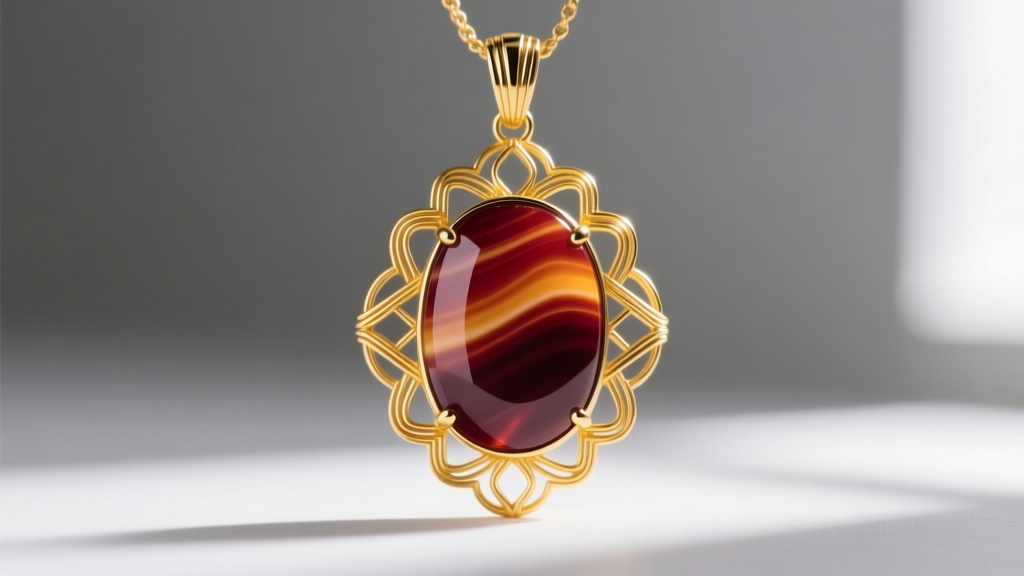
For antique cabochon carnelians, a bezel setting (where a rim of metal wraps entirely around the stone's girdle) is vastly superior to prong settings. Carnelian is brittle and lacks cleavage, meaning a sharp impact on an exposed edge can cause a catastrophic fracture. If you are looking at a Victorian or Art Deco piece, ensure the bezel wire is flush against the stone with no lifting or gaps where moisture could become trapped.
Dating by the Clasp
The clasp is the most reliable way to date a vintage necklace chain. Ensure the clasp matches the era of the pendant:
- C-Clasp: A simple 'C' shaped hook without a locking mechanism. Common on Victorian pieces (pre-1900). If you see a C-clasp on a piece claiming to be from the 1950s, it is likely a modern reproduction or a replacement.
- Trombone Clasp: Features a push-pull tube locking mechanism. Predominantly used in European jewelry from the 1890s through the 1940s.
- Push-in Box Clasp: A spring-loaded tab that clicks into a boxed housing. The standard for Mid-Century and Retro bead necklaces. Check the internal spring for rust or metal fatigue, a common failure point in 1950s gold-filled chains.
2026 Market Pricing: What You Should Actually Pay
The pricing for vintage carnelian necklaces varies wildly based on provenance, metal purity, and stone quality. Use this tiered framework to evaluate fair market value in the current economic landscape:
Tier 1: The Accessible Antique ($80 – $250)
This tier includes late Victorian silver or gold-filled chains featuring small, dyed agate beads or simple, unadorned carnelian drop pendants. Pieces in this range often show moderate wear, such as thinning gold wash on vermeil components or replaced modern clasps. They are excellent for everyday wear but hold little investment value.
Tier 2: The Collector's Sweet Spot ($350 – $900)
Here you will find authentic Art Deco 14k gold filigree pendants with natural, untreated calibré-cut carnelians, or substantial Mid-Century 14k solid gold graduated bead necklaces. The metalwork will be intricate, the clasps original, and the stones will exhibit the highly desirable 'cloudy' internal color banding indicative of natural, historically heat-treated material.
Tier 3: Museum & High-Jewelry Grade ($1,500 – $5,000+)
Reserved for signed pieces (e.g., Cartier, Boucheron, or Tiffany & Co.) or exceptional Victorian Etruscan Revival gold necklaces featuring masterfully carved carnelian intaglios. These pieces are documented, feature pristine original hardware, and are highly sought after by serious estate jewelry investors.
Care and Preservation of Vintage Carnelian
Once you have acquired your vintage carnelian necklace, proper preservation is non-negotiable. Never use ultrasonic cleaners or steamers on antique jewelry. The high-frequency vibrations can shatter carnelian, especially if the stone has internal micro-fractures common in 19th-century lapidary work. Furthermore, steam can strip the natural oils from older stones and loosen the adhesives or shellac sometimes used in antique bezel settings. Instead, clean your necklace using a soft, lint-free microfiber cloth and a mild solution of distilled water and pH-neutral dish soap, gently drying it immediately to prevent water spots on the metal patina.
'When buying vintage carnelian, you are not just purchasing a gemstone; you are acquiring a piece of material history. The slight asymmetry of a hand-cut Victorian cabochon or the soft wear on an Edwardian gold chain are not flaws—they are the fingerprints of the artisans who came before us.' — Archival Jewelry Appraisal Standards, 2025 Edition
By prioritizing natural stones, verifying era-appropriate hardware, and understanding the nuances of historical treatments, you can confidently navigate the market and secure a vintage carnelian necklace that will endure for generations to come.