Vintage Pearl Necklace Authentication & Grading Guide
Master vintage pearl necklace authentication. Learn nacre thickness grading, silk knotting techniques, and clasp identification to value estate jewelry.

The Anatomy of a True Vintage Pearl Necklace
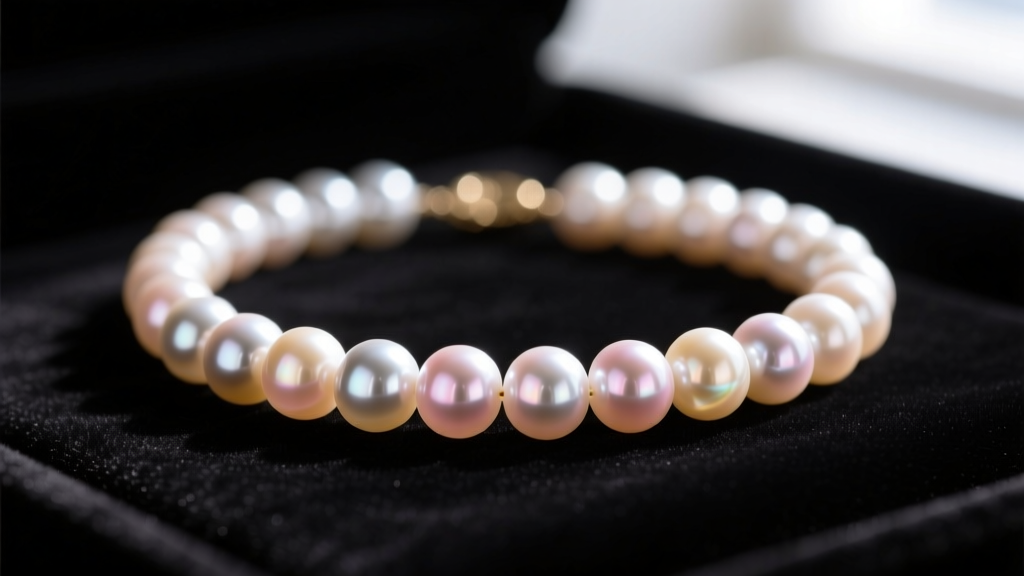
In the estate jewelry market, the term 'vintage' strictly applies to pieces that are at least 20 to 100 years old. When evaluating a vintage pearl necklace, gemologists typically focus on strands cultivated between the 1930s and the 1980s. This era represents the golden age of Japanese Akoya pearl farming, where cultivation techniques prioritized nacre thickness over rapid yield. Unlike modern mass-produced pearls, which are often harvested after 6 to 8 months, mid-century vintage pearls were left in the water for 18 to 24 months. This extended gestation period resulted in a significantly thicker layer of nacre—the crystalline substance composed of aragonite platelets and conchiolin that gives pearls their unique luster and orient.
Authenticating a vintage piece requires looking past the surface. According to the Gemological Institute of America (GIA), the structural integrity of a cultured pearl is entirely dependent on the nucleus and the subsequent nacre deposition. In vintage strands, you will frequently observe a deep, mirror-like luster with subtle rose or silver overtones, a direct result of the dense, overlapping aragonite layers that modern, quickly harvested pearls simply cannot replicate.
Nacre Thickness & Luster: The Technical Grading Matrix
Grading a vintage pearl necklace requires a departure from modern retail terminology. Estate appraisers rely on microradiography and X-ray fluorescence (XRF) to measure nacre thickness without damaging the strand. For high-end vintage Akoya strands, the 'Hanadama' certification (originating from Japanese pearl cooperatives) remains the benchmark for顶级 quality, though vintage pieces rarely come with modern lab reports. Instead, experts grade based on visual and loupe-assisted metrics.
| Grade Classification | Nacre Thickness | Luster Quality | Blemish Tolerance | Typical Overtone |
|---|---|---|---|---|
| Vintage Hanadama (Top 1%) | > 0.60 mm | Excellent (Mirror-like, sharp reflections) | Flawless to very lightly blemished | Strong Rose or Silver |
| Vintage AAA (Gem) | 0.45 - 0.60 mm | Very High (Bright, distinct reflections) | Lightly blemished (under 10%) | Moderate Rose/Ivory |
| Vintage AA (Commercial Fine) | 0.30 - 0.45 mm | Medium (Soft, slightly hazy reflections) | Moderately blemished (10-30%) | Faint or None |
| Vintage A (Chalky/Worn) | < 0.30 mm | Poor (Dull, chalky appearance) | Heavily blemished or peeling | None (Yellowed) |
When examining luster, hold the strand under a single, harsh light source. A true vintage AAA pearl will reflect the light source with sharp, defined edges. If the reflection appears blurry or 'milky,' the nacre is either too thin or has suffered from severe dehydration over the decades.
Forensic Stringing & Knotting Identification
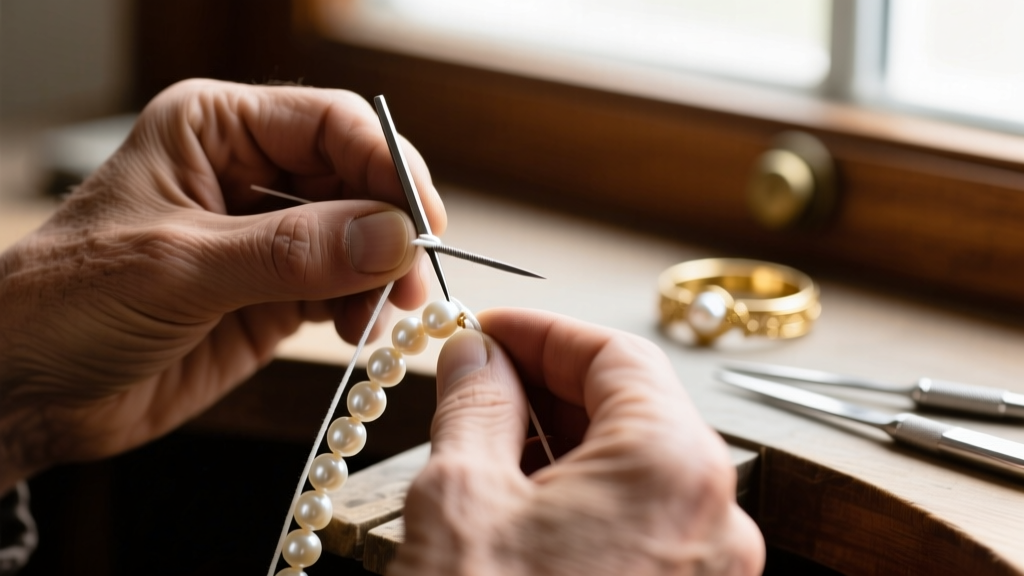
The stringing material and knotting technique are critical forensic indicators of a necklace's age and authenticity. Original mid-century vintage pearl necklaces were almost exclusively strung on pure silk thread, utilizing a technique known as French knotting or Japanese hand-knotting.
Silk Thread Sizing and Degradation
Griffin silk thread, the industry standard, ranges from Size 0 (0.20mm) to Size 8 (0.80mm). A standard 6mm to 7mm vintage Akoya strand was typically knotted on Size 2 or Size 3 silk. Over 50+ years, silk degrades, stretches, and absorbs oils from the wearer's skin. If you examine a purported 1950s vintage strand and the silk is bright white, stiff, and lacks any patina, the necklace has been recently re-strung. While re-stringing is necessary for structural safety, it diminishes the 'original condition' premium in strict collector markets.
The French Wire (Gimbal) Test
Examine the final three pearls leading up to the clasp. Authentic vintage pieces utilize a 'French wire' or gimbal—a tiny, tightly coiled tube of precious metal (usually 14k or 18k gold) that the silk thread passes through before looping into the clasp. This coil protects the silk from fraying against the sharp metal edges of the clasp mechanism. If the wire is missing, replaced with base metal, or shows signs of modern crimping beads (which were not widely used in fine pearl stringing until the late 1990s), the piece has undergone modern, non-traditional restoration.
Clasp Mechanics & Hallmark Verification
The clasp is the most frequently replaced component on a vintage pearl necklace, making original clasp identification a vital authentication step. Mid-century clasps were engineered with specific mechanical safeguards.
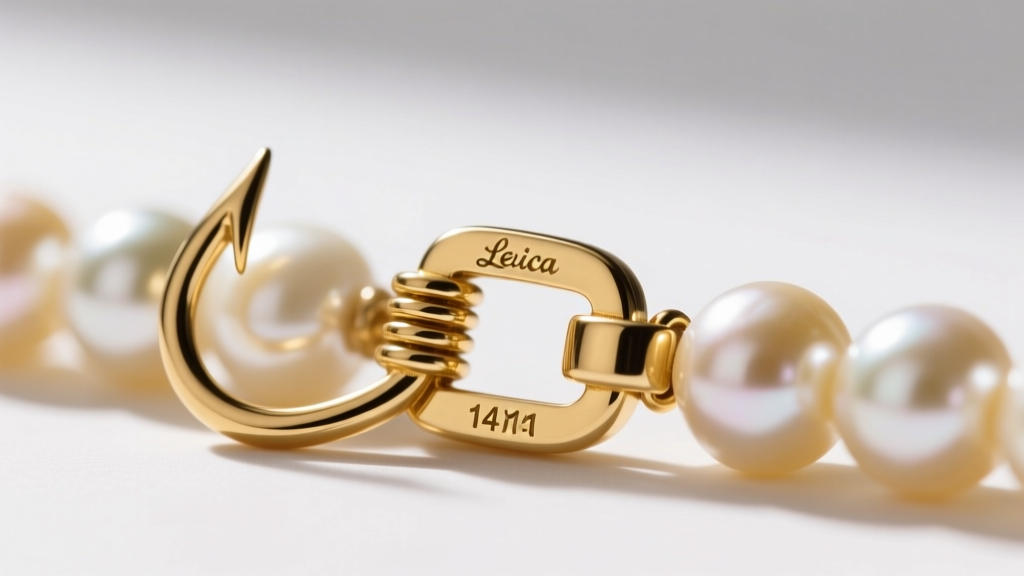
- The Fishhook Clasp: The most common vintage clasp. It features a curved hook that slides into a barrel or box and catches on an internal metal ridge. Original 1950s-1970s fishhook clasps often feature a 'figure-8' safety catch—a secondary wire loop that snaps over the hook to prevent catastrophic failure if the primary catch slips.
- The Barrel Clasp: Screws together via a fine threaded mechanism. While secure, vintage barrel clasps are notorious for cross-threading. Look for wear marks on the threads as an indicator of age.
- Hallmarks: Use a 10x jeweler's loupe to inspect the tongue and catch. You should see '14K', '18K', or '750'. Additionally, look for maker's marks. The Mikimoto clamshell hallmark or the 'K. Mikimoto' stamp is highly sought after, but be aware that many vintage strands feature unmarked, high-karat gold clasps made by specialized Japanese finding manufacturers.
Identifying Fakes: Majorica and Essence d'Orient
The secondary market is flooded with 'Majorica' pearls and other imitation strands disguised as vintage estate jewelry. Majorica pearls, invented in the late 19th century, are glass beads coated with essence d'orient (a mixture of guanine crystals from fish scales and lacquer).
To differentiate a vintage cultured pearl from a vintage imitation, perform the tooth test. Gently rub the pearl against the biting edge of your front tooth. Real nacre, composed of microscopic aragonite platelets, will feel distinctly gritty or sandy. Imitation pearls coated in lacquer will feel perfectly smooth. Under a 10x loupe, real vintage nacre reveals overlapping, tile-like edges, whereas imitation pearls show a perfectly smooth, sometimes peeling, painted surface with no crystalline structure, as noted in GIA's pearl identification guidelines.
Valuation Framework: Pricing by Millimeter & Era
Valuing a vintage pearl necklace requires cross-referencing the millimeter size, the nacre grade, and the provenance. The estate market in 2026 places a heavy premium on strands exceeding 7.5mm, as large-nucleus Akoya cultivation was incredibly difficult and rare prior to the 1980s.
Expert Appraisal Note: Never value a vintage pearl strand based solely on modern retail equivalents. A modern 7mm Akoya strand with thin nacre may sell for $400, while a vintage 1960s 7mm strand with Hanadama-grade thick nacre and original gold fittings commands a significant collector premium.
- 5.0mm - 6.0mm (Choker/Opera lengths): $300 - $600. Often considered 'starter' vintage pieces, highly dependent on luster quality.
- 6.5mm - 7.5mm (Standard Princess): $800 - $1,800. The sweet spot for mid-century Mikimoto and high-grade unbranded Japanese exports.
- 8.0mm - 9.5mm (Rare Large Akoya): $2,500 - $6,000+. Exceptionally rare for the vintage era; requires strict X-ray verification to ensure the bead nucleus isn't excessively large with paper-thin nacre.
Maintenance & Restoration of Estate Pearls
Owning a vintage pearl necklace comes with strict maintenance protocols. Pearls are organic gems with a Mohs hardness of just 2.5 to 3.0. They are highly susceptible to acids, perfumes, and dehydration.
If you acquire an unworn estate piece that has been locked in a safe for decades, the nacre may appear dull and chalky. This is severe dehydration. Never attempt to clean vintage pearls in an ultrasonic cleaner; the high-frequency vibrations will shatter the aragonite layers and detach the nacre from the bead nucleus. Instead, gently wipe the strand with a soft, damp microfiber cloth and wear it against your skin. The natural humidity and mild oils from your skin will slowly rehydrate the conchiolin, restoring the pearl's natural orient over several weeks of regular wear. Finally, plan to have the strand professionally re-knotted on Japanese silk every 3 to 5 years, or immediately if you notice more than a millimeter of stretch between the knots.
For further historical context on pearl cultivation and estate identification, consult the Mikimoto Pearl Education archives, which provide exhaustive documentation on the evolution of Japanese pearl farming techniques throughout the 20th century.


