Material Guide for Wearing a Ring on a Necklace Safely
Discover the best chain materials, gauges, and weaves for wearing a ring on a necklace. Prevent breakage and friction wear with our expert guide.

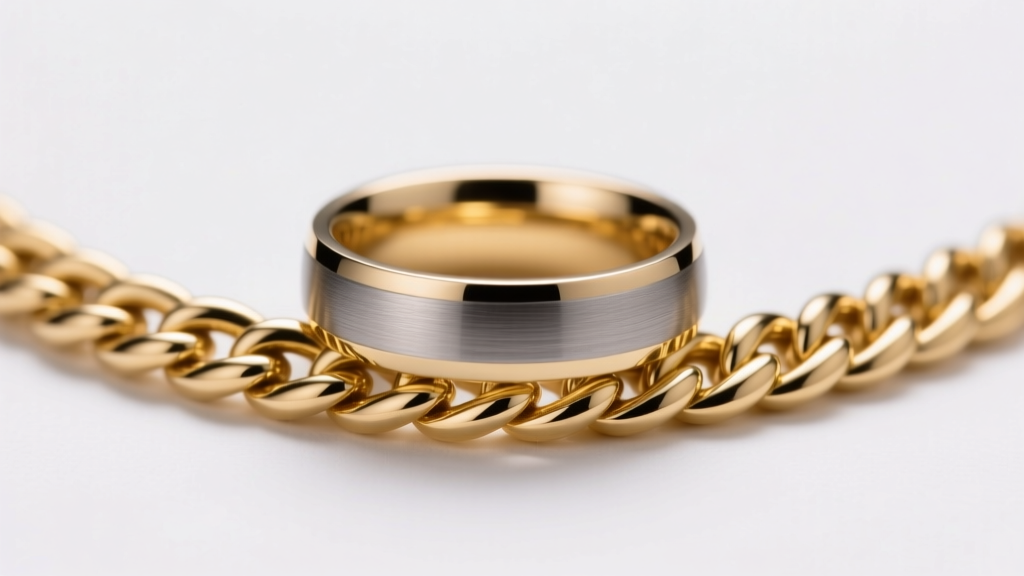
The Physics of Pendants: Why Ring Weight Matters
Threading a wedding band, signet ring, or heirloom piece onto a chain is a deeply sentimental practice, but it fundamentally alters the mechanical stress profile of the necklace. Unlike a stamped metal pendant or a gemstone that rests flat against the sternum, a ring is a dense, three-dimensional torus. It shifts, spins, and swings. When you are wearing a ring on a necklace, you must account for dynamic loading. A 10-gram platinum ring does not merely exert 10 grams of static downward force. The kinetic energy generated by walking, bending, or taking off a shirt can multiply that force by 2x to 3x, placing sudden, severe tension on the chain links and the clasp mechanism.
Because of this dynamic stress, the margin for error in material selection and chain gauge is incredibly narrow. A chain that comfortably holds a 5-gram diamond solitaire pendant may catastrophically fail when subjected to the swinging momentum of a 12-gram tungsten wedding band. To prevent the heartbreak of a lost ring, we must examine the metallurgical and structural realities of pairing rings with chains.
Material Hardness and Friction: The Mohs Scale Showdown
The most common failure mode when wearing a ring on a necklace is not the chain snapping in half, but rather the chain being slowly sawed apart by the ring itself. This is dictated by the Mohs scale of mineral hardness and the Vickers hardness test for metals. When two metals rub together continuously, the harder metal will abrade the softer one.
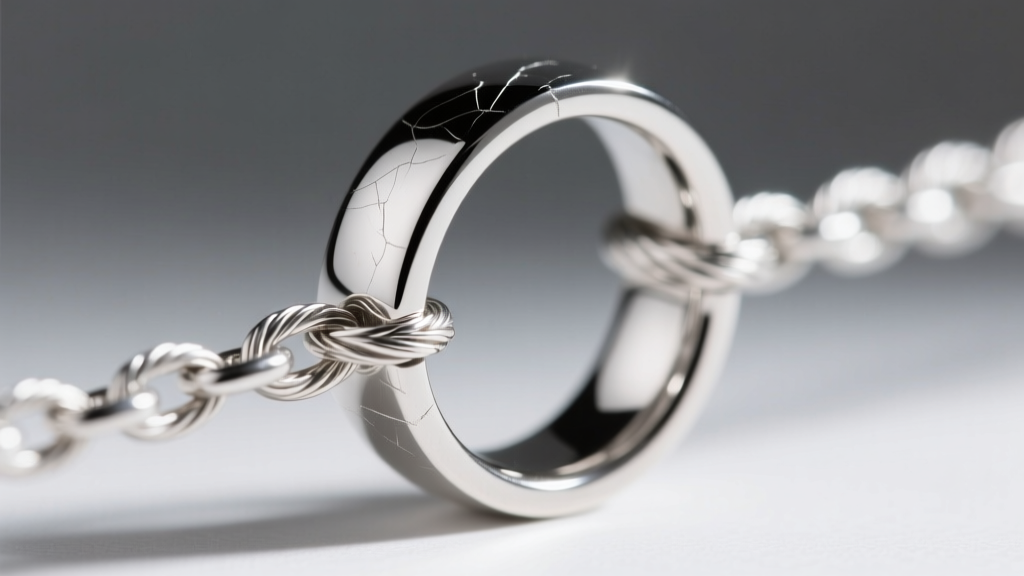
Consider a scenario where a Tungsten Carbide ring (Mohs 9, Vickers ~2600) is worn on a 14k Yellow Gold chain (Mohs 3.5, Vickers ~140). The tungsten ring is exponentially harder than the gold. Over six to twelve months of daily wear, the interior edge of the ring will act like a file, grinding away the gold links at the point of contact until they become paper-thin and snap. According to metallurgical data referenced by the Gemological Institute of America (GIA), platinum and high-karat golds are particularly susceptible to friction wear when paired with modern alternative metals like titanium or cobalt chrome.
The Hardness Hierarchy
- Tungsten Carbide & Ceramic: Mohs 9. Will destroy almost any precious metal chain over time.
- Stainless Steel & Titanium: Mohs 6-7. Will cause severe abrasion to gold and silver chains.
- Platinum: Mohs 4.5. Dense and heavy, but softer than steel. Will wear down thin silver chains but pairs well with steel or thick platinum chains.
- 14k & 18k Gold: Mohs 3.5-4. Relatively soft. Requires a protective barrier when paired with harder rings.
- Sterling Silver: Mohs 2.5-3. Very soft and highly prone to friction grooves and stretching.
Expert Solution: If you must pair a hard ring with a soft precious metal chain, use a clear silicone or Teflon bail sleeve. This acts as a sacrificial buffer, absorbing the friction and protecting the metal links.
Chain Weave vs. Tensile Strength: What Holds Up?
Not all chain weaves are created equal. The structural integrity of a necklace depends on how the links distribute lateral and vertical tension. When wearing a ring on a necklace, the chain must resist both the downward pull of the ring and the lateral twisting as the ring spins. The Halstead Bead Jewelry Chain Guide notes that link geometry is just as critical as the metal alloy itself.
| Chain Weave | Tensile Strength | Flexibility | Verdict for Heavy Rings |
|---|---|---|---|
| Wheat (Spiga) | Excellent | High | Best overall. Figure-eight weave distributes tension laterally. |
| Box | Poor to Fair | Low | Avoid. Square links kink easily and snap under heavy dynamic loads. |
| Rope | Good | Medium | Strong, but if one link fails, the entire chain unravels rapidly. |
| Cable | Fair | High | Acceptable only in very thick gauges (2.0mm+). Thin cables will stretch. |
| Figaro | Good | Medium | The long links are weak points under heavy ring pendulums. |
For heavy rings (over 8 grams), the Wheat chain is the undisputed champion. Its interlocking, multi-directional links prevent the chain from kinking and provide a high tensile strength-to-weight ratio. Box chains, while popular for their modern aesthetic, have sharp interior corners that act as stress concentrators, making them highly prone to snapping when subjected to the swinging weight of a ring.
Galvanic Corrosion: Mixing Metals Safely
Beyond physical friction, there is a chemical risk when wearing a ring on a necklace: galvanic corrosion. This electrochemical process occurs when two dissimilar metals are in direct physical contact in the presence of an electrolyte. Human sweat, which is rich in sodium chloride and lactic acid, serves as a highly effective electrolyte.
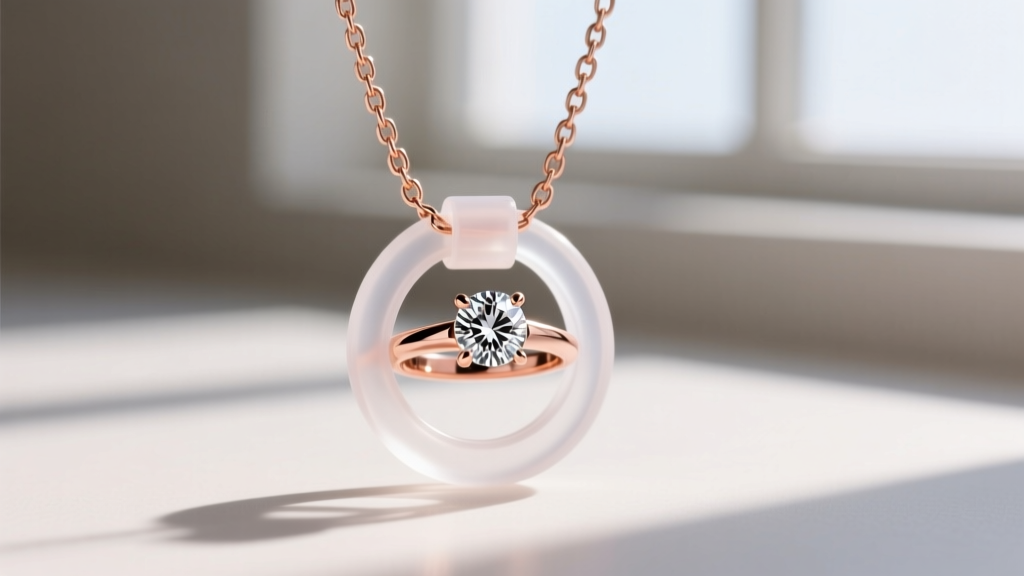
If you wear a copper-heavy alloy ring (like 14k Rose Gold) on a Sterling Silver chain, the sweat on your chest can create a microscopic galvanic cell. The less noble metal will act as an anode and corrode at an accelerated rate. While this is less of an issue with highly noble metals like Platinum or 24k Gold, it is a significant concern when mixing base metals, stainless steel, and lower-karat golds or silver. To prevent galvanic degradation, keep the chain and ring clean, wipe them down after sweating, or use a non-conductive barrier like a leather cord or silicone bail.
Gauge Sizing: Matching Chain Thickness to Ring Weight
Chain gauge (thickness) is the most critical physical specification when wearing a ring on a necklace. A chain that is too thin will stretch, deform, and eventually suffer from clasp failure or link separation. Here is a precise framework for matching chain gauge to ring weight:
- Lightweight Rings (2g - 5g): A 1.0mm to 1.5mm chain is sufficient. Standard cable or box chains in 14k gold or sterling silver will hold up well.
- Medium Rings (6g - 12g): Require a 1.8mm to 2.5mm chain. Wheat or rope chains are highly recommended. The clasp must be a medium-to-large lobster claw.
- Heavy Rings (13g - 20g+): Demand a 2.5mm to 4.0mm chain. Platinum or stainless steel wheat chains are ideal. You must use a locking clasp or a screw-lock barrel clasp to prevent accidental unhooking.
The Jump Ring Bottleneck
Bench jewelers universally agree that the weakest point of any necklace is the jump ring—the small circular wire that connects the chain to the clasp. When a heavy ring swings on a necklace, the jump ring is subjected to immense prying forces. If the jump ring is not soldered shut, the gap will slowly pull open, and the chain will detach. Always ensure that the jump rings on a necklace intended for a heavy ring are laser-welded or soldered completely closed.
Pro-Tip from the Bench: Never use a standard spring-ring clasp for a ring pendant. The internal steel spring will fatigue rapidly under dynamic loading, and the tiny lever is easily snagged on clothing. Upgrade to a solid-cast lobster clasp with a reinforced soldered loop.
Expert Verdict: The Best Combinations
Successfully wearing a ring on a necklace requires respecting the laws of physics and metallurgy. If you are wearing a modern Tungsten or Titanium band, pair it with a thick (2.5mm+) Stainless Steel or Titanium Wheat chain, or use a leather cord to bypass metal-on-metal friction entirely. If you are wearing a sentimental Gold or Platinum heirloom ring, a 2.0mm 14k Gold Wheat chain with soldered jump rings and a heavy-duty lobster clasp will provide decades of secure, beautiful wear. By matching the Mohs hardness, selecting the correct weave, and respecting gauge requirements, you can keep your most cherished rings safe, secure, and close to your heart.


