Best Metals for a Womens Large Cross Necklace: A Material Guide
Discover the best metals for a womens large cross necklace. Compare weight, durability, and skin safety for 14k gold, titanium, silver, and steel.

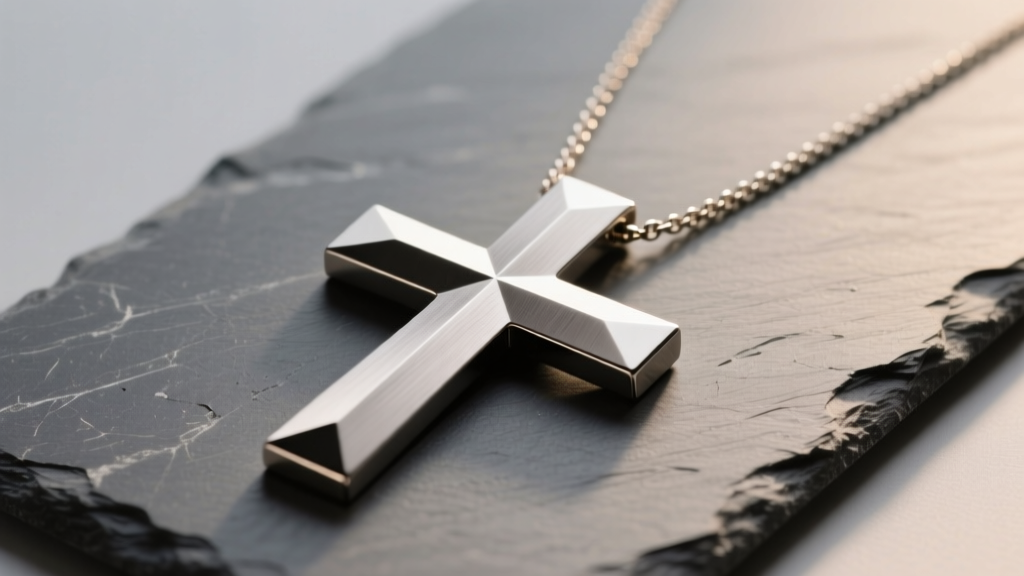
The Physics of Proportion: Why Material Matters for Oversized Pendants
When transitioning from a delicate, everyday pendant to a bold statement piece, the rules of jewelry design shift dramatically. A womens large cross necklace—typically defined as a pendant exceeding 2.5 inches in height and 1.5 inches in width—introduces unique physical and metallurgical challenges. As the dimensions of a pendant scale up, its volume (and consequently its weight) increases cubically. A standard 1-inch cross might weigh a negligible 2 grams, but a 3-inch solid cast cross can easily exceed 25 grams, fundamentally altering how the piece drapes, how it strains the chain, and how it interacts with the skin.
In 2026, modern jewelry manufacturing leverages advanced CAD (Computer-Aided Design) milling to create hollowed-out gallery backs on large pendants. This technique drastically reduces the mass of precious metals like gold without sacrificing the imposing frontal silhouette. However, the base material you choose still dictates the necklace's longevity, tarnish resistance, and biocompatibility. Below, we break down the exact metallurgical properties you must consider before investing in an oversized cross pendant.
Comprehensive Material Breakdown for Large Crosses
Solid Gold (14K vs. 18K): The Traditional Heavyweight
Gold remains the premier choice for fine jewelry, but purity matters immensely when dealing with large surface areas. According to the Gemological Institute of America (GIA), 24K gold is far too soft (Mohs hardness of 2.5) for a large pendant that is prone to bumping against tables and doorframes.
- 18K Gold (75% Pure): Offers a rich, deep yellow hue but is relatively soft. For a large cross, 18K will accumulate micro-scratches rapidly. It is best suited for collectors who plan to wear the piece infrequently or prefer a vintage patina over time.
- 14K Gold (58.5% Pure): The industry standard for durable, everyday statement pieces. Alloyed with copper, silver, and zinc, 14K gold achieves a Mohs hardness of roughly 3.5 to 4.0. It provides the necessary structural integrity to support the heavy bail and thick chain required for a large cross.
Sterling Silver (925): The High-Maintenance Classic
Sterling silver is an alloy containing 92.5% pure silver and 7.5% copper. While it offers a brilliant white luster and a much lower price point than gold, it is highly reactive. The copper content reacts with hydrogen sulfide in the air and the natural oils on your skin to form silver sulfide—the black tarnish that plagues silver jewelry.
Because a large cross necklace offers a massive surface area exposed to the elements, tarnish will accumulate much faster than on a small stud or ring. If you opt for a large sterling silver cross, ensure it has been heavily plated with rhodium. Rhodium is a platinum-group metal that provides an inert, highly reflective barrier that prevents tarnishing and increases surface hardness.
Surgical Stainless Steel (316L): The Budget Workhorse
Not all stainless steel is created equal. Cheap fashion jewelry often uses 304 stainless steel, which can rust and pit when exposed to sweat and humidity. For a large pendant resting against the sternum—an area prone to perspiration—you must seek out 316L surgical stainless steel. The "L" stands for low carbon, and this grade includes 2-3% molybdenum, which drastically increases resistance to chloride corrosion (salt from sweat).
While 316L is incredibly durable and virtually tarnish-proof, it does contain 8-10% nickel. According to the National Institutes of Health (NIH), nickel is the leading cause of allergic contact dermatitis. Although the nickel in 316L is tightly bound within the crystal lattice, individuals with severe hyper-allergies should avoid it, especially on large pieces that maintain prolonged, continuous skin contact.
Aerospace Titanium (Grade 5): The Modern Lightweight
If you want the visual impact of a massive 3-inch cross without the neck strain, Grade 5 Titanium (Ti-6Al-4V) is the ultimate 2026 solution. Alloyed with 6% aluminum and 4% vanadium, Grade 5 titanium is four times stronger than pure titanium and boasts a remarkably low density of 4.43 g/cm³. This means a large titanium cross will weigh less than half as much as an identically sized steel or silver piece. Furthermore, it is 100% hypoallergenic and completely impervious to tarnish, making it the undisputed champion for sensitive skin and active lifestyles.

Data Table: Density, Hardness, and Cost Scaling
Understanding the physical properties of these metals is crucial when scaling up pendant sizes. The table below illustrates how different materials behave when cast into a standard 3-inch by 2-inch cross pendant with a 4mm thickness.
| Material | Density (g/cm³) | Mohs Hardness | Est. Pendant Weight | Tarnish Resistance | Est. Price Range (USD) |
|---|---|---|---|---|---|
| 14K Yellow Gold | 12.9 | 3.5 - 4.0 | ~38 grams | Excellent | $1,800 - $3,500+ |
| 18K Yellow Gold | 15.6 | 2.5 - 3.0 | ~46 grams | Excellent | $2,500 - $5,000+ |
| Sterling Silver (925) | 10.4 | 2.5 - 3.0 | ~32 grams | Poor (unless Rhodium plated) | $150 - $400 |
| 316L Surgical Steel | 8.0 | 5.5 - 6.0 | ~26 grams | Superior | $40 - $120 |
| Grade 5 Titanium | 4.43 | 6.0 | ~14 grams | Absolute | $90 - $250 |
| Tungsten Carbide | 15.6 | 8.5 - 9.0 | ~55 grams | Absolute | $60 - $150 |
Note: Tungsten Carbide is included for comparison. While highly scratch-resistant, its extreme density makes a 3-inch pendant uncomfortably heavy, and its brittleness means it can shatter if dropped on a hard tile floor.
Chain Pairing and Bail Engineering
A massive pendant is only as secure as its connection point. The Federal Trade Commission (FTC) jewelry guides emphasize the importance of structural integrity in jewelry assembly, which is critical when a heavy pendant is swinging from your neck.
The Bail
The bail is the loop that connects the pendant to the chain. For a womens large cross necklace, a standard soldered loop bail is insufficient; the leverage exerted by a 3-inch pendulum can easily snap thin wire bails. You must look for a solid cast bail or a hidden CAD-milled bail that is integrated directly into the top arm of the cross. The inner diameter of the bail must be at least 4.5mm to accommodate a chain thick enough to support the weight.
The Chain
Do not pair a large, heavy cross with a delicate 1mm cable chain. The pendant will act as a guillotine, slowly sawing through the thin links. Opt for chains with a minimum gauge of 2.5mm to 3.5mm. The best structural choices include:
- Rope Chains: Excellent tensile strength and a twisted profile that catches the light, complementing the bold nature of the cross.
- Curb or Cuban Chains: Flat, interlocking links that lay flush against the skin and offer immense durability.
- Box Chains: Geometrically rigid and strong, though they can kink if bent backward sharply.
Always ensure the clasp is a heavy-duty lobster claw or a locking box clasp. Spring ring clasps are entirely inadequate for the weight of a large pendant and will inevitably fail.
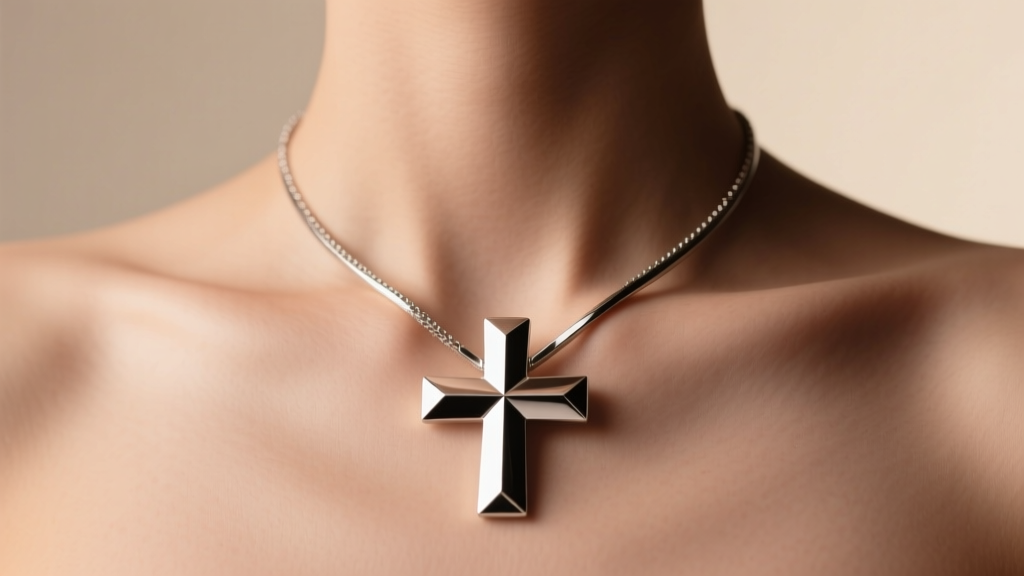
Skin Safety and the Sternum Environment
The area where a large cross rests—the sternum and upper chest—features a high concentration of sebaceous glands and is frequently exposed to sweat, perfumes, and body lotions. This creates a highly corrosive microenvironment.
When wearing a large surface area of metal against this zone, galvanic reactions can occur if the metal is porous or heavily alloyed with reactive base metals. This is why brass-based alloys disguised as "gold-plated" fashion jewelry will quickly turn the chest green and cause severe contact dermatitis. The large footprint of the cross means the allergic reaction will cover a wide, highly visible area of the chest.
If you have sensitive skin, your hierarchy of safe materials should be: Grade 5 Titanium > Platinum > 14K/18K Nickel-Free White Gold > 316L Steel. Avoid any large pendant that does not explicitly state its base metal composition, as mystery alloys are a gamble your skin will likely lose.
Final Verdict: Matching Metal to Lifestyle
Choosing the right material for your womens large cross necklace ultimately depends on how and where you intend to wear it:
- For Heirloom & Investment: Choose 14K Solid Gold. It offers the perfect balance of prestige, structural durability, and resistance to the elements. Utilize CAD hollow-back designs to keep the weight manageable.
- For Daily Wear & Active Lifestyles: Choose Grade 5 Titanium. It is featherlight, indestructible, hypoallergenic, and requires zero maintenance, allowing you to wear a massive statement piece to the gym or the beach without worry.
- For Budget-Conscious Fashion: Choose 316L Surgical Steel or Rhodium-Plated Sterling Silver. Both offer excellent visual weight and shine, provided you are not highly allergic to nickel (in the case of steel) and are willing to occasionally polish the silver.
By respecting the physics of oversized jewelry and selecting a metal engineered for the demands of a large surface area, you ensure your statement piece remains a comfortable, enduring staple in your wardrobe for decades to come.


