Technical Guide to Jewelry Cleaning Supplies for DIY Makers
Master the chemistry of jewelry cleaning supplies. Learn pH limits, surfactant types, and ultrasonic frequencies for safely cleaning DIY metals and gems.

The Surface Chemistry of Tarnish and Firescale
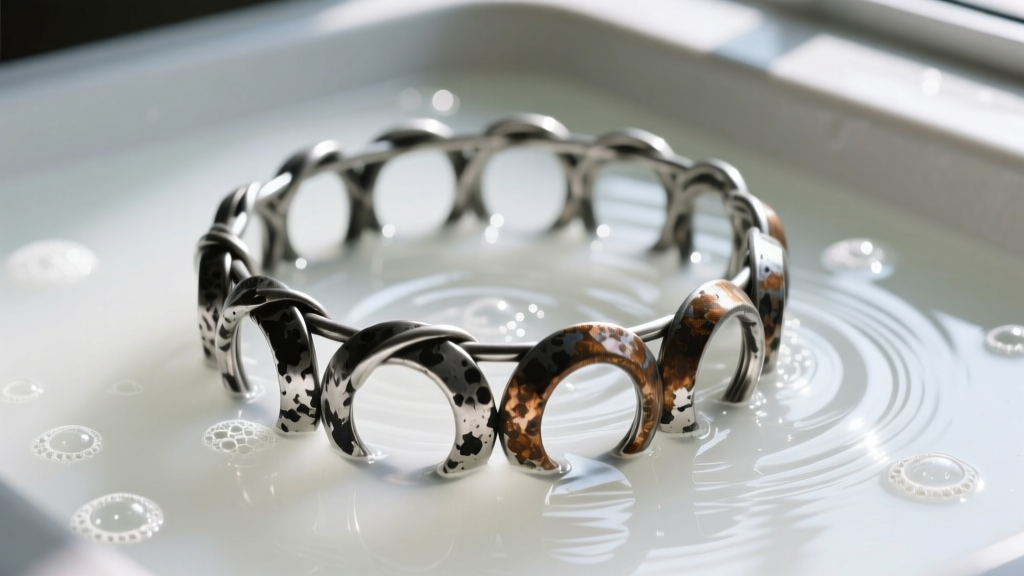
For DIY jewelry makers, understanding the metallurgical reality of tarnish and firescale is the first step in selecting the right jewelry cleaning supplies. Tarnish on sterling silver is primarily silver sulfide (Ag2S), which forms when silver reacts with sulfur compounds in the atmosphere. Firescale, on the other hand, is a deeper, more stubborn layer of copper oxide (CuO) and cuprous oxide (Cu2O) that forms during the soldering and annealing processes when copper in the alloy reacts with oxygen at high temperatures.
Many commercial jewelry cleaning supplies rely on harsh abrasives or highly acidic thiourea-based dips to strip these layers. While effective for solid cast pieces, these aggressive chemicals can destroy the delicate matte finishes, intentional liver-of-sulfur patinas, and micro-textures that wire wrappers and metal clay artists spend hours perfecting. According to the Santa Fe Symposium on Jewelry Manufacturing Technology, preserving the surface integrity of work-hardened metals requires a shift from abrasive stripping to chemical chelation and gentle surfactant action.
Deconstructing Commercial Jewelry Cleaning Supplies
The Role of Chelating Agents and Surfactants
Professional-grade jewelry cleaning supplies utilize a two-pronged chemical approach: chelators and surfactants. Chelating agents, such as EDTA (Ethylenediaminetetraacetic acid), work by binding to free metal ions and dissolved oxides, effectively pulling them away from the jewelry's surface and keeping them suspended in the solution. This prevents the redeposition of grime, a common issue with cheap, soap-based cleaners.
Surfactants (surface-active agents) lower the surface tension of the water, allowing the cleaning solution to penetrate microscopic crevices, bezel settings, and tight wire wraps. As of 2026, the industry standard has shifted heavily toward non-ionic surfactants like Decyl Glucoside. Unlike anionic surfactants (such as Sodium Lauryl Sulfate), non-ionic variants do not react with calcium or magnesium in hard water, ensuring that no insoluble soap scum is left behind on porous gemstones or matte metal finishes.
Ammoniated vs. Non-Ammoniated Formulations
A critical decision for any DIY maker is whether to use ammoniated or non-ammoniated jewelry cleaning supplies. Ammonia is highly effective at dissolving copper oxides and cutting through heavy skin oils. However, it poses a severe risk to brass and certain bronze alloys. Prolonged exposure to ammonia can cause 'stress corrosion cracking' (also known as season cracking) in brass components, particularly in wire-wrapped ear wires or tension clasps that have been heavily work-hardened. Furthermore, ammonia can strip the zinc from brass (dezincification), leaving a porous, copper-rich surface that is structurally compromised. For mixed-metal pieces or zinc-containing alloys, non-ammoniated, mildly alkaline solutions (pH 7.5 to 8.5) are strictly required.
Ultrasonic Cavitation: Frequencies and Failure Modes
Ultrasonic cleaners are a staple on the professional jeweler's bench, but they are not a universal solution. The cleaning action relies on cavitation—the formation and violent collapse of microscopic vacuum bubbles in the liquid. When these bubbles implode against the jewelry's surface, they create localized micro-jets of liquid traveling at hundreds of miles per hour, generating momentary temperatures exceeding 5,000 Kelvin.
The frequency of the ultrasonic generator dictates the size and aggressiveness of these bubbles. Standard 40 kHz units produce larger, more energetic bubbles suitable for heavy degreasing of solid sterling silver or stainless steel. However, for delicate wire-wrapped prongs, micro-pavé settings, or soft gemstones, 40 kHz can cause catastrophic failure, vibrating stones loose or pitting soft metals. The Gemological Institute of America (GIA) strongly warns against using standard ultrasonics on porous or fractured stones like opals, emeralds, and turquoise, as the cavitation micro-jets can widen internal fractures and destroy the stone's structural integrity.
| Material | Chemical Tolerance | Ultrasonic Safety | Primary Risk Factor | Recommended Supply Type |
|---|---|---|---|---|
| Sterling Silver | High (Avoid Acids) | Safe (40 kHz) | Removal of intentional patina | Mild alkaline surfactant |
| Brass / Bronze | Low (No Ammonia) | Safe (40 kHz) | Dezincification, stress cracking | Non-ammoniated chelator |
| Opal / Turquoise | Very Low (pH 7 only) | Unsafe (Do Not Use) | Fracture widening, dehydration | Distilled water, soft brush |
| Pearls | Extremely Low | Unsafe (Do Not Use) | Nacre dissolution, epoxy failure | Damp microfiber cloth only |
| Gold-Filled Wire | Moderate | Caution (80+ kHz) | Delamination of gold layer | Non-ionic mild surfactant |
Galvanic Corrosion in Mixed-Metal DIY Pieces
An often-overlooked danger when using liquid jewelry cleaning supplies on mixed-metal DIY projects is galvanic corrosion. If a piece combines two metals with different galvanic potentials—such as a copper wire core wrapped in fine silver—and is submerged in a conductive electrolyte (which most liquid cleaning solutions are), a galvanic cell is created. The more anodic metal (copper) will corrode rapidly to protect the cathodic metal (silver).
This reaction is accelerated by heat and the presence of dissolved ions in commercial cleaning dips. To prevent catastrophic galvanic etching, mixed-metal pieces should never be left to soak in ultrasonic tanks or chemical baths for more than 60 seconds. Instead, makers should apply the cleaning solution locally using a cotton swab or a soft brass brush, immediately followed by a thorough rinse in distilled water and rapid drying with compressed air.
Formulating a Professional-Grade DIY Cleaning Solution
Rather than relying on unpredictable commercial brands, advanced DIY makers can formulate their own highly effective, safe jewelry cleaning supplies. By controlling the pH and selecting biodegradable ingredients, you can create a solution that safely cleans precious metals without harming delicate wire wraps or soft stones.
Master Formulation: Mild Non-Ionic Chelating Bath (pH 8.0)
- Base: 500ml Distilled Water (Tap water introduces calcium/magnesium ions that cause spotting).
- Surfactant: 5ml Decyl Glucoside (Provides deep crevice penetration without leaving anionic residue).
- Chelator: 2g Tetrasodium EDTA (Binds to copper oxides and environmental heavy metals).
- pH Buffer: 1g Sodium Bicarbonate (Baking soda) to stabilize the solution at a safe, mildly alkaline pH of 8.0.
Mix the ingredients gently to avoid excessive foaming. This solution is safe for use in ultrasonic cleaners at 40 kHz for sterling silver and gold, and can be used as a manual soak for brass and copper. For heavily oxidized silver, a localized application of a specialized silver dip (containing thiourea) may still be necessary, but it must be neutralized immediately with a baking soda bath and thoroughly rinsed. Sourcing these raw chemical components is highly cost-effective; suppliers like Rio Grande Jewelry Supply and specialized chemical vendors offer bulk chelators and non-ionic surfactants that will yield gallons of professional-grade cleaner for a fraction of the retail cost.
Conclusion: Precision Over Aggression
The evolution of DIY jewelry making demands a parallel evolution in how we maintain and finish our pieces. Moving away from harsh, one-size-fits-all commercial polishes and embracing the precise chemistry of modern jewelry cleaning supplies ensures that your wire wraps remain secure, your patinas remain intentional, and your gemstones retain their structural integrity. By understanding the underlying physics of ultrasonics and the electrochemistry of galvanic reactions, makers can elevate their finishing processes to a true professional standard.