Comparing Materials for Your Extra Large Jewelry Organizer
Compare wood, acrylic, and metal for your extra large jewelry organizer. Discover which materials prevent tarnish and support heavy collections.

The Physics of Scale: Why Material Matters
When transitioning from a standard jewelry box to an extra large jewelry organizer, the physics of storage fundamentally change. A substantial collection of 500+ pieces—including heavy sterling silver chains, chunky gemstone necklaces, and solid gold bangles—can easily add 30 to 50 pounds of dead weight to your storage unit. At this scale, material selection is no longer just an aesthetic choice; it is a critical structural and chemical decision.
Flimsy materials will bow, sag, and eventually fail under the load. Worse, certain composite materials emit volatile organic compounds (VOCs) that actively accelerate the oxidation and tarnishing of precious metals. According to the Smithsonian Museum Conservation Institute, improper storage materials are a leading cause of preventable degradation in metal and organic gemstone collections. In this guide, we dissect the structural and chemical properties of the primary materials used in large-scale jewelry storage to help you protect your investment.
Wood: Solid Hardwood vs. Engineered Composites
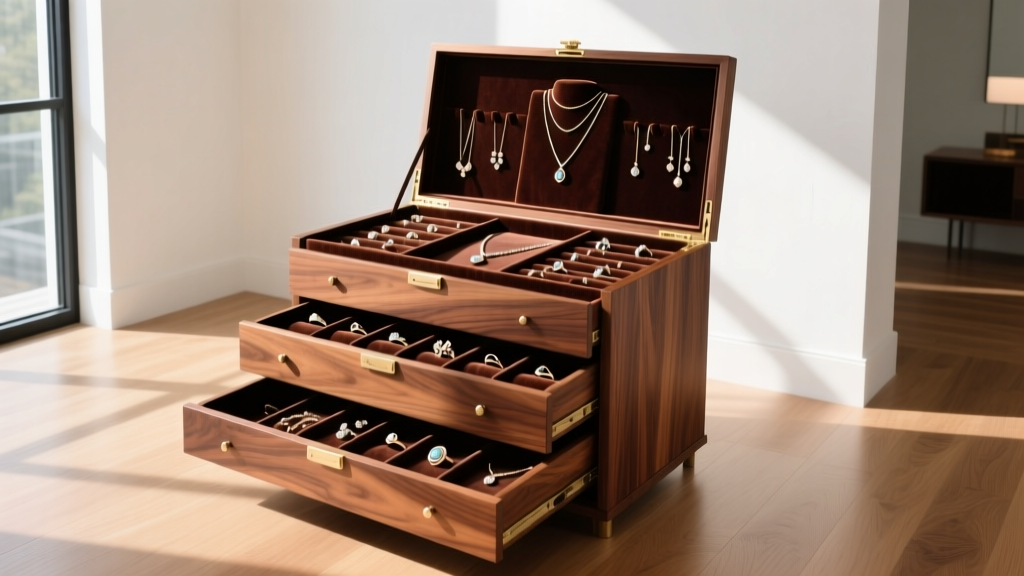
Wood remains the most popular choice for substantial jewelry armoires, but the distinction between solid hardwood and engineered wood is vast when it comes to chemical off-gassing and structural integrity.
The Hidden Danger of MDF and Particleboard
Many budget-friendly, oversized organizers are constructed from Medium-Density Fiberboard (MDF) or particleboard. These materials are bound together using urea-formaldehyde resins. Formaldehyde is a known VOC that slowly off-gasses into the enclosed microclimate of a jewelry drawer. When trapped in a closed space, these gases react with the moisture in the air and the sulfur naturally present in some environments, rapidly accelerating the formation of silver sulfide (tarnish) on your sterling silver pieces.
Solid Hardwood and the Sealing Imperative
Solid hardwoods like Black Walnut, White Oak, and Maple offer superior load-bearing capabilities. A 3/4-inch solid oak shelf can support over 60 pounds without deflection, making it ideal for heavy bead and metal storage. However, raw wood contains natural acids and tannins that can damage porous gemstones like pearls, turquoise, and coral. The Gemological Institute of America (GIA) notes that organic gems are highly sensitive to acidic environments. Therefore, any solid wood extra large jewelry organizer must be sealed with a fully cured, water-based polyurethane finish to create an inert barrier between the wood's natural chemistry and your collection.
Acrylic and Polycarbonate: The Modern Alternative
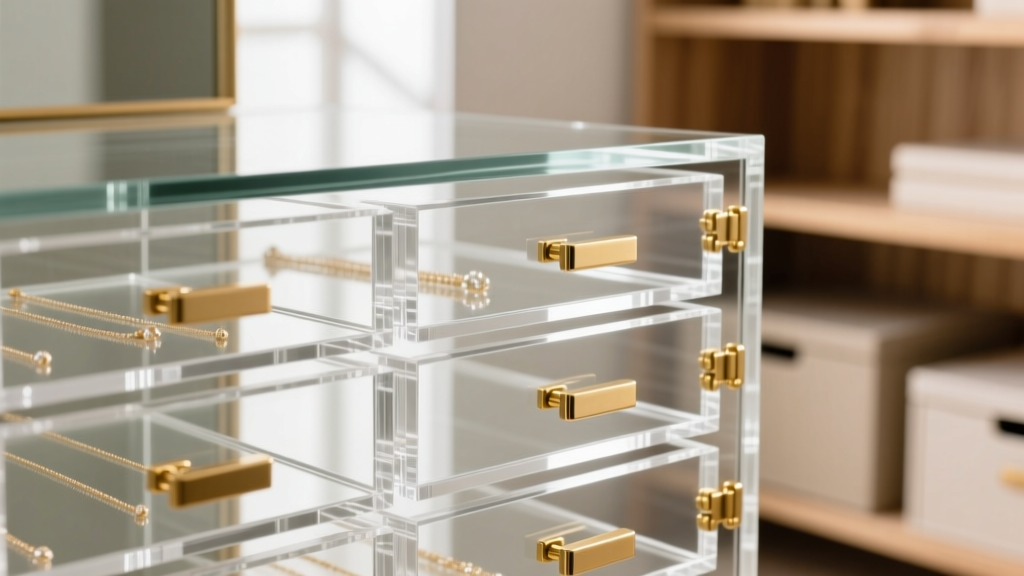
For collectors who prefer to see their inventory at a glance, clear synthetic organizers are highly desirable. However, not all clear plastics are created equal, especially when spanning the wide dimensions required for an extra large jewelry organizer.
Cast Acrylic (PMMA) vs. Extruded Acrylic
You must look for cell-cast acrylic (Polymethyl Methacrylate or PMMA) rather than extruded acrylic. Extruded acrylic is manufactured by pushing molten plastic through a die, which creates internal stresses. When subjected to the constant downward pressure of heavy jewelry, extruded acrylic is prone to micro-cracking and catastrophic snapping. Cast acrylic, poured into a mold, has a much higher molecular weight and superior tensile strength.
For large drawers spanning 18 inches or more, the acrylic must be at least 4mm to 5mm thick. Anything thinner will bow in the center over time, causing drawers to stick and slide tracks to warp. Furthermore, high-quality cast acrylic is inherently UV-resistant, which helps protect light-sensitive gemstones like amethyst and kunzite from fading when placed in sunlit rooms.
Metals: Steel, Wire, and the Coating Crucible
Metal organizers, particularly those utilizing steel wire grids or powder-coated sheet metal, offer a sleek, industrial aesthetic and immense structural strength. A 12-gauge steel wire shelf will never bow under the weight of jewelry, but bare metal poses severe risks.
Galvanic Corrosion and Oxidation
Bare steel is highly susceptible to ambient humidity. As it oxidizes (rusts), the iron oxide can transfer to your jewelry, staining porous stones and degrading delicate metal chains. Furthermore, if bare steel comes into direct contact with certain alloys in the presence of moisture, it can trigger galvanic corrosion. To prevent this, metal organizers must feature a high-quality epoxy-polyester hybrid powder coating. This electrostatically applied and heat-cured finish provides a chemically inert, non-porous barrier that is completely safe for long-term jewelry contact, as supported by Library of Congress Preservation Guidelines regarding metal storage environments.
Material Comparison Matrix
Use the table below to evaluate which material best suits the specific demands of your collection size and environmental conditions.
| Material | Max Load (per 24" shelf) | Off-Gassing Risk | Tarnish Acceleration | Best Use Case |
|---|---|---|---|---|
| Solid Hardwood (Sealed) | 60+ lbs | None (if water-based) | Low | Heavy gold/silver, heirloom pieces |
| MDF / Veneer | 35 lbs | High (Formaldehyde) | High | Costume jewelry, short-term storage |
| Cast Acrylic (5mm) | 25 lbs | None | None | Visual inventory, light-sensitive gems |
| Powder-Coated Steel | 80+ lbs | None | None (if coated) | Massive collections, heavy beads |
Hardware Mechanics: Hinges and Slide Tracks
An often-overlooked aspect of material comparison in an extra large jewelry organizer is the hardware. The doors of a large armoire can weigh upwards of 15 pounds. Standard zinc-alloy (Zamak) hinges frequently succumb to 'zinc pest'—a slow, intergranular corrosion that causes the metal to crumble and fail under heavy loads. Always inspect the hardware specifications. You want solid brass, stainless steel (Grade 304), or heavy-duty cold-rolled steel hinges with ball bearings. For drawers, side-mounted ball-bearing steel slides rated for at least 45 pounds are essential to prevent the drawer from derailing when fully extended.
The Crucial Interface: Lining Materials
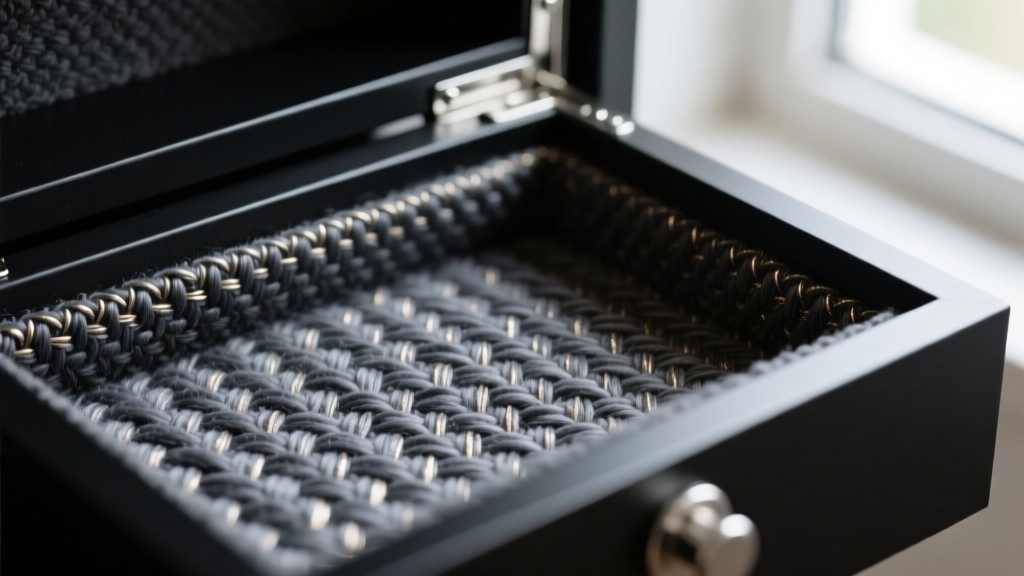
The exterior shell of your organizer provides structural integrity, but the interior lining dictates the chemical microclimate surrounding your jewelry. The wrong lining can ruin a collection regardless of how good the exterior material is.
Foams and Polyurethanes: A Moisture Trap
Many mass-produced organizers use cheap polyurethane (PU) foams or EVA (ethylene-vinyl acetate) inserts. These closed-cell foams trap ambient moisture against the metal surfaces of your jewelry, creating a humid microclimate that accelerates tarnish. Furthermore, some synthetic foams contain sulfur-based catalysts from their manufacturing process, which is the exact element required to turn sterling silver black.
The Gold Standard: Acid-Free Cotton and Sacrificial Anodes
The ideal lining for a premium extra large jewelry organizer is 100% acid-free, unbleached cotton flannel. Cotton is breathable, preventing moisture buildup, and lacks the chemical additives found in synthetic fabrics. For ultimate protection, look for organizers lined with specialized tarnish-inhibiting fabrics, such as Pacific Silvercloth. These fabrics are impregnated with microscopic silver or zinc particles that act as a sacrificial anode. The sulfur in the air reacts with the particles in the cloth rather than your jewelry, keeping your silver brilliant for years without the need for constant polishing.
Final Verdict: Matching Material to Your Collection
Selecting the right extra large jewelry organizer requires matching the material properties to your specific collection profile. If you possess a massive, heavy collection of solid gold and chunky silver, a sealed solid hardwood armoire with steel ball-bearing hardware and Pacific Silvercloth linings is the ultimate archival solution. If your priority is rapid visual inventory management for a modern collection of colorful gemstones and diamonds, a 5mm cast acrylic system with UV-blocking properties will serve you best while maintaining structural rigidity. Avoid MDF and polyurethane foams at all costs; the short-term savings are never worth the long-term chemical damage to your precious metals and stones.


