How to Identify Bakelite Jewelry: A Step-by-Step Authenticity Guide
Learn how to identify Bakelite jewelry with our step-by-step guide. Master the Simichrome, hot water, and visual tests to spot genuine vintage plastics.

Introduction to Bakelite and the Vintage Plastic Market
Bakelite, the world's first synthetic plastic, was invented by Leo Baekeland in 1907. By the 1920s and 1930s, this revolutionary phenol formaldehyde resin had become the premier material for Art Deco jewelry, celebrated for its rich colors, substantial weight, and ability to be deeply carved. Today, vintage Bakelite jewelry is highly sought after by collectors, with rare hinged bangles and figural brooches fetching thousands of dollars at auction. However, the mid-2020s vintage market is flooded with convincing fakes, including modern phenolic resins, Lucite, and celluloid. Knowing how to identify Bakelite jewelry is essential for any serious collector or reseller looking to navigate estate sales, antique malls, and online marketplaces without falling victim to costly misattributions.
This comprehensive, step-by-step guide will walk you through the exact diagnostic methods used by professional appraisers and veteran collectors. We will cover visual inspections, chemical reactions, and thermal tests to ensure you can confidently authenticate vintage plastics.
Visual Inspection: The First Line of Defense
Before applying any polishes or heat, a thorough visual and tactile inspection can eliminate a significant percentage of modern fakes. Bakelite possesses unique physical characteristics stemming from its manufacturing process.
Weight and Density
Bakelite is remarkably dense. When you hold a genuine Bakelite bangle or brooch, it should feel surprisingly heavy for its size—roughly 30% heavier than modern acrylics or Lucite. If a piece feels lightweight or hollow, it is almost certainly a later injection-molded plastic or a modern reproduction.
The Absence of Mold Seams
Authentic Bakelite jewelry was not injection-molded. Instead, it was cast into large rods, tubes, or blocks, which were then sliced, machined, and hand-carved. Because of this, genuine Bakelite will never have a mold seam (a thin, raised line where two halves of a metal mold met). If you run your fingernail along the inside edge of a bangle or the side of a brooch and feel a distinct ridge or seam, you are holding a later, mass-produced plastic.
Carving Marks and Tool Lines
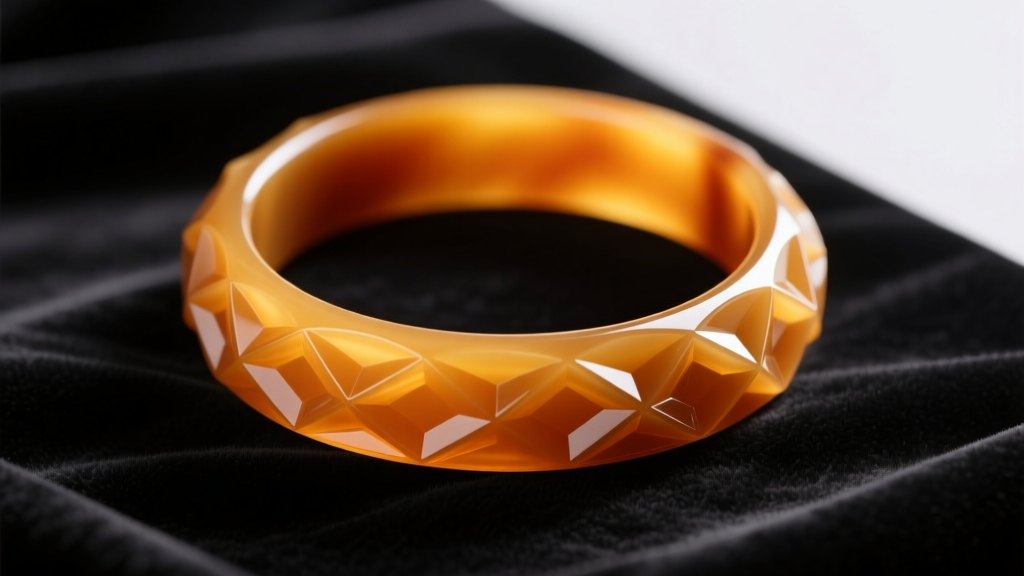
Look closely at the carved areas under a jeweler's loupe. Hand-carved Bakelite, particularly the highly prized 'Philadelphia Style' pieces from the 1930s, will feature deep, dramatic, and sometimes slightly asymmetrical geometric cuts. You may even spot faint, parallel tool marks left by the artisan's carving implements. Modern fakes are often cast in molds taken from original pieces, resulting in shallow, rounded, and 'melted' looking carving details with no tool marks.
Patina and Color Oxidation
Bakelite oxidizes over time when exposed to light and air. A piece that was originally light cream will age into a rich butterscotch or dark amber. Light blue often turns to a murky green, and pale pink can shift to a dusty orange. This patina is usually uneven, accumulating more heavily in the deep crevices of carvings. Fakes often feature artificially applied, uniform 'antiquing' that wipes away easily with a damp cloth.
The Simichrome Polish Test: The Gold Standard
The most reliable non-destructive test for authenticating Bakelite is the Simichrome polish test. Simichrome is a high-quality metal polish that contains specific mild abrasives and solvents. When these solvents interact with the oxidized surface layer of phenol formaldehyde resin, they produce a distinct color change.
Step-by-Step Simichrome Testing
- Step 1: Prep the Piece. Ensure the jewelry is clean and dry. Dirt, lotion, or heavy wax coatings can create a barrier that prevents the polish from reaching the oxidized resin.
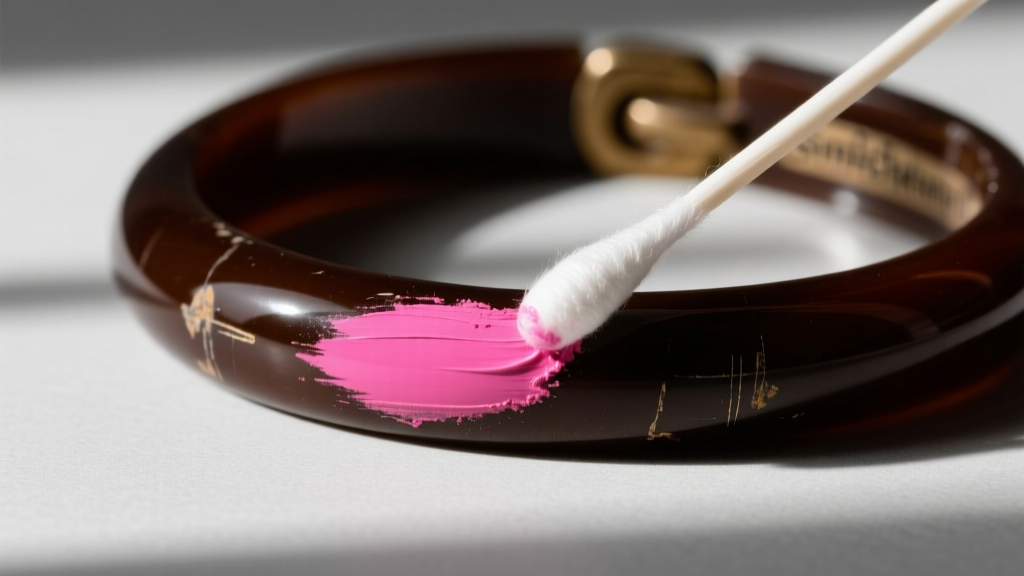
- Step 2: Apply the Polish. Dab a small amount of pink Simichrome polish onto a cotton swab or a soft, white microfiber cloth. You only need a pea-sized amount.
- Step 3: Rub Gently. Rub the swab firmly against an inconspicuous area of the jewelry, such as the inside of a bangle or the back of a brooch. Apply moderate pressure for about 15 to 20 seconds.
- Step 4: Observe the Color. Inspect the swab. If the pink polish has turned a bright, crusty yellow, mustard, or dark brown, you have genuine Bakelite. If the swab remains pink or turns a faint, dusty gray, the piece is likely Lucite, celluloid, or a modern plastic.
Expert Note: There are two notable exceptions to the Simichrome test. First, heavily lacquered or recently repolished Bakelite may not react because the oxidized layer has been removed. Second, black Bakelite (often used in mourning jewelry or stark Art Deco designs) rarely yields a yellow reaction because the carbon black pigment masks the oxidation. For black pieces, rely on the hot water test and visual weight cues.
According to the authentication guides provided by Collectors Weekly, the Simichrome test remains the industry standard for antique dealers because it is highly accurate and completely non-destructive when performed correctly. Always wipe the piece clean with a damp cloth immediately after testing to prevent long-term chemical interaction.
The Hot Water Test: Using Heat and Scent
When the Simichrome test is inconclusive—particularly with black, heavily polished, or lacquered pieces—the hot water test is your next best diagnostic tool. Bakelite emits a very specific odor when heated, a direct result of its phenol formaldehyde chemical composition.
Executing the Hot Water Test Safely
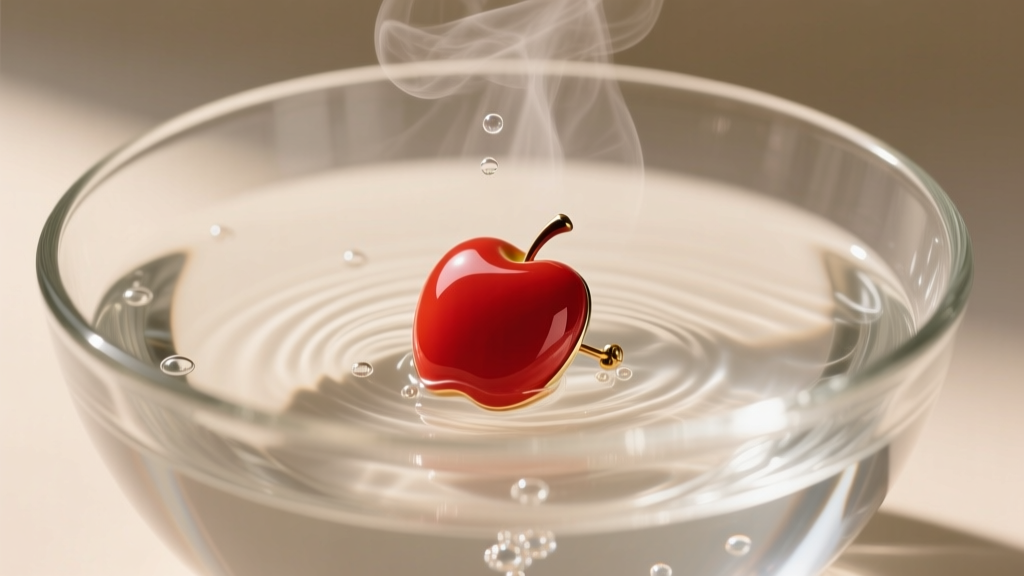
- Step 1: Heat the Water. Run your tap water until it is hot, or heat a cup of water to approximately 140°F (60°C). Never use boiling water. Extreme thermal shock can crack vintage plastics, and boiling water can cause certain unstable early plastics to warp or release toxic fumes.
- Step 2: Submerge the Piece. Dip the jewelry into the hot water for 15 to 30 seconds. If testing a bangle, you only need to submerge a small section of it.
- Step 3: The Smell Test. Remove the piece from the water and immediately bring it to your nose. Genuine Bakelite will emit a harsh, acrid, chemical odor that is frequently compared to formaldehyde, carbolic acid, or the smell of a hospital laboratory.
Differentiating the Scents
If the piece does not smell like formaldehyde, use the scent to identify what it actually is. If it smells distinctly like camphor, pine, or Vicks VapoRub, you are holding Celluloid, an earlier and highly flammable plastic that requires specialized, climate-controlled storage. If it smells like nothing at all, or faintly of modern acrylic, it is likely Lucite or a contemporary resin. For more on the historical distinctions between these materials, the Ruby Lane Jewelry Blog offers excellent comparative insights for vintage buyers.
Comparison Chart: Bakelite vs. Other Vintage Plastics
Understanding how Bakelite stacks up against its contemporaries is crucial for accurate identification and valuation. Use this quick-reference table when evaluating estate sale finds.
| Characteristic | Bakelite (Phenolic) | Lucite (Acrylic) | Celluloid | Modern Phenolic Resin |
|---|---|---|---|---|
| Era of Peak Use | 1920s - 1940s | 1940s - 1960s | 1890s - 1920s | 1980s - Present |
| Weight/Density | Very Heavy / Dense | Lightweight | Very Lightweight | Medium to Heavy |
| Mold Seams | None (Cast & Carved) | Often Present | Often Present | Often Present |
| Simichrome Test | Turns Yellow/Mustard | No Reaction (Pink) | No Reaction (Pink) | Faint Yellow or Pink |
| Hot Water Scent | Formaldehyde / Chemical | Odorless | Camphor / Vicks | Faint Chemical / Odorless |
| Flammability | Low (Will char) | Low | Extremely High | Low |
Advanced Diagnostics: UV Light and Friction
While less definitive than chemical or thermal tests, Ultraviolet (UV) light can provide supporting evidence. Under a longwave UV blacklight, some Bakelite pieces will fluoresce, often glowing a bright orange, yellow, or milky blue depending on the specific dyes and fillers used in the 1930s. However, many authentic pieces will not fluoresce at all, and some modern plastics are manufactured with optical brighteners that also glow. Therefore, UV testing should only be used as a supplementary clue, never as standalone proof.
The friction test is another old-school method. By rubbing the plastic vigorously against your palm or a soft cloth until it becomes hot from friction, you can sometimes coax out the formaldehyde smell without using water. While useful in a crowded antique show where hot water isn't available, it is far less reliable than the submersion method and can leave your skin smelling like chemicals for hours.
Destructive Tests to Avoid
You may encounter older reference books recommending the 'hot pin test,' where a red-hot needle is poked into an inconspicuous area of the plastic to see if it melts or burns. Never perform this test. Not only does it permanently damage and devalue the jewelry, but it is also incredibly dangerous. If the piece happens to be celluloid, the hot pin can cause it to instantly ignite or explode. Furthermore, modern phenolic resins will react similarly to Bakelite when burned, rendering the test useless for differentiating vintage from contemporary fakes. Stick to non-destructive methods to preserve both the artifact and your safety.
Conclusion and Market Valuation Tips
Mastering how to identify Bakelite jewelry requires a combination of tactile awareness, visual scrutiny, and chemical testing. As the vintage market continues to evolve in 2026, the proliferation of high-quality Asian-made phenolic reproductions means that relying on a single test is no longer sufficient. Always combine the weight and seam inspection with the Simichrome or hot water test for a definitive conclusion.
When it comes to valuation, condition and color are paramount. Standard 'endless' (non-hinged) bangles in common colors like brown or black may sell for $50 to $150. However, rare colors like 'peach,' 'cream corn,' or the highly marbled 'end of day' swirls can command $1,000 to $5,000. Deeply carved, hinged 'Philadelphia' bangles and intricate figural brooches featuring reverse-carved lucite elements (often called 'apple juice' Bakelite) represent the pinnacle of the market, regularly achieving $5,000 to $15,000+ at premier auction houses. By applying the rigorous authentication steps outlined above, you can confidently hunt for these wearable pieces of history while leaving the fakes behind.