Troubleshooting Hallmark Jewelry: Faded, Fake, or Missing Stamps
Learn how to troubleshoot hallmark jewelry with missing, faded, or suspicious stamps. Expert guides on acid tests, magnet checks, and verifying authenticity.

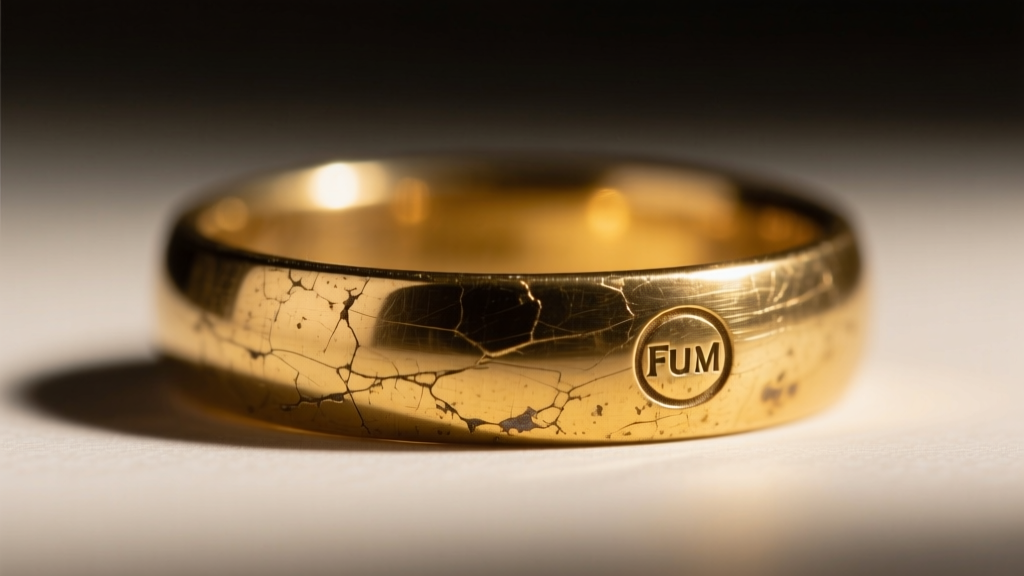
Encountering questionable hallmark jewelry is one of the most common and frustrating problems in the secondary jewelry market. Whether you are evaluating an inherited estate piece, authenticating a vintage designer find, or verifying a newly purchased gold chain, the hallmark stamp is your first line of defense. But what happens when that crucial stamp is faded, entirely missing, or suspiciously crisp on a piece that fails basic material tests?
Troubleshooting compromised or counterfeit hallmarks requires moving beyond visual inspection and applying a systematic, multi-tiered testing framework. In this guide, we break down the exact methodologies gemologists and experienced jewelers use to authenticate precious metals when the hallmark cannot be trusted.
Why Do Hallmark Jewelry Stamps Disappear or Look Suspicious?
Before applying destructive or advanced non-destructive tests, it is vital to understand why a hallmark might be compromised. Genuine stamps fail or disappear for three primary reasons:
- Abrasive Polishing: Over decades, professional buffing and at-home polishing cloths remove microscopic layers of metal. A shallow stamp on a 1940s ring band can easily be polished into illegibility.
- Friction and Wear: The inside of a ring band or the clasp of a bracelet experiences constant friction against skin and clothing, naturally wearing down the metal over time.
- Counterfeit Laser Etching: Modern counterfeiters use CNC lasers to etch '925' or '14K' onto base metals. These fake stamps often look too perfect, lacking the micro-tearing and die-strike compression marks seen in genuine mechanical stamping.

The Troubleshooting Framework for Unreadable Marks
When a stamp is partially visible, your goal is to enhance contrast and magnification without altering the piece.
Step 1: The Loupe and Raking Light Technique
A standard 10x jeweler's loupe is insufficient for heavily worn micro-stamps on modern cable chains or thin band rings. Upgrade to a 30x triplet loupe to eliminate chromatic aberration at high magnification. To read a faded stamp, do not shine light directly onto it. Instead, use raking light (oblique illumination). Hold a focused LED penlight at a 10-degree angle to the metal surface. This forces the light to catch the microscopic ridges of the worn stamp, casting micro-shadows that reveal the numbers or maker's marks.
Step 2: Digital Microscopy
For severe wear, a $40 USB digital microscope (40x to 1000x magnification) connected to a laptop is a game-changer. By adjusting the software's contrast and applying a false-color filter, you can often read a hallmark that is entirely invisible to the naked eye.
Decoding Conflicting or 'Fake' Hallmarks
Sometimes the hallmark is perfectly legible, but the physical properties of the jewelry contradict the stamp. Counterfeiters frequently stamp brass or copper alloys with '14K' or '925'. Below is a troubleshooting matrix to identify fake hallmark red flags.
| Stamp | Fake Red Flags (Troubleshooting) | Genuine Characteristics |
|---|---|---|
| 925 | Stamp is perfectly laser-etched on a casting with visible surface porosity. Fails the magnet test (attracted to magnet). | Slight tooling marks around the edges from a mechanical die strike. Non-magnetic. |
| 14K / 585 | Stamp is crooked, but the metal has a brassy hue. Fails the 14K nitric acid test (turns green or milky). | Crisp, deep impression. Often accompanied by a registered maker's mark or trademark. |
| 18K HGE | Buyer assumes '18K' means solid gold. 'HGE' means Heavy Gold Electroplate (base metal core). | Solid 18K will simply be stamped '18K', '750', or feature a pictorial hallmark. |
| PLAT / 950 | Lightweight for its size. Scratches easily with a steel pin (platinum is dense and hard). | Extremely dense (21.45 g/cm³). Hefty feel. Does not tarnish or react to standard acids. |
What to Do When the Hallmark is Completely Gone
If raking light and digital microscopy fail to reveal a stamp, you must pivot from visual identification to material science. According to the Federal Trade Commission's Jewelry Guides, selling precious metals without accurate purity disclosure is illegal, making independent verification essential for buyers.
Non-Destructive Testing: Specific Gravity (SG)
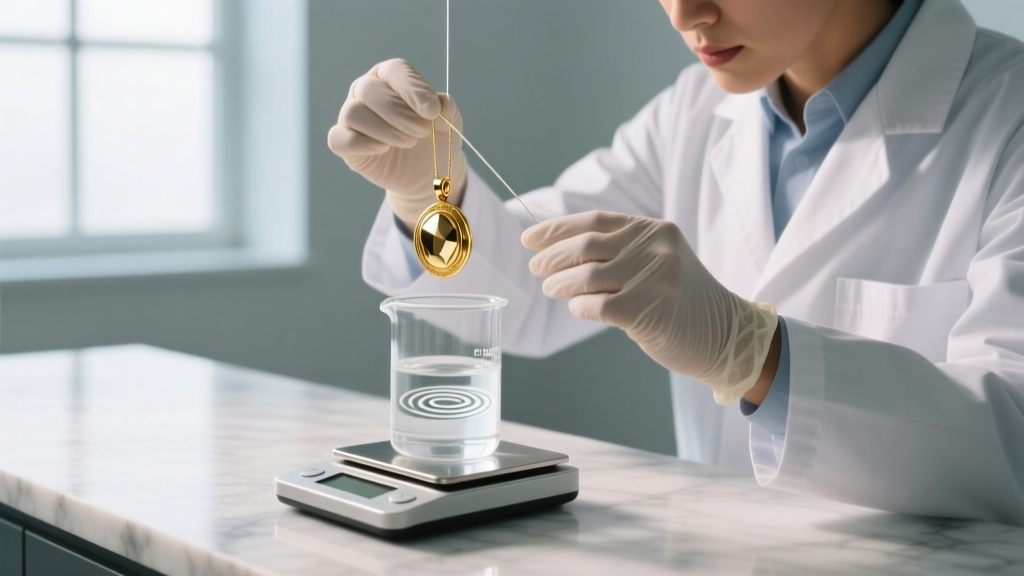
If the jewelry is solid (not hollow or heavily gem-set), you can calculate its Specific Gravity to determine the metal alloy. You will need a digital scale accurate to 0.01 grams, water, and a suspension wire.
- Weigh the piece in the air (e.g., 15.40g).
- Suspend the piece in water and weigh it again (e.g., 14.60g).
- Calculate the difference (15.40 - 14.60 = 0.80g).
- Divide the air weight by the difference (15.40 / 0.80 = 19.25).
A result of 19.25 strongly indicates 22K or 24K gold (pure gold is 19.32 g/cm³). Sterling silver will yield an SG of roughly 10.36 g/cm³. Note: This test is invalid for hollow electroformed jewelry or pieces with large gemstones, as the trapped air or stone density will skew the math.
Destructive Testing: The Acid Scratch Test
When SG is not viable, the nitric acid scratch test is the industry standard. However, troubleshooting requires strict adherence to protocol to avoid false negatives.
- Never test the clasp: Clasps contain steel tension springs. Testing a clasp will yield a false 'base metal' result and ruin the acid.
- File a deep notch: If you suspect gold-plated brass, a surface scratch will test the gold plating. Use a jeweler's file to cut a 1mm deep notch into an inconspicuous area, then apply the 14K or 18K nitric acid testing solution directly to the exposed core.
- Read the reaction: If the acid turns milky green, it is base metal. If it turns slightly brown or remains clear, it is solid gold of that karatage or higher.
Real-World Scenarios: Resolving Hallmark Disputes
Scenario A: The Unmarked European Estate Piece
A common troubleshooting scenario involves inherited jewelry from Europe that lacks a numerical '14K' or '18K' stamp. Many European countries use pictorial hallmarks rather than numbers. For example, the French tête d'aigle (eagle's head) guarantees a minimum of 18K (750/1000) gold, while the tête de sanglier (boar's head) indicates 800-grade silver. The UK Assay Office maintains an excellent database of international pictorial marks that can solve these mysteries without a single drop of acid.
Scenario B: The 'Tiffany & Co.' Rubbed-Off Stamp
Designer silver jewelry, particularly vintage Tiffany & Co. pieces, often feature shallow maker's marks and '925' stamps that wear away completely on the high-polish surfaces. If the stamp is gone, authenticate the piece through its casting quality, the specific font style of any remaining partial letters, and the soldering quality of the jump rings. Counterfeiters often use sloppy, blob-like solder on chain links, whereas genuine designer pieces feature seamless, laser-welded, or perfectly flushed solder joints.
When to Seek Professional Gemological Intervention
If your troubleshooting steps yield conflicting data—for example, a piece that passes the magnet test and the acid test, but fails the specific gravity test—you may be dealing with advanced counterfeiting, such as tungsten-core gold bars or heavy gold-filled chains. In these cases, consult a certified gemologist equipped with an XRF (X-ray Fluorescence) spectrometer. While XRF machines cost upwards of $15,000, many local jewelers will perform a non-destructive XRF scan for a nominal fee of $25 to $50. As noted by the Gemological Institute of America (GIA), XRF technology provides an exact elemental breakdown of the metal alloy, definitively solving even the most complex hallmark jewelry disputes.
Ultimately, a hallmark is a claim of purity, not a guarantee. By mastering these troubleshooting techniques, you can confidently verify the true material value of your jewelry, regardless of the condition of its stamps.