September Birthstone Jewelry: Expert Guide to Sapphire Grading
Discover expert insights on September birthstone jewelry. Learn sapphire grading, heat treatments, setting mechanics, and pricing tiers for fine rings.

The Mineralogy of Corundum: Why Sapphire Demands Respect
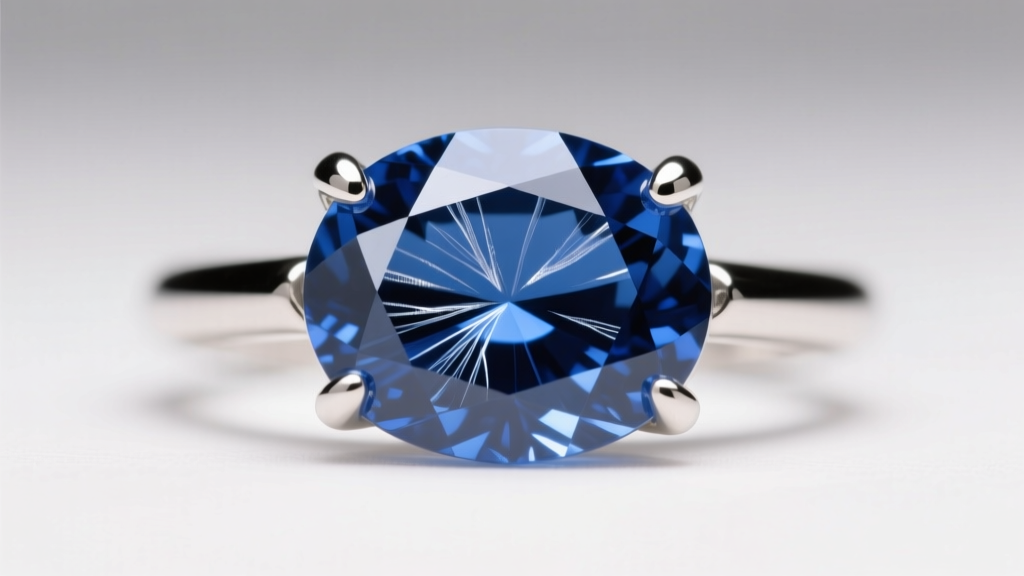
When evaluating september birthstone jewelry, understanding the underlying mineralogy of sapphire is non-negotiable for serious collectors and jewelers. Sapphire is a variety of corundum (aluminum oxide, Al2O3), crystallizing in the trigonal system. While it boasts a formidable 9 on the Mohs hardness scale—second only to diamond—hardness alone does not dictate durability. Corundum lacks true cleavage, but it exhibits distinct parting along rhombohedral twinning planes. This structural nuance is a critical failure mode in jewelry manufacturing; if a jeweler applies excessive pressure during setting, particularly over a twinning plane, the gemstone can fracture cleanly.
Optically, sapphire is uniaxial negative with a refractive index ranging from 1.762 to 1.778 and a specific gravity of 3.99 to 4.01. The coveted blue hue in traditional September birthstones is not inherent to pure corundum (which is colorless) but is the result of trace intervalence charge transfer between iron (Fe2+) and titanium (Ti4+) ions. The precise ratio and distribution of these trace elements dictate the stone's saturation and tone, forming the basis of advanced gemological grading.
Decoding Sapphire Treatments: Heat, Diffusion, and Filling
The vast majority of commercial and fine sapphire jewelry on the market has undergone some form of enhancement. As an expert buyer, you must distinguish between universally accepted practices and those that severely compromise a stone's integrity and value.
Traditional Thermal Enhancement
Heating sapphire to temperatures between 1500°C and 1800°C is an accepted industry standard. This process dissolves microscopic rutile needles (known as 'silk') that scatter light and reduce transparency. By carefully controlling the cooling rate, jewelers can also induce or enhance the blue coloration. According to the Gemological Institute of America (GIA), standard heat treatment without flux healing is permanent and does not require special care beyond standard gemstone maintenance.
Lattice Diffusion and Beryllium Treatment
A more controversial treatment involves introducing beryllium into the crystal lattice during heating. Because beryllium atoms are exceptionally small, they can penetrate the entire stone, fundamentally altering its color to produce vibrant oranges, pinks, and padparadscha hues. While stable, beryllium diffusion must be explicitly disclosed. Undisclosed diffusion is considered fraudulent in the high-end market and can be detected using Energy Dispersive X-Ray Fluorescence (EDXRF) spectroscopy.
Lead-Glass Fracture Filling
At the lowest end of the market, heavily included sapphires are treated with lead-glass to fill surface-reaching fractures. This treatment drastically improves apparent clarity but creates a massive durability vulnerability. The glass filler has a Mohs hardness of only 5 to 6 and is highly susceptible to etching from mild acids, including household cleaners and citrus juices. Expert jewelers universally advise against purchasing fracture-filled sapphires for everyday September birthstone jewelry.
Technical Setting Mechanics: Protecting a Mohs 9 Gemstone
Designing the mounting for September birthstone jewelry requires balancing aesthetic exposure with structural protection. The choice of metal and setting style directly impacts the longevity of the piece.
Prong vs. Bezel: Stress Points and Tolerances
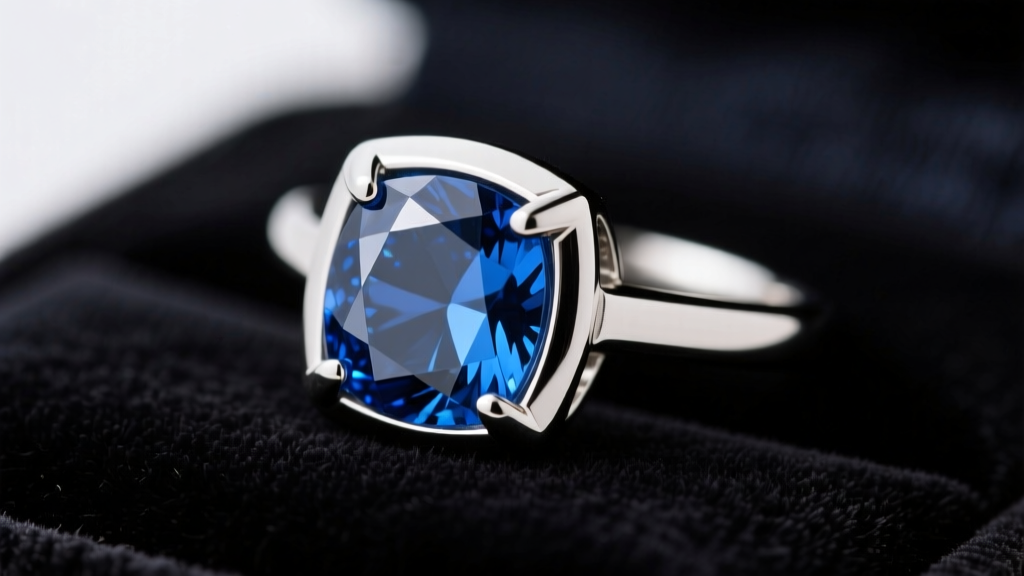
For active wearers, a full bezel setting in platinum or 18k palladium white gold offers superior protection against lateral impacts. However, if a prong setting is preferred for maximum light return, the prong dimensions must be engineered precisely. Standard 0.7mm wire prongs are insufficient for securing a sapphire long-term; they are prone to wear and snagging. Expert bench jewelers recommend milling prongs from 1.0mm to 1.2mm platinum stock. Platinum's high tensile strength and lack of memory ensure that once the prong is burnished over the sapphire's crown, it will not slowly lift away from the girdle over time, a common failure point in 14k gold settings.
Furthermore, tension settings should be strictly avoided for sapphires. The immense compressive force (often exceeding 12,000 PSI) required to hold a stone in a tension mount can trigger catastrophic failure along the corundum's rhombohedral parting planes.
Pricing Tiers and Market Valuations
The valuation of sapphire jewelry is highly stratified, driven by the intersection of origin, treatment status, and color saturation. Below is a 2026 market matrix for blue sapphires in the 1.50 to 2.50 carat range.
| Grade Tier | Clarity & Color | Treatment Status | Typical Origin | Price Per Carat (USD) |
|---|---|---|---|---|
| Commercial | Included, Dark/Inky | Heavily Heated / Filled | Australia / Thailand | $150 - $450 |
| Fine | Eye-Clean, Vivid Blue | Standard Heat Only | Sri Lanka / Madagascar | $1,800 - $4,500 |
| Extra-Fine | Loupe-Clean, Cornflower | Standard Heat Only | Kashmir / Burma | $8,000 - $18,000 |
| Investment | Flawless, Royal Blue | Unheated (No Heat) | Kashmir / Ceylon | $30,000 - $120,000+ |
As noted by the American Gemological Laboratories (AGL), the premium for an 'unheated' designation on a high-clarity stone can increase its per-carat value by 200% to 400% compared to an identical heated stone, purely due to geological rarity.
Verifying Authenticity: Spectroscopy and Inclusion Mapping
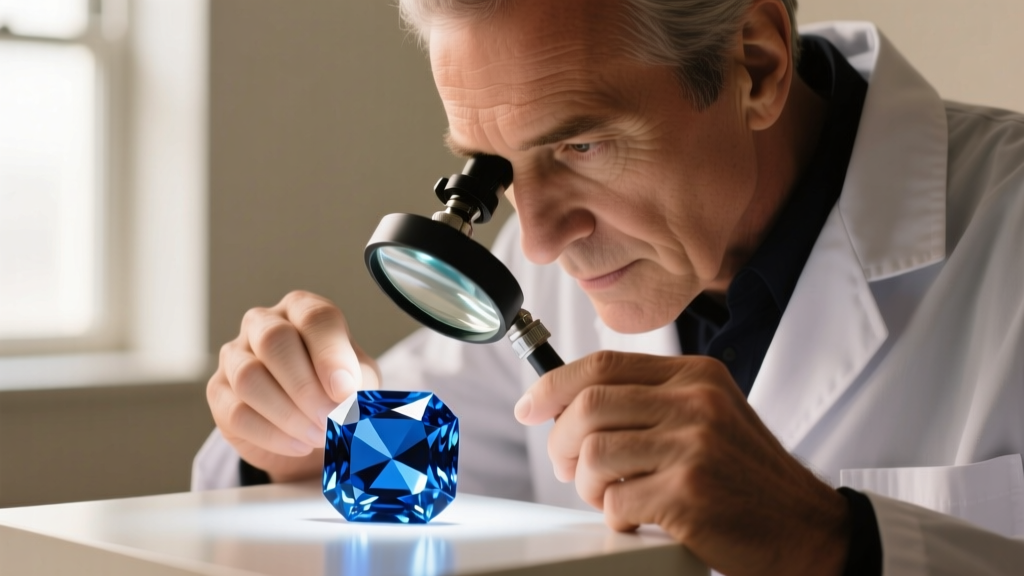
When acquiring high-value September birthstone jewelry, relying on visual inspection is inadequate. Advanced gemological laboratories utilize inclusion mapping and spectroscopy to determine origin and treatment. For instance, the presence of intact rutile silk intersecting at 60-degree angles is a strong indicator of an unheated stone, as high-temperature treatments would melt these needles. Conversely, the presence of tension halos around crystals or melted crystal inclusions confirms thermal enhancement.
For stones claiming prestigious origins like Kashmir or Burma, trace element analysis via Laser Ablation Inductively Coupled Plasma Mass Spectrometry (LA-ICP-MS) is required to map the specific chemical fingerprint of the rough. Always demand a comprehensive report from a tier-one laboratory (GIA, AGL, or Gübelin) that explicitly states the treatment status and geographic origin before finalizing a significant purchase.
Conclusion: Engineering Heirloom September Birthstone Jewelry
Creating or purchasing exceptional September birthstone jewelry is an exercise in applied mineralogy and precision engineering. By prioritizing unheated or traditionally heated stones, insisting on robust platinum setting mechanics, and verifying claims through advanced spectroscopy, you ensure the piece will endure both as a wearable artifact and a stable financial asset. True expertise lies not just in appreciating the gem's vibrant blue hue, but in understanding the immense geological and mechanical forces that bring it to the light.