Springfield Jewelry & Diamond Appraisal: Technical Guide
Master the technical appraisal of vintage and modern stones with our expert guide to the Springfield jewelry & diamond market. Learn 4C nuances.

The Gemological Landscape of the Springfield Market
Navigating the Springfield jewelry & diamond market in 2026 requires a sophisticated understanding of both modern gemological standards and historical cutting techniques. As a prominent regional hub for estate liquidations, probate auctions, and antique jewelry trading, Springfield offers a high concentration of vintage stones. However, this market is also fraught with technical pitfalls for the untrained eye. Buyers and appraisers frequently encounter older diamonds that have been subjected to modern recutting, undisclosed clarity enhancements, or High Pressure High Temperature (HPHT) color treatments. To operate successfully in this environment, one must move beyond basic 4Cs education and master the nuanced metrics of light performance, facet architecture, and inclusion mapping specific to estate diamonds.
Unlike the standardized modern round brilliant market, the Springfield jewelry & diamond estate circuit demands a dual-lens approach. Appraisers must evaluate a stone's technical durability and light return while simultaneously preserving the historical premium associated with its original cut. A poorly proportioned Old European Cut (OEC) might be penalized under modern grading systems, yet command a significant premium among purist collectors if it exhibits the highly coveted 'chunky' arrow patterning and an open culet. This guide provides the deep technical frameworks required to accurately appraise, authenticate, and price diamonds within this unique market.
Decoding Vintage vs. Modern Cut Metrics
The most common error made by novice buyers in the Springfield market is applying modern cut grading parameters to antique stones. The American Gem Society cut grading standards are optimized for Modern Round Brilliants (MRB) and specific fancy shapes, heavily penalizing the steep crowns and large culets inherent to vintage cuts. To properly evaluate estate pieces, you must understand the distinct proportional ranges of historical cuts.
| Cut Style | Table % | Crown Angle | Pavilion Depth | Lower Half Facet Length | Culet Size |
|---|---|---|---|---|---|
| Old European (OEC) | 53% - 60% | 35° - 40° | 41% - 45% | 45% - 55% (Short) | Small to Open |
| Old Mine (OMC) | 40% - 50% | 35° - 42° | 42% - 46% | Variable / Asymmetrical | Very Large |
| Modern Round (MRB) | 54% - 58% | 34° - 35° | 40.5% - 41% | 75% - 80% (Long) | Pointed / None |
The critical differentiator between an OEC and an MRB lies in the lower half facet length. Shorter lower half facets (typical of OECs) create the broad, scintillating flashes of light known as 'chunky' patterns, whereas longer lower half facets (MRBs) produce the tight, crushed-ice brilliance. When examining a purported OEC in the Springfield jewelry & diamond market, use a 10x triplet loupe to measure the lower half facets relative to the distance from the girdle to the culet. If the facets extend beyond 65%, the stone is likely a transitional cut or a modern recut designed to mimic an antique, which significantly alters its valuation.

Technical Inclusion Mapping and Treatment Identification
Estate diamonds rarely possess the pristine clarity of modern, laser-mapped rough. However, the primary concern for an expert appraiser is not the presence of inclusions, but the identification of post-mining treatments designed to mask them. In the Springfield jewelry & diamond sector, it is increasingly common to encounter older stones that have undergone HPHT annealing or fracture filling.
Identifying HPHT Color Enhancement
HPHT treatment is frequently used to shift the color of older, faint brown diamonds into the near-colorless range (G-H). This process alters the crystal lattice by removing brown plastic deformation. While the color improvement is permanent, the stone must be disclosed. Gemologists identify HPHT treatment by examining the stone under crossed polarizers for distinctive graining patterns. A stone that exhibits strong blue fluorescence under long-wave UV (LWUV) but remains inert or shows weak yellow-green under short-wave UV (SWUV) warrants immediate laboratory verification. Furthermore, HPHT-treated stones often display 'color zoning' or a hazy, milky appearance when viewed under darkfield illumination.
Fracture Filling and Durability Risks
Older cuts, particularly OMCs, often feature extremely thin to bruted girdles. A 'knife-edge' girdle on an OEC is highly susceptible to chipping, especially if the stone is reset into a modern tension or prong setting without protective V-tips. Appraisers must meticulously inspect the girdle for glass-like fracture fillings used to hide surface-reaching cleavages. Look for the 'flash effect'—a vivid blue or pink iridescent flash visible only when the stone is tilted under a fiber-optic light source. Filled diamonds are highly sensitive to heat and can be destroyed during routine jewelry repairs or retipping.
Fluorescence and Color Grading Nuances
Color grading antique diamonds requires a departure from the standard GIA D-to-Z methodology. According to GIA research on antique diamonds, the high crowns and small tables of OMCs and OECs naturally trap more body color, making them face up warmer than modern cuts of the same laboratory grade. A GIA-graded 'K' color OEC may face up significantly whiter than a 'K' color MRB due to its unique light return path.
Fluorescence also plays a highly specific role in this market. In modern diamonds, strong blue fluorescence can cause a stone to appear milky or oily in direct sunlight. However, in the warm-toned estate diamonds prevalent in the Springfield jewelry & diamond market, strong blue fluorescence is often actively sought after. It acts as a natural color-corrector, neutralizing the faint yellow or brown body tones under UV-rich daylight. When appraising, always grade the color in a controlled, UV-free environment using a neutral grey background, then document the fluorescence reaction separately to provide a complete picture of the stone's visual performance in real-world lighting.
Appraisal Framework: Pricing and Certification
Establishing accurate pricing for estate diamonds requires adjusting the standard Rapaport or IDEX price-per-carat (PPC) matrices. The Springfield jewelry & diamond market operates on a bifurcated pricing model based on cut desirability and certification status.
- Certified Ideal Vintage: Stones graded by GIA or AGS that exhibit exceptional symmetry for their cut type, with highly desirable 'chunky' patterning and no clarity treatments. These trade at parity or a 5-10% premium over standard modern cuts due to collector scarcity.
- Uncertified / As-Is Estate: Stones sold without modern laboratory dossiers. These require a mandatory 20-30% discount from the appraiser to account for the risk of undisclosed treatments, inaccurate color/clarity grading, and the cost of submitting the stone to a laboratory.
- Recut / Transitional: Older stones that have been modified to improve their modern light return, often resulting in asymmetrical outlines and mismatched facet junctions. These suffer a 15-25% penalty, as they lose their historical premium without achieving modern ideal light performance.
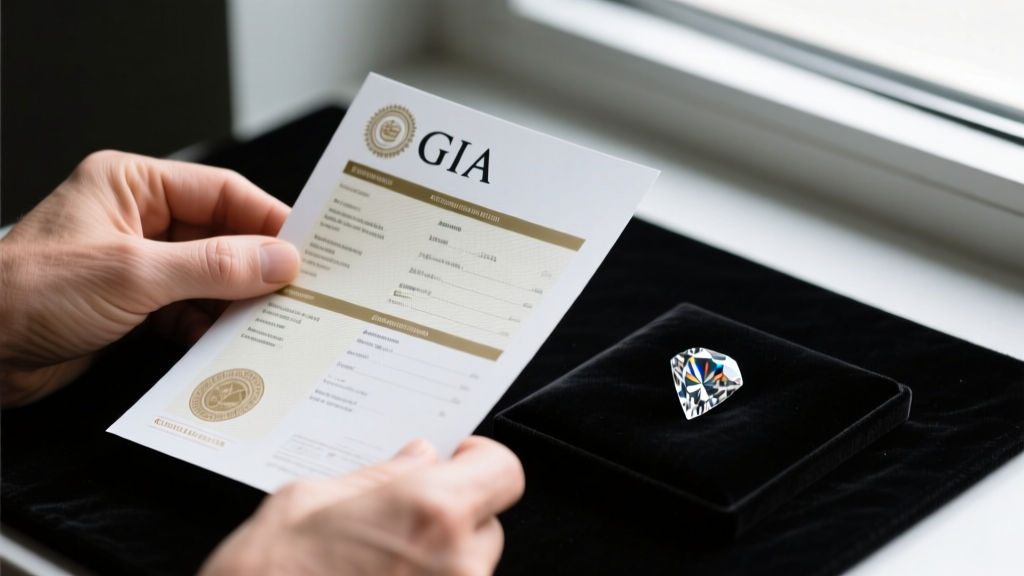
Always demand a GIA Diamond Dossier or full grading report for any estate stone over 1.00 carats. The GIA Diamond Cut Grading System provides the baseline metrics necessary to verify the stone's physical dimensions against its stated weight, ensuring the buyer is not paying for excessive depth hidden in the pavilion.
Final Verification Protocols
Before finalizing any acquisition in the Springfield jewelry & diamond market, execute this strict verification protocol using a 10x Hastings triplet loupe and a darkfield loupe:
- Girdle Inspection: Rotate the stone 360 degrees to check for micro-chips, abrasions, or natural bruting marks. Ensure no surface-reaching inclusions intersect the girdle edge.
- Culet Verification: View the stone table-down. Confirm the culet is intact and not chipped. An open culet should be perfectly centered; an off-center culet indicates poor historical symmetry or a botched recut.
- Facet Junction Analysis: Examine the meet points of the crown and pavilion facets. Crisp, sharp junctions indicate excellent original polish, while rounded or abraded junctions suggest decades of wear or aggressive commercial repolishing.
- Light Return Test: Observe the stone under diffuse, non-directional light. Look for areas of 'extinction' (black zones where light leaks out the bottom). While some extinction is normal in OECs, large, dead zones indicate a poorly matched crown and pavilion angle.
By adhering to these rigorous technical standards, appraisers and collectors can confidently navigate the complexities of the estate market, ensuring that every acquisition is both historically significant and gemologically sound.