Troubleshooting Wear and Damage in Diamond Ruby Jewelry
Learn how to identify, troubleshoot, and repair common wear issues in diamond ruby jewelry, from loose prongs to treated stone damage.

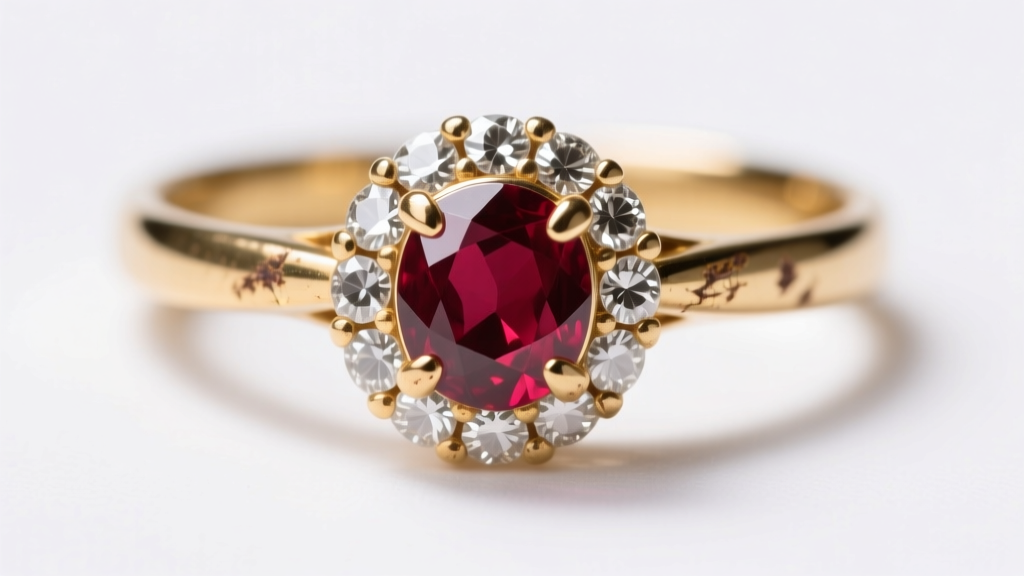
Pairing diamonds and rubies creates some of the most striking, high-contrast jewelry on the market. However, from a gemological and bench-jeweler perspective, combining these two stones introduces unique structural and chemical vulnerabilities. While both are considered precious gemstones, their distinct crystal habits, hardness profiles, and common market treatments mean that diamond ruby jewelry requires highly specific troubleshooting when wear and damage occur.
Whether you are dealing with a vintage estate piece or a modern custom design, understanding the failure modes of this specific gemstone pairing is critical for preserving both the financial value and structural integrity of your jewelry. This guide dives deep into the metallurgical and gemological troubleshooting required to maintain diamond and ruby combinations in 2026.
The Mohs Scale Mismatch: Abrasion and Facet Wear
A common misconception among jewelry owners is that because diamonds (10) and rubies (9) are adjacent on the Mohs scale of mineral hardness, they wear at similar rates. In reality, the Mohs scale is logarithmic, not linear. On the absolute Vickers hardness scale, a diamond is roughly four to five times harder than corundum (the mineral family of rubies).
Shared Prong and Bezel Failures
When diamond ruby jewelry is designed with shared prongs, channel settings, or bezels where the stones physically touch, the diamond will act as an abrasive against the ruby. Over years of daily wear, you will notice the ruby's facet junctions becoming rounded, frosted, or abraded where they contact the diamond.
- The Fix: A bench jeweler cannot 'polish' a set stone. If the ruby's facets are abraded by a neighboring diamond, the ruby must be unmounted and sent to a lapidary for a re-cut or re-polish. This typically costs between $150 and $400, and will result in a slight loss of carat weight.
- Prevention: When commissioning or buying diamond ruby jewelry, insist on a design that maintains at least a 0.5mm metal barrier or gap between the diamond's girdle and the ruby's crown.
Troubleshooting Loose Stones and Prong Fatigue
Rubies and diamonds have different cleavage properties. Diamonds have perfect octahedral cleavage, meaning a sharp blow can split them, while rubies lack true cleavage but exhibit parting. This dictates how prongs should be engineered for each stone.
Prong Thickness and Alloy Selection
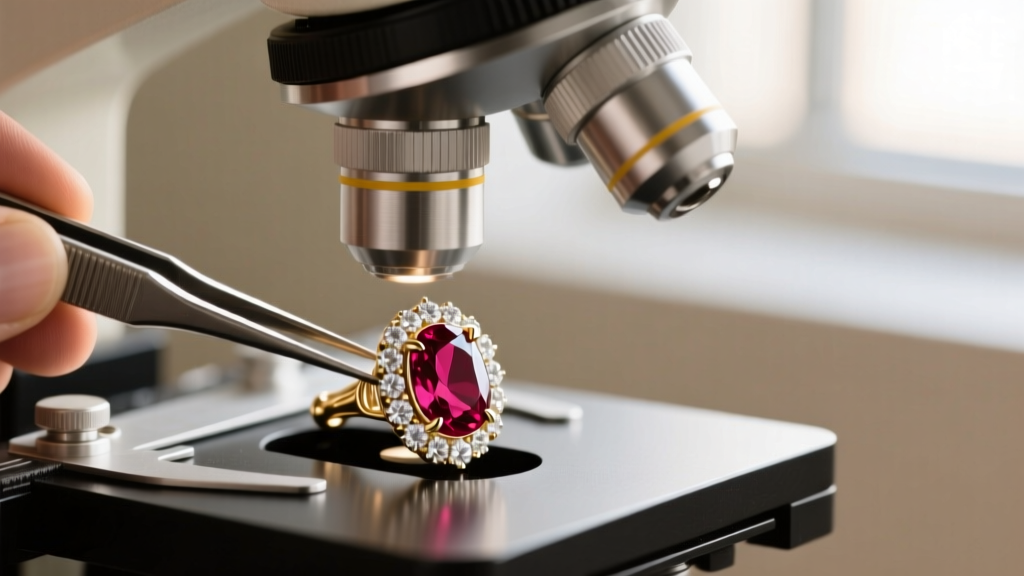
Standard prong wire for diamond jewelry is often 18-gauge (1.02mm) or 16-gauge (1.29mm). However, because rubies are frequently cut with thicker, more irregular girdles than precision-cut diamonds, they require custom-fitted prong seats. If a jeweler uses a standard diamond burr to cut a seat for a ruby, it can cause microscopic internal fractures.
Bench Jeweler Insight: Never use a standard diamond-coated burr to seat a ruby. The diamond grit can embed itself into the ruby's surface or cause micro-fractures along the stone's parting planes. Always use high-quality carbide or ruby-inlay burs for cutting corundum seats.
If you notice your ruby rattling or shifting, do not attempt to push the prongs down yourself with pliers. 14k and 18k gold undergo work-hardening; bending a fatigued prong back over the stone will often cause the prong to snap entirely. According to the American Gem Society, professional re-tipping (adding new metal to the worn prong tip) costs roughly $35 to $65 per prong, while rebuilding an entire head can range from $120 to $250 depending on the karat and complexity.
Cleaning Disasters: Heat, Chemicals, and Ultrasonics
The most catastrophic damage to diamond ruby jewelry occurs during cleaning. While diamonds are virtually impervious to standard jewelry cleaning chemicals, rubies are heavily treated in the global market. As of 2026, lead-glass filled (composite) rubies remain highly prevalent in secondary markets and lower-tier commercial jewelry.
| Cleaning Method | Diamond Safety | Untreated / Heat-Treated Ruby | Lead-Glass Filled Ruby | Beryllium Diffused Ruby |
|---|---|---|---|---|
| Ultrasonic Cleaner | Safe (if no feathers) | Generally Safe | SEVERE RISK (Shatters filler) | Safe |
| Steam Cleaner | Safe | Safe | HIGH RISK (Thermal shock) | Safe |
| Warm Soapy Water | Safe | Safe | Safe (Use pH neutral soap) | Safe |
| Acidic Solutions (e.g., Pickle) | Safe | Safe | FATAL (Dissolves glass) | Safe |
According to the Gemological Institute of America (GIA), lead-glass filled rubies are highly susceptible to even mild acids. If a bench jeweler accidentally exposes your composite ruby to jeweler's pickle (an acidic solution used to clean metal after soldering) or even common household lemon juice, the glass filler will dissolve, leaving the ruby looking opaque, heavily fractured, and structurally compromised. Always verify your ruby's treatment status via a gemological lab report before allowing ultrasonic or chemical cleaning.
Color Fading and Coating Failures
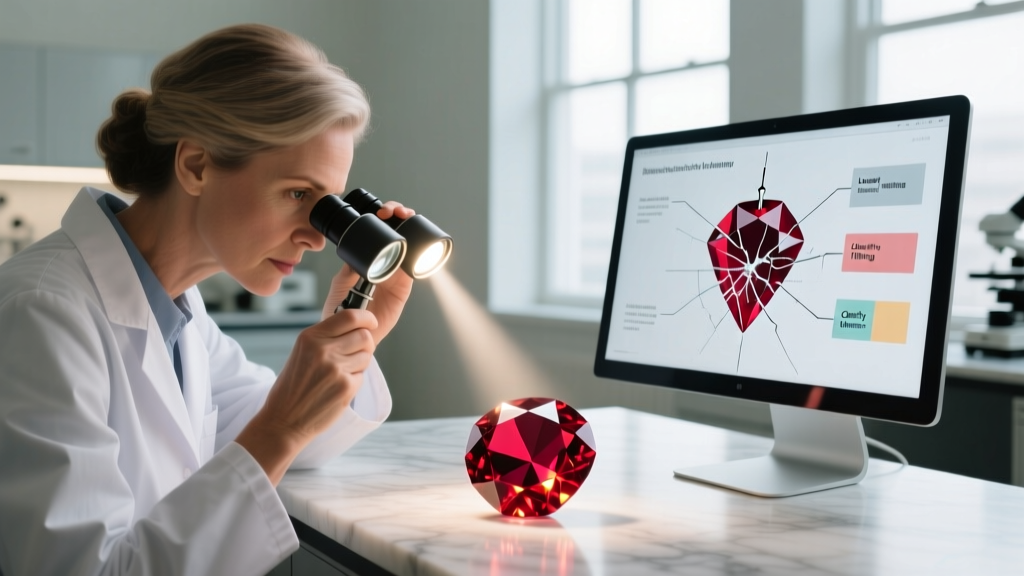
Another troubleshooting scenario involves color inconsistency. If your ruby appears to be fading or revealing a lighter, pinkish undertone near the facet edges, you are likely dealing with a surface-coated or lattice-diffused stone.
Identifying Beryllium Diffusion Wear
Beryllium diffusion is a treatment where light-colored sapphires or rubies are heated with beryllium to induce a deep red or orange color. Because beryllium atoms are small, they can penetrate the entire stone. However, older diffusion techniques or surface coatings only penetrate a few millimeters.
If a ruby in your diamond halo ring takes a hard knock against a doorframe, it may chip. If the chip reveals a pale pink or colorless interior, the stone was surface-treated. Troubleshooting this requires replacing the stone entirely, as a lapidary cannot re-polish a coated stone without stripping the color entirely. Always purchase diamond ruby jewelry accompanied by a GIA or AGL (American Gemological Laboratories) report that explicitly states 'No indications of heating' or details the exact diffusion treatment.
Rhodium Plating Risks for White Gold Settings
Most diamond ruby jewelry is crafted in 14k or 18k white gold, which requires periodic rhodium plating to maintain its bright white appearance. The troubleshooting issue here arises during the pre-plating polishing and cleaning stages.
- The Ultrasonic Trap: Jewelers typically place pieces in an ultrasonic cleaner to remove polishing compounds before rhodium plating. If the ruby is fracture-filled, this step will destroy it.
- The Heat Factor: While rhodium plating itself uses a mild electrical current and warm solutions, aggressive pre-polishing with a rouge wheel can generate localized heat on the prongs, potentially causing thermal shock to a heavily included ruby.
Actionable Advice: When taking your diamond ruby jewelry in for rhodium plating, explicitly instruct the jeweler to avoid ultrasonic cleaning and to mask or protect the ruby if there is any doubt regarding its treatment status. A reputable bench jeweler will clean the piece manually with a soft brush and mild dish soap before plating.
When to Seek Professional Lapidary vs. Bench Jeweler Services
Knowing who to hire for specific damage is half the battle in jewelry troubleshooting. Bench jewelers and lapidaries possess entirely different skill sets and equipment.
- Hire a Bench Jeweler For: Sizing rings, re-tipping prongs, soldering broken shanks, replacing missing side diamonds, and rhodium plating.
- Hire a Lapidary For: Re-polishing abraded ruby facets, re-cutting a chipped ruby girdle, removing deep surface scratches from the corundum, and custom-cutting a replacement ruby to fit an existing diamond halo mounting.
By understanding the distinct physical properties and market treatments of rubies and diamonds, you can proactively troubleshoot wear, avoid catastrophic cleaning errors, and ensure your diamond ruby jewelry remains pristine for generations.