Expert Care and Cleaning for Quartz Jewelry Stones
Learn expert cleaning methods, storage tips, and variety-specific care for quartz jewelry stones to maintain their clarity and brilliance.

The Science of Quartz: Why Hardness Isn't Invincibility
Quartz is one of the most abundant minerals on Earth, yet treating it as indestructible is a common mistake that leads to ruined jewelry. On the Mohs scale of mineral hardness, quartz ranks at a 7. While this means it is harder than most everyday dust and dirt (which typically contains quartz particles at a 7), it is softer than topaz (8), corundum (9), and diamond (10). More importantly, hardness only measures scratch resistance, not toughness.
Quartz lacks true cleavage, meaning it does not split along defined crystallographic planes. However, it exhibits a conchoidal fracture, making it susceptible to chipping if struck against a hard surface at the wrong angle. Furthermore, quartz has moderate thermal conductivity. Sudden temperature changes can cause internal stress fractures, a phenomenon known as thermal shock. Understanding these physical properties is the first step in properly maintaining your quartz jewelry stones.
Step-by-Step Cleaning Protocol for Quartz Jewelry Stones
Because quartz is non-porous, it does not absorb oils and lotions as deeply as organic gems like pearls or turquoise. However, the facets and the gallery (the underside of the stone) easily trap dead skin cells, soap scum, and cosmetic residues, which dull the stone's refractive brilliance.
The Safest Method: Warm Soapy Soak
For standard macrocrystalline quartz (clear, rose, smoky, amethyst, citrine), the warm soapy soak is the gold standard for safe, effective cleaning.
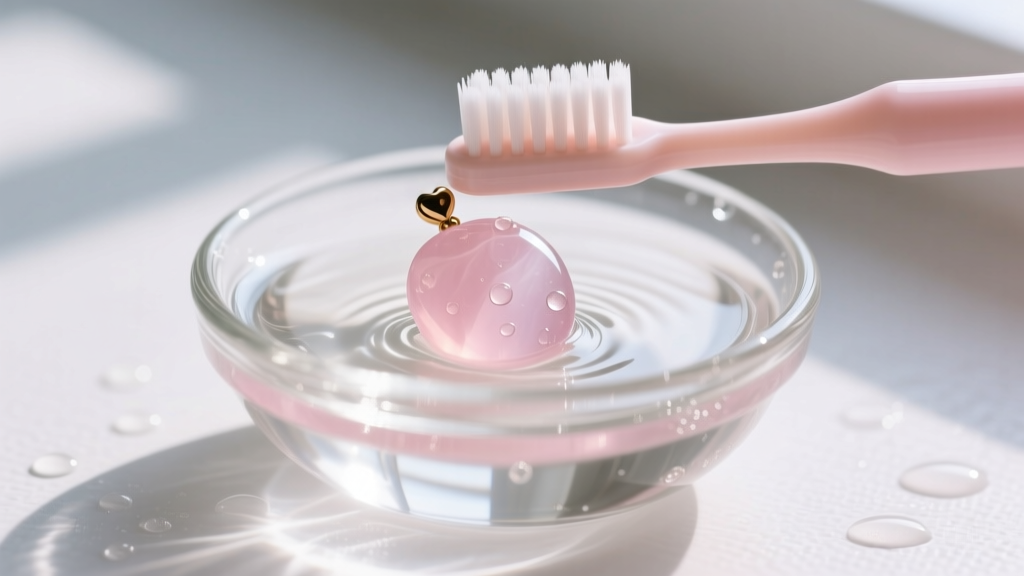
- The Solution: Mix 1 cup of lukewarm water (around 85°F or 29°C) with 2 drops of a mild, pH-neutral dish soap. Avoid harsh detergents or soaps with heavy moisturizers, which leave a film.
- The Soak: Submerge the jewelry for 10 to 15 minutes. This loosens the microscopic debris trapped in the prong settings and facet junctions.
- The Agitation: Use an extra-soft baby toothbrush. Standard adult toothbrushes have stiff nylon bristles that can micro-scratch the precious metal settings (like 14k gold or sterling silver) and push abrasive dirt particles against the quartz.
- The Rinse: Rinse thoroughly under lukewarm running water. For the best results, use distilled water for the final rinse to prevent hard water mineral spots from drying on the stone's surface.
- The Dry: Pat dry with a lint-free microfiber cloth. Avoid paper towels, as their wood-pulp fibers can cause micro-abrasions on polished metal over time.
What to Avoid: Ultrasonic and Steam Cleaners
While many jewelers use ultrasonic cleaners, they are a significant risk for quartz jewelry stones. The high-frequency vibrations can easily shake loose stones from worn prongs and, more critically, can widen pre-existing internal fractures that are invisible to the naked eye. Steam cleaners are even more dangerous due to the risk of thermal shock. The sudden blast of 212°F (100°C) steam hitting a room-temperature stone can cause it to fracture internally or shatter entirely.
Variety-Specific Care: Not All Quartz is Equal
The term "quartz" covers a wide array of gemstones, and specific varieties require tailored care protocols. Treatments, inclusions, and color centers drastically alter how a stone reacts to light, heat, and chemicals.
| Quartz Variety | Unique Vulnerabilities | Specific Care Instructions |
|---|---|---|
| Clear Quartz | Fracture-prone if included | Standard soapy soak. Avoid ultrasonic if liquid inclusions or internal fractures are visible. |
| Rose Quartz | UV and heat sensitivity | Keep out of direct, prolonged sunlight to prevent color fading. Never use steam or boiling water. |
| Smoky Quartz | Extreme UV fading | Store in dark pouches. Prolonged exposure to harsh sunlight can bleach the brown color centers to gray or clear. |
| Rutilated / Tourmalinated | Inclusion weak points | The internal rutile or tourmaline needles create structural weak points. Strictly hand-wash; zero ultrasonic use. |
| Mystic / Aura Quartz | Surface coatings | Coated with titanium or gold vapor. Wipe only with a damp microfiber cloth. No soaking, no brushes, no chemicals. |
Chemical Resistance and Environmental Hazards
Quartz is highly resistant to most common acids, which is why it survives in soil long after other minerals dissolve. However, it is highly vulnerable to hydrofluoric acid. While you won't find this in standard household cleaners, it is a primary ingredient in heavy-duty rust removers, aluminum brighteners, and some masonry cleaners. If you are doing home renovation or automotive work, always remove your quartz rings to prevent the stone's surface from being permanently etched and frosted.
Additionally, while quartz is resistant to chlorine, repeated exposure to heavily chlorinated pool water can degrade the alloys in your gold or silver settings, eventually leading to prong failure and stone loss.
Storage and Wearability: Preventing Micro-Abrasions
Proper storage is just as critical as cleaning. Because quartz sits at a 7 on the Mohs scale, it acts as a middle-ground abrasive in a jewelry box.
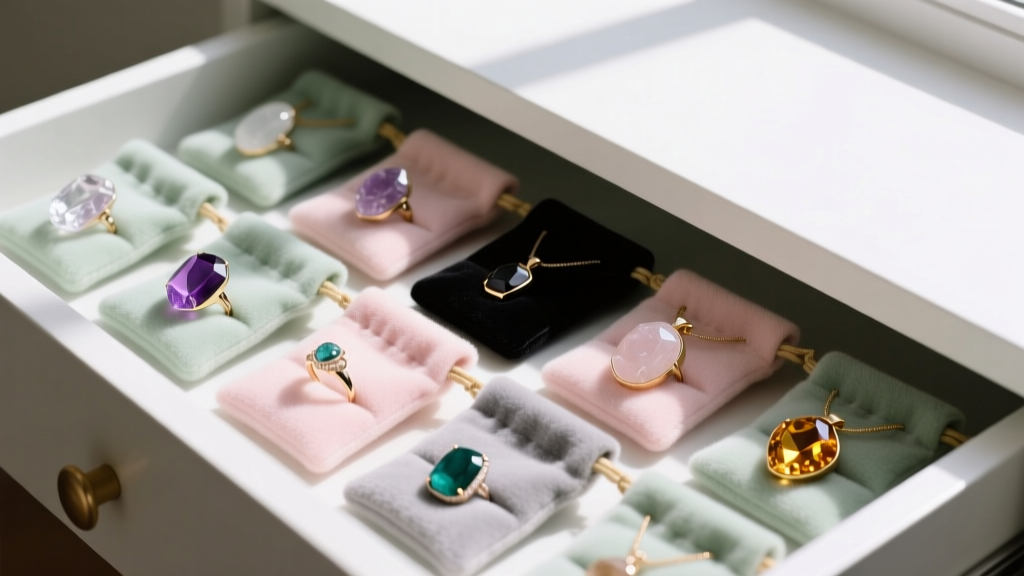
If you toss a quartz ring into a communal jewelry dish alongside a diamond or sapphire ring, the harder stones will easily scratch the quartz. Conversely, if stored loose with sterling silver or high-karat gold (which sit around 2.5 to 3 on the Mohs scale), the quartz will heavily scratch the metal. According to mineralogical data from Mindat.org, the physical interaction between varying hardness levels is the primary cause of degraded gemstone polish.
The Solution: Store every piece of quartz jewelry individually. Use soft, anti-tarnish flannel pouches or individual compartments in a fabric-lined jewelry box. For travel, use a hard-shell jewelry roll with separate zippered polyethylene compartments to prevent the stones from knocking against one another.
Troubleshooting Common Quartz Issues
Cloudiness and Hard Water Spots
If your clear quartz looks cloudy even after a thorough wash, it is likely suffering from hard water mineral buildup or a heavy film of cosmetic oils. To strip this safely, mix a 50/50 solution of distilled water and 90% isopropyl alcohol. Dip a soft cotton swab into the solution and gently roll it over the facets. The alcohol cuts through the oils and evaporates quickly without leaving mineral deposits behind.
Loose Settings and Rattling
If you hear a faint clicking or rattling when you tap your quartz ring against your finger, the stone is loose in its setting. Quartz is often cut with slightly uneven girdles, making it challenging for jewelers to seat perfectly. Stop wearing the piece immediately and take it to a professional jeweler to have the prongs tightened or the bezel burnished down. Continuing to wear a loose quartz stone will cause the metal setting to act like a file, slowly grinding away the stone's girdle until it chips.
Conclusion
Maintaining the optical clarity and structural integrity of quartz jewelry stones requires moving beyond generic jewelry advice. By respecting the stone's thermal limits, avoiding ultrasonic vibrations, and understanding the specific vulnerabilities of treated or included varieties, you can ensure your quartz pieces remain brilliant for a lifetime. Consistent, gentle cleaning with the right tools is the ultimate secret to preserving the natural fire of this remarkable silicate mineral.