Obsidian Jewelry Buying Guide: How to Spot Fakes & Choose Settings
Discover how to buy authentic obsidian jewelry. Learn to identify fakes, compare varieties like snowflake and sheen, and choose the safest settings.

Introduction: Understanding Volcanic Glass in Jewelry
Obsidian is not a traditional crystal; it is a naturally occurring volcanic glass formed when felsic lava extrudes from a volcano and cools so rapidly that atoms are unable to arrange themselves into a crystalline lattice. This amorphous structure gives obsidian its signature glassy luster and conchoidal (shell-like) fracture pattern. For jewelry buyers, this unique geological origin presents a specific set of challenges and opportunities.
With a Mohs hardness rating of 5 to 5.5, obsidian is significantly softer and more brittle than quartz or beryl. It scratches easily and is highly susceptible to chipping upon impact. Therefore, buying obsidian jewelry requires looking past the stone's deep, mysterious beauty to critically evaluate the lapidary cut, the structural integrity of the setting, and the authenticity of the material. This guide provides the technical framework needed to navigate the obsidian market confidently.
The Lapidary Reality: Cabochons vs. Carvings vs. Facets
When shopping for obsidian jewelry, you will notice a distinct lack of faceted stones. Because obsidian lacks a crystal lattice, it does not possess the optical dispersion (fire) that makes faceted diamonds or sapphires sparkle. Instead, its beauty lies in its reflectivity, color banding, and inclusions.
- Cabochons: The most common and safest cut. A high-dome cabochon minimizes the surface area of the stone's edges, reducing the risk of chipping while showcasing the stone's internal sheen or patterns.
- Carvings and Cameos: Obsidian's conchoidal fracture allows master carvers to create incredibly sharp, detailed edges. However, carved pieces should be reserved for pendants or brooches, never rings or bracelets where they will face blunt force.
- Faceted Obsidian: Rare and usually reserved for expert lapidaries. If you find faceted obsidian, inspect the girdle and facet junctions under a 10x loupe for micro-chipping, a common failure mode during the cutting process.
Decoding Obsidian Varieties: Beyond Basic Black
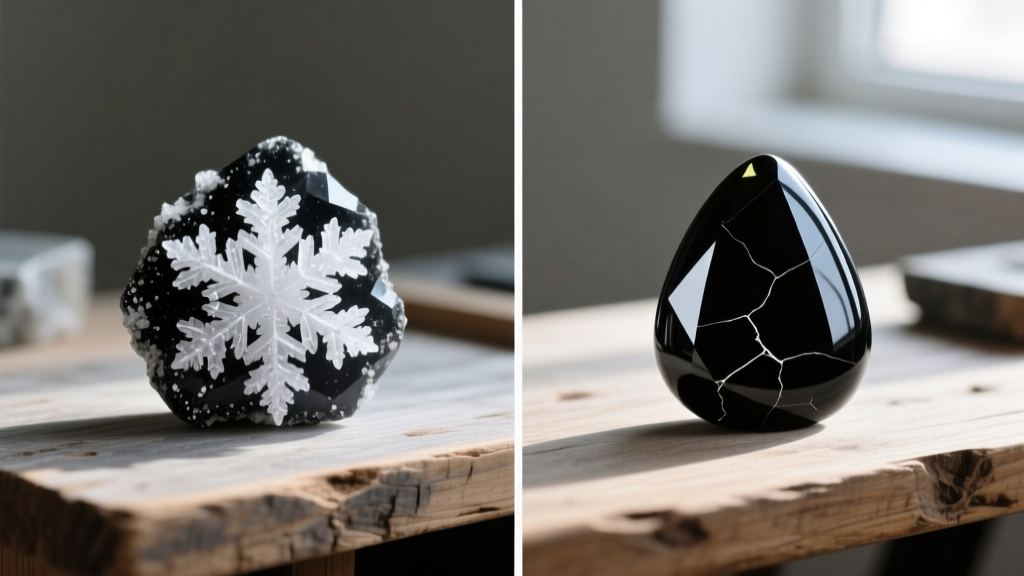
While pure black obsidian is the most recognized, the presence of trace elements and mineral inclusions creates several highly sought-after varieties. Understanding these variations is crucial for accurate valuation.
| Variety | Visual Characteristics | Inclusion / Cause | Avg. Cab Price (20x30mm) | Best Jewelry Application |
|---|---|---|---|---|
| Snowflake | Black base with distinct white or gray radial clusters | Cristobalite (quartz polymorph) | $8 - $18 | Pendants, Statement Rings |
| Mahogany | Swirling bands of deep red, brown, and black | Iron oxide / Magnetite nanoparticles | $10 - $25 | Carved Cameos, Cufflinks |
| Golden Sheen | Black base with a brilliant gold/copper metallic flash | Aligned magnetite/ilmenite inclusions | $25 - $60 | Bezel Rings, High-end Pendants |
| Apache Tear | Small, naturally rounded, semi-transparent black nodules | Natural hydration and weathering | $3 - $8 (per piece) | Wire-wrapped Pendants, Rosaries |
| Rainbow / Fire | Iridescent bands of green, purple, and gold | Nanometer-thin layers of magnetite | $40 - $120+ | Collector Cabochons, Custom Bezels |
The Authenticity Test: Spotting Glass and Onyx Fakes
Because obsidian is essentially natural glass, it is frequently faked using manufactured black glass, smelted slag, or even dyed resin. Furthermore, unscrupulous sellers often mislabel black onyx (a much harder, more valuable cryptocrystalline quartz) as obsidian to inflate prices. Here is how to verify your stone according to mineralogical standards.
1. The Magnification Test (Loupe Required)
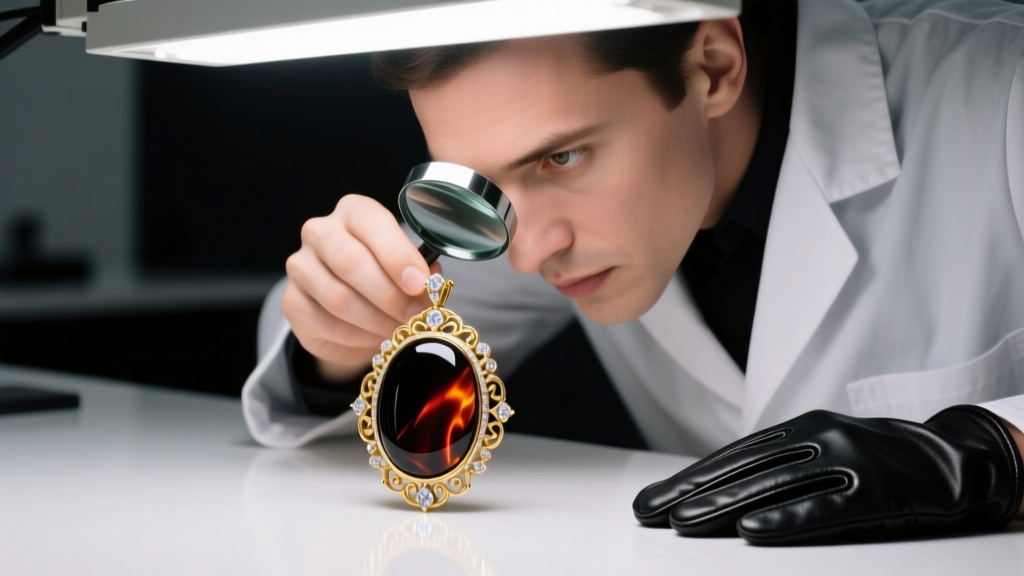
Examine the stone under a 10x jeweler's loupe. Manufactured glass will almost always contain perfectly spherical gas bubbles trapped during the smelting process. Genuine obsidian may contain voids, but they are typically elongated or irregular, following the flow lines of the cooling lava. You may also spot tiny, needle-like inclusions or the distinct white cristobalite clusters in snowflake varieties.
2. Thermal Conductivity
Obsidian has a lower thermal conductivity than crystalline quartz (onyx). When you touch genuine black onyx to your cheek or lips, it will feel noticeably colder and take longer to warm up to your body temperature than obsidian. While subjective, this is a rapid field test used by experienced gemologists.
3. The Scratch Test (Proceed with Caution)
Obsidian sits at 5-5.5 on the Mohs scale. A standard steel knife blade (Mohs 5.5) will struggle to scratch high-quality obsidian but will easily scratch manufactured soda-lime glass (Mohs 4.5-5) or plastic imitations. Never perform this test on the face of a polished stone; test an unpolished edge or the bottom of a cabochon.
Setting Selection: Engineering Around Conchoidal Fractures
The most critical point of failure in obsidian jewelry is the setting. Because obsidian lacks cleavage planes, it does not split predictably; instead, it shatters and chips unpredictably along conchoidal curves. The setting must act as a shock absorber and a physical barrier.
Settings to Avoid
- Prong Settings: Never buy an obsidian ring held in by four or six prongs. The exposed girdle and corners are guaranteed to chip against doors, desks, and steering wheels. Furthermore, the localized pressure of a prong tightening can easily crack the amorphous glass.
- Tension Settings: The immense pressure required to hold a stone in a tension mount will instantly shatter volcanic glass.
- Channel Settings with Sharp Corners: If the stone has sharp geometric corners (like a baguette cut), the corners will fracture under daily wear.
Settings to Demand
- Full Bezel: A thick metal rim that completely encircles the girdle of the cabochon is mandatory for obsidian rings. Ensure the bezel wire is at least 0.5mm thick to provide adequate structural support.
- Halo Settings: A halo of smaller, harder gemstones (like black spinel or white sapphire) surrounding the central obsidian acts as a physical bumper, taking the brunt of lateral impacts.
- Recessed / Gypsy Settings: Setting the stone flush with the metal surface, where the metal rises slightly above the stone's dome, offers excellent protection for daily-wear rings.
Pricing Tiers & Market Valuations
Obsidian is an abundant material, meaning the raw stone itself is inexpensive. When buying obsidian jewelry, you are primarily paying for the lapidary artistry, the metalwork, and the brand prestige.
- Mass-Market / Tourist Grade ($15 - $45): Typically features poorly polished black obsidian in thin, stamped sterling silver or silver-plated settings. Often mislabeled and prone to rapid tarnishing and stone pop-outs.
- Artisan / Lapidary Grade ($80 - $250): The sweet spot for buyers. Features precision-cut cabochons (especially Golden Sheen or Rainbow varieties) set in heavy-gauge, cast or fabricated sterling silver or 14k gold with proper bezel engineering.
- Designer / High Jewelry ($400 - $1,500+): Obsidian is occasionally used by high-end houses (like David Yurman or Stephen Webster) as a dark, dramatic backdrop for diamond accents. Here, you are paying for the designer's name and the precision of the surrounding diamond pavé.
Care Protocols: Preventing Thermal and Mechanical Shock
Once you have acquired a quality piece of obsidian jewelry, maintenance requires strict adherence to thermal and mechanical boundaries.
- Beware of Thermal Shock: Because it is glass, sudden temperature changes will cause obsidian to fracture internally. Never wear obsidian rings in hot tubs, saunas, or while washing dishes in scalding water. Never clean it with steam.
- No Ultrasonic Cleaners: The high-frequency vibrations of an ultrasonic jewelry cleaner will exploit micro-fractures in the stone, causing it to crack or completely shatter. Clean only with warm water, mild dish soap, and a microfiber cloth.
- Storage Isolation: Store obsidian pieces in individual soft pouches. If tossed into a jewelry box with diamonds, sapphires, or even quartz, the harder stones will leave deep, permanent scratches across the obsidian's polished surface.
By prioritizing protective settings, verifying inclusions under magnification, and respecting the stone's amorphous limitations, you can confidently acquire obsidian jewelry that remains as striking and intact as the day it was forged in volcanic fire.