Best Jewelry Cleaner for Gold: Budget and Value Guide
Discover if premium jewelry cleaner for gold is worth the cost. We compare budget DIY, commercial liquids, and ultrasonic machines for true value.

When evaluating the best jewelry cleaner for gold, consumers are often caught between two extremes: expensive, branded chemical solutions and free homemade hacks. As we navigate the 2026 jewelry care market, the sheer volume of cleaning products can make it difficult to determine where your money is actually going. Does a $15 bottle of premium liquid cleaner offer a superior shine compared to a $3 bottle of dish soap? Is a $50 ultrasonic machine a worthwhile investment, or a fast track to damaging your favorite pieces?
Gold itself is a noble metal and does not tarnish. However, the alloys mixed with gold to create durable jewelry—such as copper, silver, nickel, and zinc—are highly reactive. Understanding the metallurgy of your gold jewelry is the first step in assessing the true value and safety of any cleaning method. In this comprehensive budget and value assessment, we break down the ROI of commercial liquids, ultrasonic technology, and DIY solutions to help you protect your investment without overspending.
The Chemistry of Gold Alloys: Why Your Cleaner Matters
Pure 24k gold (99.9% gold) is remarkably inert. You could drop a 24k gold coin in harsh acid, and it would remain unaffected. However, 24k gold is far too soft for daily wear jewelry, which is why it is alloyed with other metals. The karat system dictates the purity: 18k is 75% gold, 14k is 58.3% gold, and 10k is 41.7% gold. The remaining percentage consists of alloy metals that provide structural integrity and color (like the copper used in rose gold), but these metals are susceptible to oxidation, tarnish, and chemical degradation.
This metallurgical reality is why choosing the right jewelry cleaner for gold is critical. Many budget or multi-purpose jewelry cleaners contain high concentrations of ammonia or chlorine derivatives. According to the Gemological Institute of America (GIA), exposure to chlorine and harsh chemicals can cause 'stress corrosion cracking' in karat gold, particularly in lower karats like 10k and 14k. This failure mode causes the metal to become brittle and eventually snap at stress points, such as the clasps of a chain or the prongs of a ring. Therefore, the 'value' of a cleaner is not just about how well it shines the metal, but how safely it preserves the structural integrity of the alloys over decades of use.
Commercial Liquid Cleaners: Budget vs. Premium Breakdown
Walk into any department store, and you will see rows of commercial liquid gold cleaners. Brands like Connoisseurs, Blitz, and Hagerty dominate the shelf space, with prices typically ranging from $6 to $15 per bottle. But what are you actually paying for?
What is Inside the Bottle?
Most commercial liquid cleaners are essentially water mixed with mild non-ionic surfactants, a small amount of ammonia (for cutting through grease and oils), and sometimes a light tarnish inhibitor. Premium brands often include specialized conditioning agents designed to leave a micro-thin protective film on the metal, which temporarily repels fingerprints and skin oils.
- Budget Commercial Cleaners ($5 - $8): Typically rely on higher ammonia concentrations to cut through sebum and lotion buildup. While effective for quick shine, frequent use can degrade the rhodium plating on white gold and accelerate wear on porous gemstones.
- Premium Commercial Cleaners ($10 - $18): Formulated with gentler, plant-based surfactants and specialized chelating agents that bind to dirt without relying on harsh alkalines. They offer a safer long-term value for intricate pieces and gemstone-set jewelry.
Pro-Tip: If your 14k or 18k gold jewelry features soft, porous gemstones like pearls, opals, emeralds, or turquoise, avoid all liquid commercial cleaners. The chemicals can seep into the microscopic fissures of these stones, causing permanent clouding or structural failure.
Cost-Per-Use Comparison Matrix
To truly assess value, we must look beyond the upfront price tag and evaluate the cost-per-use, safety profile, and efficacy of each cleaning method available on the market today.
| Cleaning Method | Upfront Cost | Cost Per Use | Best Suited For | Risk Level |
|---|---|---|---|---|
| Premium Liquid Cleaner | $12 - $18 | $0.15 - $0.25 | 18k/14k gold with diamonds/sapphires | Low |
| Budget Ammonia Cleaner | $5 - $8 | $0.05 - $0.10 | Plain 10k/14k gold chains, no gems | Medium |
| Ultrasonic Machine | $40 - $80 | $0.01 (electricity) | Heavy soil, plain chains, durable gems | Medium-High |
| DIY Dish Soap Method | $3 (bottle) | < $0.01 | All gold karats, delicate settings | Very Low |
Ultrasonic Cleaners: A High-Upfront Investment for Solid Gold
Ultrasonic jewelry cleaners have surged in popularity, with consumer-grade models from brands like Magnasonic and iSonic retailing between $40 and $80. These machines use high-frequency sound waves (typically around 42,000 Hz) to create microscopic bubbles in a liquid solution. When these bubbles collapse against the surface of the gold, they create tiny, high-pressure jets that blast away dirt, oils, and tarnish from microscopic crevices that a brush simply cannot reach.
The Value Proposition of Cavitation
From a pure cleaning efficacy standpoint, an ultrasonic cleaner offers unmatched value for heavily soiled items. If you wear a 14k yellow gold Cuban link chain daily, the intricate links will accumulate a paste-like mixture of dead skin, soap scum, and environmental dust. An ultrasonic cleaner will restore a factory-new shine in just three minutes, using only water and a few drops of mild dish soap. The cost-per-use quickly drops to fractions of a penny, making the ROI undeniable for frequent wearers.
When to Avoid Ultrasonics (Failure Modes)
Despite their effectiveness, ultrasonics are not a universal solution. The violent cavitation process can cause severe damage if used incorrectly:
- Hollow Chains: Thin, hollow 14k gold chains (like 1.2mm hollow rope chains) can suffer structural fatigue from the vibrations, leading to snapping.
- Fractured Gemstones: Diamonds with internal feathers or inclusions can shatter under ultrasonic pressure.
- Loose Prongs: If your gold ring has worn or loose prongs, the vibrations will shake the gemstone completely out of its setting. Always have a jeweler check your prongs annually before relying on ultrasonic cleaning.
DIY and Homemade Solutions: The Ultimate Budget Hack?
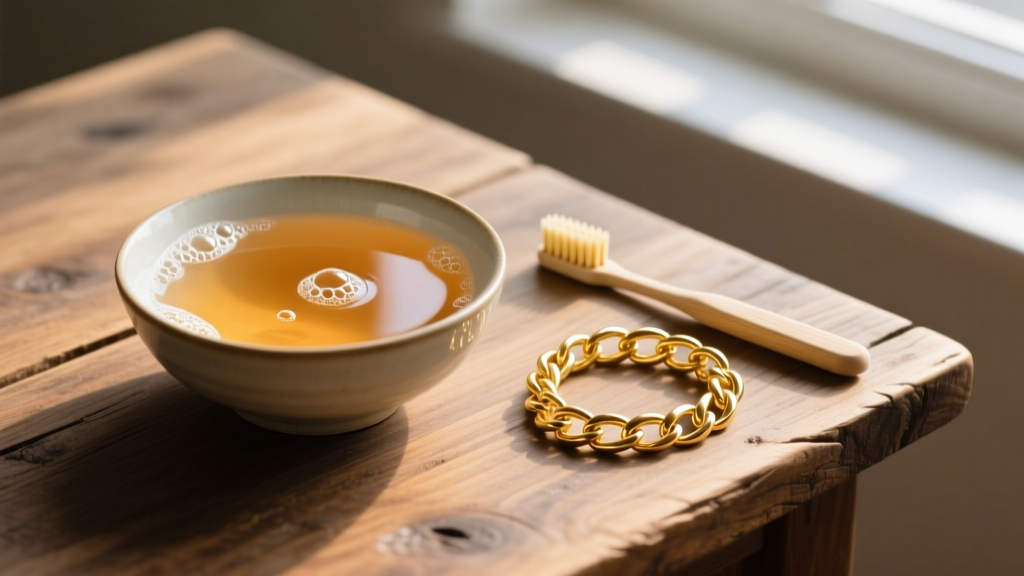
For the budget-conscious consumer, the DIY method remains the gold standard for safe, effective, and virtually free cleaning. The Federal Trade Commission (FTC) and leading gemologists frequently note that a simple solution of warm water and a few drops of mild, phosphate-free dish soap (like Dawn Platinum) is sufficient for 95% of routine gold maintenance.
The Optimal DIY Protocol
- Preparation: Fill a small ceramic or glass bowl with warm (not hot) water. Add three drops of mild dish soap and agitate to create suds.
- Soaking: Submerge your gold jewelry for 15 to 20 minutes. This allows the surfactants to break down the lipid bonds of skin oils and lotions.
- Agitation: Using a brand-new, ultra-soft baby toothbrush, gently brush the jewelry. Pay special attention to the backs of settings and the interiors of chain links. Never use stiff-bristled brushes, as they can leave micro-scratches on high-polish 18k and 24k gold.
- Rinsing and Drying: Rinse thoroughly under lukewarm running water (ensure the drain is plugged!). Pat dry with a lint-free microfiber cloth. Avoid paper towels, as the wood fibers can cause microscopic abrasions over time.
The primary drawback of the DIY method is the manual labor required. It lacks the 'set it and forget it' convenience of an ultrasonic machine and doesn't offer the instant chemical gratification of a commercial dip. However, in terms of sheer safety and long-term preservation of your gold's structural integrity, the DIY method is virtually unbeatable.
Value Assessment Matrix: Which Gold Type Needs Which Cleaner?
To maximize your budget, match your cleaning method to the specific type of gold jewelry you own. Using the wrong method is a waste of money at best, and a destructive mistake at worst.
- Plain 10k and 14k Gold Chains (No Gems): Budget commercial dips or ultrasonic cleaners offer the best time-to-value ratio here. The higher alloy content means these pieces can handle slightly more aggressive cleaning to remove heavy tarnish.
- 18k Gold Engagement Rings (Diamond/Sapphire): Premium commercial liquids or the DIY dish soap method. You want gentle surfactants that won't degrade the setting or leave a chemical residue on the gemstones.
- 22k and 24k Gold (Indian/Asian Bridal Jewelry): Strictly DIY. High-karat gold is incredibly soft and prone to scratching. Avoid ultrasonics and stiff brushes entirely. Use only a soft cloth and soapy water.
- White Gold with Rhodium Plating: DIY method only. Commercial cleaners, especially those with ammonia, can strip the rhodium plating prematurely, forcing you to pay $50–$100 for a professional re-plating job.
Final Verdict: Maximizing Your Gold Care Budget
Is a premium jewelry cleaner for gold worth the budget? The answer depends entirely on your lifestyle and the composition of your jewelry collection. If you own a large collection of intricate, gemstone-set 14k or 18k gold pieces and value convenience, a $15 bottle of premium, ammonia-free cleaner is a worthwhile investment that protects your assets. If you primarily wear plain gold chains and durable pieces, a $45 ultrasonic cleaner will pay for itself within a year through sheer efficacy and zero recurring chemical costs.
However, for the vast majority of gold jewelry owners, the humble combination of warm water, mild dish soap, and a soft brush provides 90% of the results at 1% of the cost. By understanding the metallurgy of your gold and avoiding harsh chemicals that trigger stress corrosion, you can maintain a brilliant shine while keeping your jewelry care budget firmly in the green.