The Art of Florentine Gold Jewelry: Technical Engraving Guide
Explore the technical mastery behind Florentine gold jewelry. Learn about cross-hatch engraving, karat suitability, light refraction, and expert care.

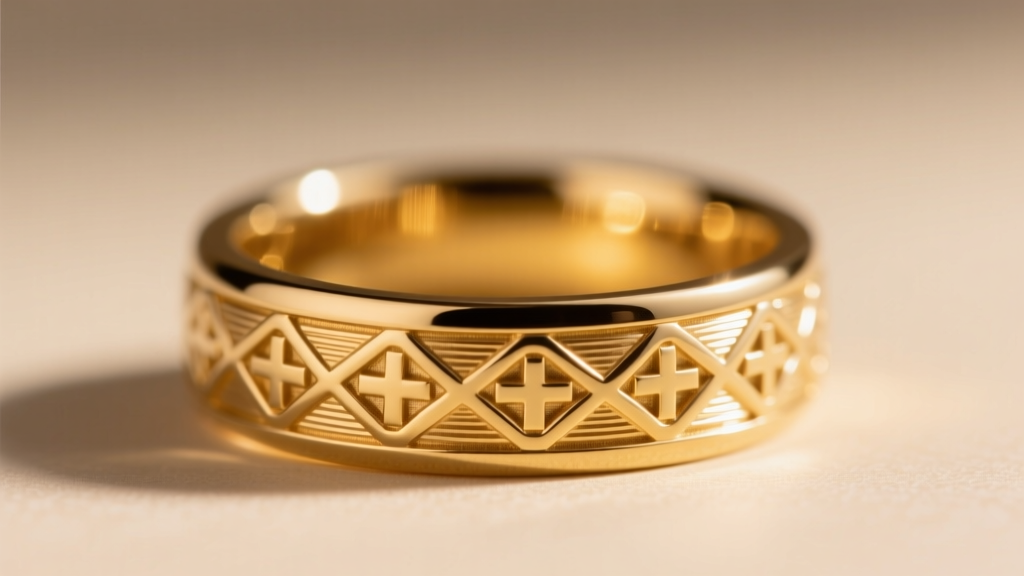
The Anatomy of a Florentine Finish
When discerning collectors and master goldsmiths discuss surface textures, few techniques command as much respect as the Florentine finish. Unlike brushed or sandblasted surfaces that rely on abrasion, Florentine gold jewelry is defined by a meticulously hand-engraved cross-hatch pattern. This technique involves cutting intersecting sets of parallel lines into the precious metal, typically at 90-degree or 45-degree angles, creating a woven, matte topography that diffuses light beautifully.
The true hallmark of a genuine Florentine finish is not merely the visual cross-hatching, but the precise depth and consistency of the grooves. Master engravers aim for groove depths between 0.05mm and 0.15mm. Anything shallower risks wearing away within a few years of daily friction, while anything deeper compromises the structural integrity of the gold piece, particularly on thin-walled castings or hollow-formed jewelry.
Tooling and Burin Mechanics
Creating this texture requires specialized gravers, also known as burins. The flat graver and the knife graver are the primary tools of choice. The geometry of the graver's face and heel is critical. A standard face angle of 90 degrees to 120 degrees is utilized to ensure the metal is sliced cleanly rather than plowed or displaced. Displaced metal creates 'burrs' or raised edges along the groove, which not only ruins the optical uniformity but also creates a rough tactile surface that snags on fabrics.
In modern ateliers, while traditional hand-push methods are still revered, pneumatic engraving systems have become the industry standard for maintaining consistent groove depth across large surface areas, such as wide bangle bracelets or the broad faces of signet rings. These pneumatic handpieces deliver thousands of micro-impacts per minute, allowing the goldsmith to guide the burin with minimal physical fatigue, ensuring the intersecting lines remain perfectly parallel.
Karat Metallurgy: How Gold Purity Dictates the Cut
Not all gold is created equal when it comes to engraving. The alloy composition drastically alters the metal's Vickers Hardness (HV), its work-hardening rate, and its tendency to 'gall' or smear under the pressure of a burin. Understanding this metallurgy is essential for both the artisan creating the piece and the consumer investing in Florentine gold jewelry.
| Gold Karat | Typical Vickers Hardness (HV) | Engraving Characteristics | Durability of Finish |
|---|---|---|---|
| 24k (Pure) | 25 - 45 HV | Too soft. Metal smears and galls. Burins drag rather than cut. | Poor. Grooves will flatten quickly with wear. |
| 18k (75% Gold) | 120 - 140 HV | The luxury sweet spot. Crisp cuts, excellent chip evacuation, rich color. | Excellent. Maintains depth and optical scattering. |
| 14k (58.3% Gold) | 140 - 160 HV | Requires sharper burin angles. Highly durable, slightly more tool wear. | Superior. Highly resistant to abrasion and flattening. |
| 10k (41.7% Gold) | 160+ HV | Can be brittle. Risk of micro-chipping the graver tip if not annealed. | Exceptional, but lacks the optical warmth of higher karats. |
According to metallurgical guidelines from the Gemological Institute of America (GIA), the alloying metals—typically copper, silver, and zinc—do more than change the color; they dictate the crystalline slip planes of the metal. In 18k yellow gold, the higher gold content allows for a smoother, more predictable cut, resulting in the lustrous, soft-matte finish that defines high-end Florentine gold jewelry. Conversely, 14k white gold, often alloyed with nickel or palladium, can be notoriously work-hardened, requiring the goldsmith to frequently anneal the piece during the engraving process to prevent stress fractures.

Optical Physics: Light Diffraction in Cross-Hatching
Why does a Florentine finish look so distinctly different from a standard matte or satin finish? The answer lies in optical physics. A sandblasted surface scatters light randomly (diffuse reflection), resulting in a flat, chalky appearance. A high-polish surface reflects light directly (specular reflection), creating harsh, blinding highlights.
The Florentine finish acts as a two-dimensional diffraction grating. The intersecting V-shaped grooves create thousands of microscopic facets. When light strikes the surface, it bounces between the walls of the grooves before reflecting back to the observer. This secondary internal reflection softens the specular highlight, giving the gold a 'woven' or 'silky' luminosity. The gold appears to glow from within rather than merely reflecting the environment. This optical phenomenon is highly dependent on the sharpness of the groove intersections; as the edges wear down over years of friction, the light scattering degrades, and the piece begins to look more like a standard brushed finish.
Authenticating Hand-Cut vs. CNC-Milled Florentine Patterns
As of 2026, the market is flooded with mass-produced jewelry claiming to feature a 'Florentine finish.' However, true Florentine gold jewelry is hand-cut or at least hand-guided via pantograph. Modern CNC (Computer Numerical Control) milling and laser etching can mimic the visual pattern, but they fail to replicate the physical topography. Here is how experts authenticate the technique:
- Groove Cross-Section: Hand-cut grooves are V-shaped with a sharp, defined valley. CNC-milled grooves often have a slight U-shape or flat bottom due to the geometry of the end-mill bits.
- Intersection Overlap: In hand-engraved pieces, the second set of cross-hatching lines slightly displaces or 'ticks' the edges of the first set. This microscopic overlapping is a hallmark of human execution. CNC machines cut both axes simultaneously or with perfect mathematical isolation, lacking this organic overlap.
- Laser Etching Depth: Laser-etched 'Florentine' patterns are purely superficial. They lack the physical depth required for light refraction and will polish away or wear off within months. Under a 10x loupe, laser marks appear burnt or melted at the edges, lacking the clean shearing action of a steel burin.
- Tool Tear-Out: Even master engravers leave microscopic 'tear-outs' or slight variations in groove width when navigating the crystalline grain boundaries of the gold alloy. Absolute, mathematical perfection is a red flag for machine milling.

Long-Term Maintenance and Abrasion Resistance
The very topography that gives Florentine gold jewelry its beauty also makes it a magnet for environmental debris. The micro-grooves readily trap sebum, dead skin cells, cosmetic lotions, and microscopic dust. Over time, this compacted debris can dull the optical scattering effect, making the gold appear muddy or grayish.
'Never subject a Florentine finish to a motorized polishing wheel. The cotton or muslin buff, combined with rouge compound, will aggressively round over the sharp peaks of the cross-hatching. You will permanently destroy the light-diffusing geometry and turn a masterwork of engraving into a mediocre satin finish.'
— Master Goldsmith Guild Technical Advisory
Expert Cleaning Protocol
To maintain the crispness of the engraving, routine cleaning must be non-abrasive. While Rio Grande Jewelry Supply recommends ultrasonic cleaners for most gold jewelry, the frequency matters. A standard 40kHz ultrasonic bath with a mild, ammonia-free alkaline detergent is highly effective at cavitation-cleaning the micro-grooves without damaging the metal.
However, steam cleaning requires caution. High-pressure steam can sometimes drive oily debris deeper into the intersections if the piece has not been pre-soaked. For mechanical agitation, experts eschew soft toothbrushes—which can leave microscopic scratches on the polished peaks of the grooves—in favor of fiberglass scratch brushes or soft brass bristle brushes. A fiberglass brush gently sweeps the valleys of the cross-hatch without altering the V-groove geometry, restoring the original light-diffusing properties of the Florentine finish.
Conclusion
Florentine gold jewelry represents a perfect synthesis of metallurgical science, optical physics, and artisanal handcraft. It is not merely a decorative afterthought but a structural manipulation of the gold's surface that fundamentally changes how the metal interacts with light. For the serious collector, understanding the burin mechanics, karat limitations, and authenticating markers of hand-engraving ensures that you are acquiring a true masterwork rather than a mass-produced, machine-milled imitation. With proper, non-abrasive maintenance, the silky, woven luster of a hand-cut Florentine finish will endure for generations.


