Beginner's Guide to Gold Jewelry Marks Identification
Learn gold jewelry marks identification with our beginner guide. Decode purity stamps, maker's marks, and hallmarks to verify your gold pieces.

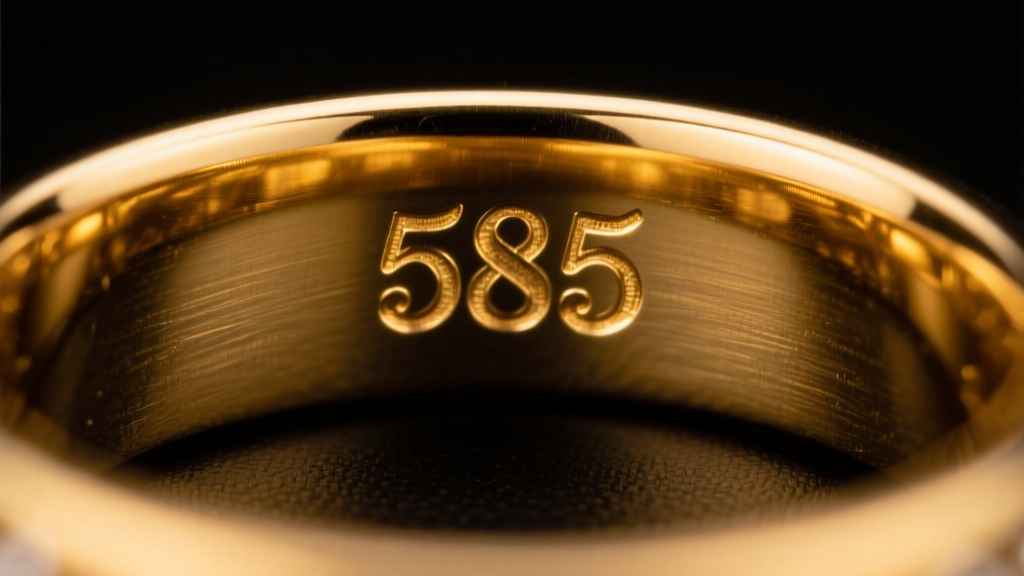
Whether you are thrifting for vintage treasures, evaluating a family heirloom, or simply trying to understand the worth of your everyday accessories, mastering gold jewelry marks identification is the single most valuable skill you can develop. A tiny stamp hidden inside a ring band or on the back of a pendant clasp holds the DNA of the piece—revealing its purity, origin, and sometimes even the exact decade it was forged.
For beginners, the alphabet soup of numbers, symbols, and microscopic letters can feel overwhelming. However, by breaking down the anatomy of jewelry stamps and understanding the legal frameworks that govern them, you can confidently authenticate pieces and avoid costly mistakes. This guide will walk you through the exact process of decoding gold marks, spotting dangerous red flags, and utilizing the right tools for the job.
The Big Three: Purity, Maker, and Assay Marks
When examining a piece of gold jewelry, you are generally looking for three distinct types of markings. While not every piece will feature all three, understanding the difference between them is the foundation of gold jewelry marks identification.
1. Purity Stamps (The Metal Content)
Purity stamps tell you exactly how much pure gold is in the alloy. Because 24-karat gold is too soft for daily wear, it is alloyed with metals like copper, silver, and zinc. Purity is expressed in two primary ways: the Karat system (predominant in the US and Asia) and the Millesimal Fineness system (predominant in Europe and modern luxury markets).
| Karat Stamp | Millesimal Stamp | Pure Gold Content | Common Alloy Traits |
|---|---|---|---|
| 10k or 10K | 417 | 41.7% | Highly durable, pale yellow hue, prone to tarnishing. |
| 14k or 14K | 585 | 58.5% | Industry standard for US jewelry, excellent balance of color and strength. |
| 18k or 18K | 750 | 75.0% | Rich, deep yellow color, softer, standard for high-end European and bridal jewelry. |
| 22k or 22K | 916 | 91.6% | Very soft, distinct orange-yellow tone, common in Middle Eastern and Indian jewelry. |
| 24k or 24K | 999 | 99.9% | Pure gold, buttery yellow, easily scratched or bent, mostly used in investment bullion. |
2. Maker's Marks (The Signature)
A maker's mark is the registered trademark or signature of the jeweler, designer, or manufacturing company. In the United States, the National Gold and Silver Stamping Act of 1906 mandated that if a piece is stamped with a purity mark (like 14k), it must also bear a registered maker's mark to ensure accountability. These can be initials, a company logo, or a specific geometric symbol enclosed in a shield or cartouche.
3. Assay and Date Letters (The Vintage Clues)
While the US relies heavily on the maker's mark and purity stamp, European countries utilize a strict Assay Office system. An assay mark guarantees that an independent government body has tested and verified the metal's purity. For example, UK gold jewelry will often feature a Crown symbol alongside the millesimal number, while French gold features an Eagle's head for 18k (750) and higher. Some regions also include date letters—a specific alphabetical character that changes yearly, allowing historians to pinpoint the exact year a piece was hallmarked.
Essential Tools for Gold Jewelry Marks Identification
You cannot accurately identify microscopic hallmarks with the naked eye. To perform a professional-grade inspection, you need a dedicated toolkit. According to the Gemological Institute of America (GIA), proper magnification and lighting are non-negotiable for evaluating jewelry stamps.
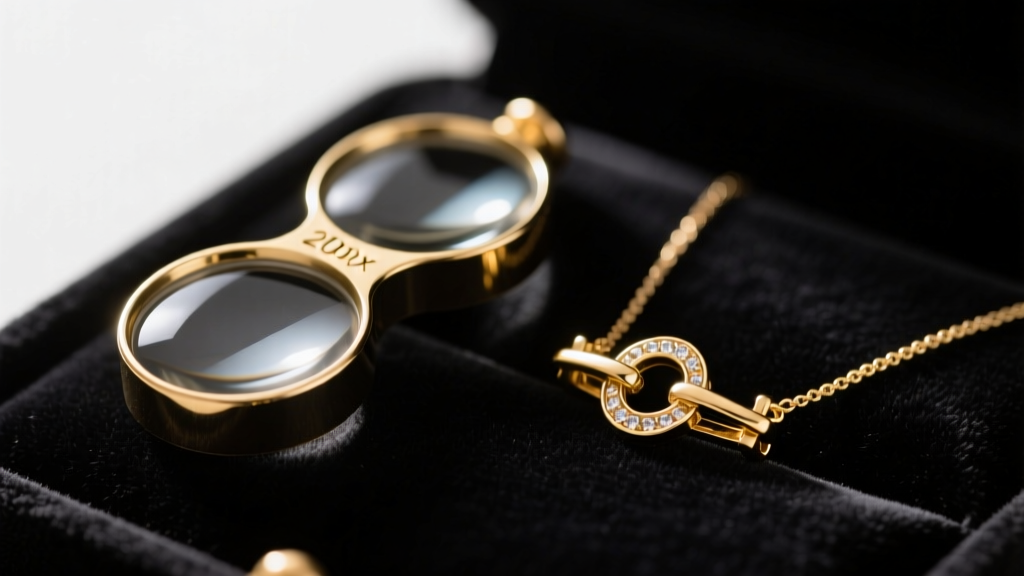
- 10x or 20x Triplet Loupe: A triplet loupe uses three lenses to eliminate edge distortion and color fringing. A 20x magnification is ideal for reading heavily worn maker's marks on vintage clasps.
- Directed LED Pen Light: Shadows hide stamps. A focused, cool-white LED beam raked at a 45-degree angle across the metal will make recessed stamps pop out visually.
- Wooden Toothpicks or Soft Brushes: Dirt, lotion, and skin cells frequently pack into the crevices of ring shanks, obscuring hallmarks. Gently cleaning the area with a soft brush is always step one.
- Neodymium Magnet: Pure gold is diamagnetic (non-magnetic). While a magnet won't confirm gold, a strong magnetic pull immediately exposes a base-metal core, saving you time.
Red Flags: When Marks Indicate Plated or Fake Gold
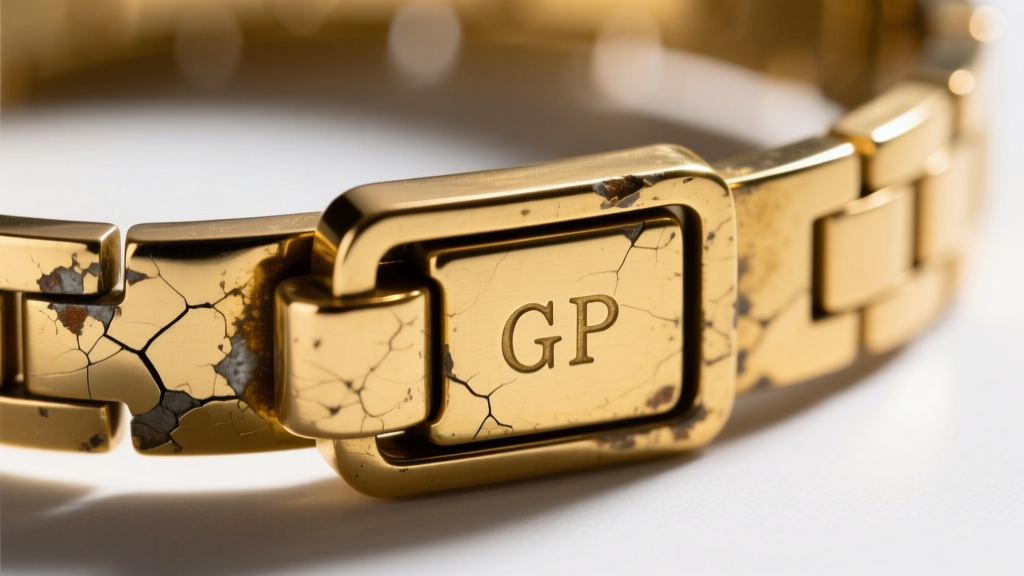
The most critical aspect of gold jewelry marks identification is knowing what indicates a piece is not solid gold. Scammers and fast-fashion manufacturers use confusing terminology to make plated items appear valuable. If you see a karat stamp accompanied by any of the following letters, you are looking at gold-plated, gold-filled, or electroplated jewelry, not solid gold.
The Plating Alphabet
- GP (Gold Plated): A microscopic layer of gold over base metal. Often wears off within months.
- GEP or EGP (Gold Electroplated): Applied via an electrical current. Slightly more durable than standard flash plating but still not solid.
- HGE (Heavy Gold Electroplate): Regulated by the Federal Trade Commission (FTC), HGE requires a gold layer of at least 100 millionths of an inch. It is durable but ultimately contains very little actual gold value.
- GF (Gold Filled): A thick layer of gold mechanically bonded to a brass core. Stamped as "1/20 14k GF," meaning 5% of the item's total weight is 14k gold. Highly durable, but not solid gold.
- Vermeil: Rarely stamped with a specific acronym, but legally must be a heavy gold plating (minimum 2.5 microns) over sterling silver (925). If you see "925" on a yellow gold piece, it is vermeil.
Expert Troubleshooting Tip: If a piece is stamped "14k" but shows no maker's mark, proceed with extreme caution. Under US law, a purity stamp without a maker's mark is a violation of the 1906 Stamping Act. While it could simply be a foreign-made import, it is also the most common hallmark found on counterfeit gold jewelry produced overseas. Always pair visual identification with an electronic gold tester or specific gravity test for unverified pieces.
Step-by-Step Gold Jewelry Marks Identification Process
When you acquire a new piece, follow this standardized inspection protocol to ensure you don't miss critical data points.
- Clean the Suspect Area: Use a microfiber cloth and a soft brush to clear debris from the inside of ring bands, the back of earring posts, and the tongues of necklace clasps.
- Locate the Primary Stamp: Shine your pen light at an oblique angle. Look for the purity mark (e.g., 585, 14k). Note the font and depth of the stamp; genuine vintage stamps are often slightly asymmetrical due to hand-hammering, while modern laser stamps are perfectly uniform.
- Hunt for the Maker's Mark: Usually located adjacent to the purity stamp. If you find a logo or initials, use a hallmark directory or database to cross-reference the symbol.
- Check for Plating Suffixes: Ensure there are no microscopic letters like 'P' (which can mean 'Plumb' gold—an exact karat weight—or 'Plated', depending on the era and accompanying marks) or 'GF' hiding behind the main stamp.
- Verify with Secondary Testing: Marks can be faked by stamping a base-metal counterfeit. Always verify high-value items using an acid scratch test or X-ray Fluorescence (XRF) spectrometer analysis at a local jeweler.
International Variations in Gold Hallmarks
If you are buying estate jewelry or shopping internationally, you must adapt your identification strategy. A piece without a "14k" stamp isn't necessarily fake; it might simply be European.
In the United Kingdom, the Hallmarking Act of 1973 requires three compulsory marks: the Sponsor's (maker's) mark, the Fineness mark (e.g., 375 for 9k, 750 for 18k), and the Assay Office mark (like an anchor for Birmingham or a leopard's head for London). In France, the system relies heavily on pictograms. An Eagle's head guarantees a minimum of 18k (750) gold, while a boar's head was historically used for lower karats and silver mixes. In Italy, you will often see a provincial mark alongside a registration number, such as "1234 AR" (where AR stands for the province of Arezzo, a massive hub for gold manufacturing).
Conclusion
Mastering gold jewelry marks identification transforms you from a passive buyer into an informed collector. By understanding the interplay between millesimal fineness, maker's accountability, and international assay symbols, you can navigate estate sales, antique shops, and online auctions with absolute confidence. Remember that while a stamp is the first and most vital clue, it is part of a broader diagnostic process. Equip yourself with a quality loupe, memorize the plating red flags, and always respect the legal history forged into the metal.