A Step-by-Step Guide to Identifying Marks on Gold Jewelry
Learn the step-by-step process for identifying marks on gold jewelry. Decode hallmarks, maker's marks, and karat stamps to verify authenticity.


The Importance of Gold Jewelry Stamps
When evaluating estate pieces, shopping for vintage gold, or simply verifying your own collection, identifying marks on gold jewelry is the most critical first step. These microscopic stamps act as the DNA of your jewelry, revealing its exact metal purity, geographic origin, and the artisan who crafted it. However, decades of wear, inconsistent international standards, and deliberate counterfeiting can make decoding these symbols incredibly challenging. According to the Gemological Institute of America (GIA), understanding the difference between a true karat mark and a plating stamp is essential for accurate valuation and avoiding allergic reactions to base metals.
This comprehensive, step-by-step guide will teach you how to locate, magnify, and interpret the various hallmarks, maker's marks, and assay symbols found on gold jewelry, ensuring you can authenticate your pieces with professional confidence.
Essential Tools for the Job
Before you begin identifying marks on gold jewelry, you need the right optical equipment. Relying on the naked eye will cause you to miss crucial micro-stamps or misread a '14k' as '144'.
- 10x Triplet Jeweler's Loupe: The industry standard. A triplet lens corrects edge distortion and chromatic aberration, giving you a crisp view of the stamp's floor and walls.
- Digital USB Microscope (50x-200x): Ideal for heavily worn pieces or verifying the sharpness of a stamp to detect counterfeits.
- Soft-Bristle Brush & Mild Soap: Dirt and lotion easily obscure shallow stamps. Always clean the area first.
- Raking Light Source: A focused LED flashlight held at a 45-degree angle creates shadows inside the stamp, making worn letters pop out.
Step 1: Locating the Hidden Marks
Jewelers strategically place stamps in areas protected from daily friction. If you are identifying marks on gold jewelry, you must know exactly where to look based on the item type:
- Rings: Check the inner shank (the part touching your finger). If the ring was resized, the stamp may have been cut out, so inspect the outer edges of the solder seam.
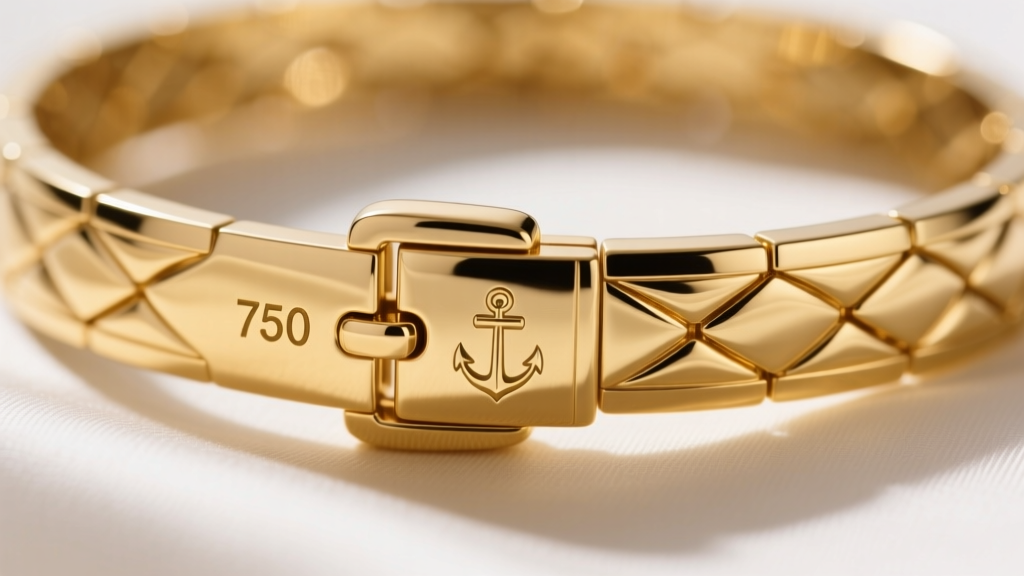
- Necklaces & Bracelets: Examine the clasp mechanism, the jump ring connecting the clasp, and the figure-eight safety catch. For link bracelets, check the inner side of the links near the clasp.
- Earrings: Look at the base of the post, the back of the stud, or the inner curve of a hoop. Butterfly backs are also frequently stamped.
- Pins & Brooches: Inspect the backplate, specifically near the hinge and the C-clasp catch.
Step 2: Decoding Karat and Purity Marks
Once located, the primary mark you will encounter denotes the gold's purity. The United States primarily uses the karat system (parts per 24), while Europe and Asia favor the millesimal fineness system (parts per 1,000). The Federal Trade Commission (FTC) mandates strict guidelines on how these purities can be legally stamped and sold in the US market.
Global Gold Purity Conversion Chart
| Karat Mark | Millesimal Stamp | Gold Percentage | Common Regions |
|---|---|---|---|
| 10k / 10kt | 417 | 41.7% | United States (Minimum legal limit for 'gold') |
| 14k / 14kt | 585 | 58.5% | US, Middle East, Eastern Europe |
| 18k / 18kt | 750 | 75.0% | Global standard for fine jewelry, Europe, Asia |
| 22k / 22kt | 916 | 91.6% | India, Middle East, Southeast Asia |
| 24k / 24kt | 999 | 99.9% | China, Investment bullion jewelry |
Note: In the US, a 14k stamp legally allows for a 3/1000 tolerance, meaning a piece testing at 58.2% purity can still be legally stamped 14k.
Step 3: Recognizing Maker's Marks and Assay Symbols
Identifying marks on gold jewelry goes beyond mere purity. To trace a piece's origin, you must understand the distinction between a maker's mark and an assay mark.
Maker's Marks (Trademarks)
In the US, a maker's mark is simply a registered trademark or the initials of the manufacturing company. It is not government-regulated for purity verification. For example, a 'T&Co' stamp indicates Tiffany & Co., but it relies on the brand's internal quality control rather than an independent government test. You will often find these stamped alongside the karat mark (e.g., '14k T&Co').
Assay Office Marks (The European Standard)
In countries with strict hallmarking laws, like the UK, France, and Switzerland, gold must be sent to an independent government assay office to be tested and stamped. The London Assay Office, for instance, uses a Leopard's Head to denote its origin. A full British hallmark includes:
- Sponsor's Mark: The maker's unique initials inside a specific shield shape.
- Standard Mark: The millesimal fineness (e.g., 750 inside an oval for 18k gold).
- Assay Office Mark: Leopard (London), Anchor (Birmingham), Rose (Sheffield), or Castle (Edinburgh).
- Date Letter: A specific font and background shape denoting the exact year of testing.
Step 4: Spotting Counterfeit or Misleading Stamps
Not all stamps indicate solid gold. When identifying marks on gold jewelry, you must be vigilant for abbreviations that denote plating, filling, or electroplating. Unscrupulous sellers often rely on buyers seeing the '14k' and ignoring the tiny letters next to it.
- GF (Gold Filled): e.g., '1/20 14k GF'. This means 1/20th of the total weight is a mechanical layer of 14k gold bonded to a brass core. It is durable but not solid gold.
- HGE / HGP (Heavy Gold Electroplate): e.g., '18k HGE'. This is a thick layer of gold applied via electricity over base metal. It has no intrinsic melt value.
- GP (Gold Plated): A microscopic flash of gold that will quickly wear off.
- Vermeil: Usually stamped '925' (indicating the sterling silver base) and sometimes accompanied by a 'Vermeil' stamp. This is gold plating over sterling silver, not a solid gold alloy.

Troubleshooting: What If There Are No Marks?
If you have thoroughly cleaned the piece, used raking light, and magnified the area with a 10x loupe but still cannot find a stamp, do not immediately assume the piece is fake. There are several legitimate reasons for missing marks:
- Wear and Tear: Rings worn for 50+ years, especially on the dominant hand, can have their inner shanks worn completely smooth, erasing shallow stamps.
- Resizing and Polishing: Aggressive machine polishing or cutting out a section of the band to resize it can easily obliterate a hallmark.
- Pre-Stamping Era or Custom Work: Jewelry made before the 1900s, or custom pieces made by independent bench jewelers, often lack formal stamps.
When identifying marks on gold jewelry fails, you must pivot to scientific testing. Take the piece to a certified gemologist or a reputable pawn shop that utilizes XRF (X-Ray Fluorescence) testing. XRF machines shoot X-rays into the metal and read the energy signature that bounces back, providing an exact elemental breakdown of the alloy without damaging the piece. Alternatively, a traditional acid test (scratching the metal on a touchstone and applying nitric acid of varying strengths) can definitively confirm the karat grade.
Conclusion
Mastering the art of identifying marks on gold jewelry transforms you from a passive buyer into an informed collector. By equipping yourself with a 10x triplet loupe, understanding the nuances between karat and millesimal stamps, and recognizing the vital difference between a maker's mark and an official assay hallmark, you can confidently navigate the secondary jewelry market. Always remember: while stamps are powerful indicators of authenticity, they should be the beginning of your verification process, not the end. When in doubt, rely on professional XRF testing to ensure your gold is exactly what it claims to be.


