Insights from Missouri Gold Buyers and Jewelry Appraisers
Discover how Missouri gold buyers and jewelry experts evaluate karats, alloys, and material properties to determine authentic melt value and resale prices.


The Metallurgical Reality of Commercial Gold
Pure 24-karat gold is a metallurgical marvel and a functional nightmare. With a Vickers hardness (HV) of roughly 25, pure gold is so malleable that a heavy 24k chain will stretch and deform under its own weight over time. Consequently, the secondary market and the retail jewelry industry rely entirely on gold alloys. When you bring items to a professional appraiser, they are not just looking for a hallmark stamp; they are evaluating the precise metallurgical composition, specific gravity, and structural integrity of the piece. Understanding these material properties is the difference between receiving an accurate melt-value payout and being shortchanged by an inexperienced buyer.
The Midwest market has its own distinct material preferences and testing protocols. Insights from Missouri gold buyers and jewelry professionals reveal a high volume of 10k and 14k pieces, alongside specialized items like dental gold and vintage class rings. Evaluating these items requires a deep understanding of how alloying metals like copper, silver, zinc, and nickel alter both the physical properties of the gold and the chemical reactions used to test it.
Alloy Composition and Vickers Hardness
Gold purity is measured in karats, with 24k representing 99.9% pure gold. To increase durability and alter color, master jewelers introduce specific alloy metals. The exact ratio of these alloys dictates the jewelry's color, melting point, and hardness. According to the Gemological Institute of America (GIA), the most common commercial karats and their material properties are standardized as follows:
- 22k (91.6% Gold): Typically alloyed with copper and silver. HV of ~50. Still quite soft, primarily used in specific cultural jewelry and high-value bullion coins.
- 18k (75.0% Gold): The luxury standard. Alloyed with copper, silver, and sometimes palladium (for white gold). HV of ~125. Offers an excellent balance of rich color and scratch resistance.
- 14k (58.3% Gold): The dominant US retail standard. Yellow 14k is usually 58.3% gold, 25% copper, and 16.7% silver. HV of ~160. Highly durable and resistant to everyday abrasion.
- 10k (41.7% Gold): The minimum legal standard to be stamped "gold" in the US, per Federal Trade Commission (FTC) guidelines. High copper and zinc content pushes the HV up to 200+, making it extremely hard but prone to tarnishing and skin discoloration due to copper oxidation.
The White Gold Rhodium Factor
White gold does not exist in nature. It is created by alloying yellow gold with white metals like nickel, palladium, or manganese. However, the resulting alloy usually retains a faint yellowish or brownish hue. To achieve the brilliant, mirror-like finish consumers expect, manufacturers electroplate the jewelry with rhodium, a platinum-group metal. When selling white gold, buyers are purchasing the underlying gold alloy; the rhodium plating holds zero melt value and is burned off during the refining process.
Verification Methods: Acid vs. XRF Spectrometry
Accurate material verification is the cornerstone of gold trading. Professional buyers rely on a combination of destructive and non-destructive testing to uncover plated fakes and mis-hallmarked items.
Chemical Acid Testing
Acid testing remains the most reliable field test for solid gold. A jeweler will file a small notch into the item to bypass any surface plating, then apply nitric acid or a specialized testing solution (a mix of nitric and hydrochloric acid). The chemical reaction is immediate and definitive:
- No Reaction: The metal is high-karat gold (18k or higher).
- Faint Milky Reaction: Indicates the presence of silver in the alloy, typical of 14k yellow gold.
- Green Reaction: The acid is reacting with copper or base metals, indicating 10k gold or gold-plated brass.
- Immediate Dissolution: The item is entirely base metal.
X-Ray Fluorescence (XRF) Spectrometry
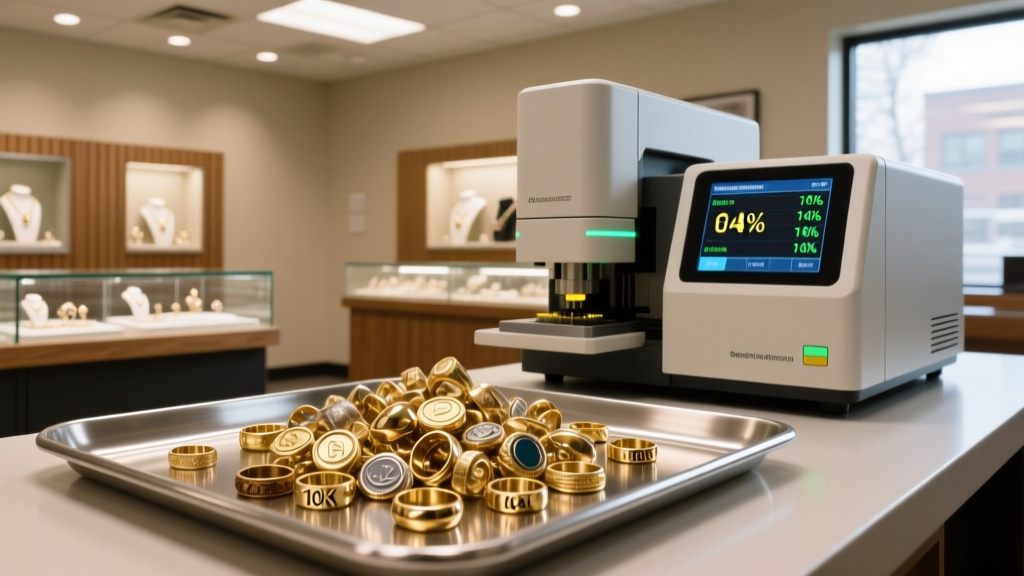
High-volume buyers and refineries utilize XRF machines to determine the exact elemental breakdown of a piece without damaging it. XRF fires X-rays into the metal and measures the fluorescent rays emitted by the atoms. While highly accurate for surface composition, XRF has a critical limitation: it only penetrates roughly 10 to 50 microns deep. A thick layer of 24k gold plated over a tungsten or lead core will fool an XRF machine. This is why reputable buyers always pair XRF analysis with specific gravity testing or a deep file acid test on suspicious items.
Material Breakdown and Melt Value Factors
When calculating payout, buyers use the spot price of pure gold and multiply it by the item's weight and its purity factor. The table below illustrates how material properties and purity directly impact the baseline melt value calculation.
| Karat | Gold Content | Primary Alloy Metals | Specific Gravity (g/cm³) | Melt Value Factor |
|---|---|---|---|---|
| 24k | 99.9% | None (Trace impurities) | 19.32 | 0.999 |
| 22k | 91.6% | Copper, Silver | 17.70 | 0.916 |
| 18k | 75.0% | Copper, Silver, Palladium | 15.60 | 0.750 |
| 14k | 58.3% | Copper, Silver, Zinc | 13.50 | 0.583 |
| 10k | 41.7% | Copper, Zinc, Nickel | 11.60 | 0.417 |
Note: Specific gravity testing involves weighing the item in air, then weighing it suspended in distilled water. The ratio provides a highly accurate density measurement that can instantly expose tungsten-filled counterfeit bars or hollow electroformed chains.

Red Flags: Identifying Plated and Filled Materials
The secondary market is flooded with items that mimic the visual properties of solid gold but possess entirely different material structures. Expert appraisers look for specific hallmarks and physical anomalies to identify these pieces.
Gold Filled vs. Gold Plated
Gold-filled (GF) jewelry consists of a thick layer of solid gold mechanically bonded to a brass core via heat and pressure. By US law, the gold layer must constitute at least 5% of the item's total weight. While highly durable and resistant to flaking, gold-filled items hold very little melt value due to the low total gold content and the difficulty of separating the gold from the brass during refining. Look for stamps like "1/20 14k GF".
Gold-plated items, marked with "HGE" (Heavy Gold Electroplate) or "GEP", feature a microscopic layer of gold applied via electrical current. These layers are often less than 0.5 microns thick and will wear away to reveal the base metal beneath. They are rejected by almost all precious metal refineries.
The Magnet and Ping Tests
While not definitive on their own, physical property tests are excellent first-line defenses. Gold is diamagnetic, meaning it is slightly repelled by a magnetic field. If a gold chain is attracted to a rare-earth neodymium magnet, it contains ferromagnetic metals like iron, nickel, or cobalt in the core, proving it is not solid gold. Similarly, the "ping test" relies on gold's high density and low acoustic velocity; a solid gold coin struck lightly will emit a long, high-pitched resonance, whereas a plated tungsten or brass counterfeit will produce a dull, short thud.
"Understanding the exact alloy composition of your jewelry empowers you as a seller. When you know the difference between a 14k nickel-white gold ring and a 14k palladium-white gold ring, you can better evaluate the offers presented by local buyers and refiners."
Market Nuances and Final Valuations
Ultimately, the price you receive for scrap gold is dictated by the global spot market, adjusted by the buyer's refining overhead and profit margin. Reputable buyers will weigh your items on a calibrated, state-certified digital scale in plain sight, separate the items by karat using acid or XRF, and calculate the pure gold weight (Gross Weight × Purity Factor). By understanding the material properties, alloy compositions, and testing methodologies outlined above, you can navigate the secondary gold market with confidence and ensure your jewelry is evaluated strictly on its true metallurgical merit.


