The Expert Guide to Proportions and Styling Mens Cross Jewelry
Master the technical details of mens cross jewelry. Learn expert guidelines on metal grades, pendant-to-chain weight ratios, and proportionate styling.

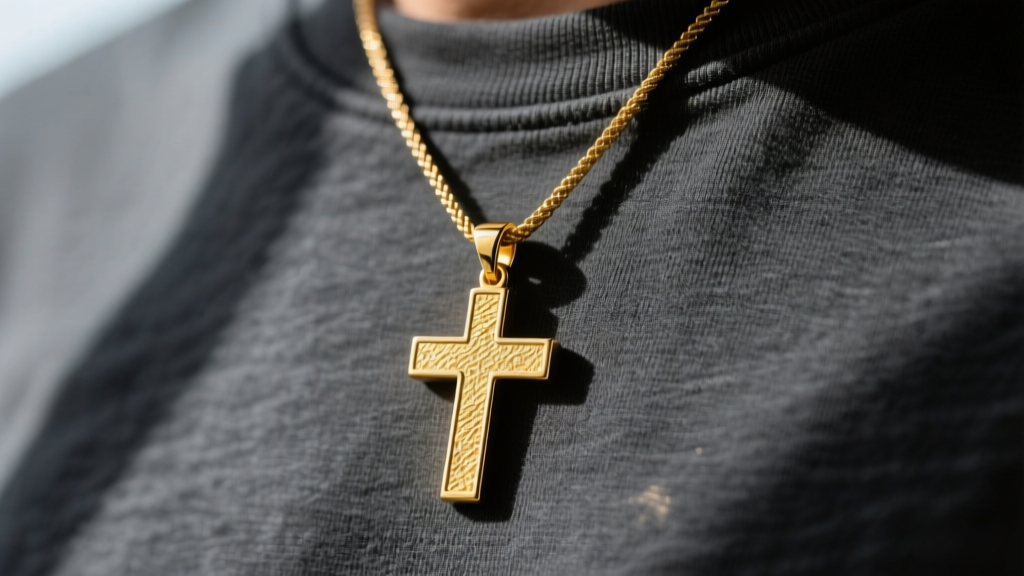
The Metallurgy of Men's Cross Pendants: Choosing the Right Alloy
When evaluating mens cross jewelry, the aesthetic appeal is only as enduring as the metallurgical foundation. The most common alloys used in men's pendants—316L stainless steel, 925 sterling silver, and 14k gold—each possess distinct Vickers hardness (HV) ratings, tensile strengths, and oxidation profiles that dictate their longevity and wearability.
316L Surgical Stainless Steel: Known for its exceptional corrosion resistance, 316L contains 16-18% chromium, 10-14% nickel, and 2-3% molybdenum. The "L" denotes low carbon, which prevents carbide precipitation during the casting or welding process. With a Vickers hardness of approximately 150-190 HV, it is highly resistant to scratching and deformation, making it ideal for heavy, everyday wear. However, its high melting point and hardness make intricate, micro-detailed casting more difficult compared to precious metals.
925 Sterling Silver: Comprising 92.5% pure silver and 7.5% copper, sterling silver is a softer alloy with a Vickers hardness of roughly 60-70 HV. According to metallurgical standards outlined by the Gemological Institute of America (GIA), the copper content provides necessary structural integrity but introduces a vulnerability to sulfur-induced tarnishing. For mens cross jewelry, high-quality silver pieces are often plated with a 0.1 to 0.3-micron layer of rhodium to create an inert, anti-tarnish barrier that mimics the cool tone of white gold.
14k Gold: Containing 58.5% pure gold alloyed with copper, silver, and zinc, 14k gold offers the optimal balance of precious metal value and structural durability. The specific alloy ratios determine the color (yellow, white, or rose) and increase the hardness to around 120-150 HV, ensuring the cross pendant maintains its structural integrity over decades of wear.
Proportional Scaling: Matching Pendant Dimensions to Physique
The most frequent error in styling mens cross jewelry is ignoring proportional scaling. A pendant that is too small looks lost against a broader chest, while an oversized piece can appear costumey. The traditional Latin cross relies on a specific aspect ratio: the vertical beam should ideally be 1.3 to 1.5 times the length of the horizontal beam.
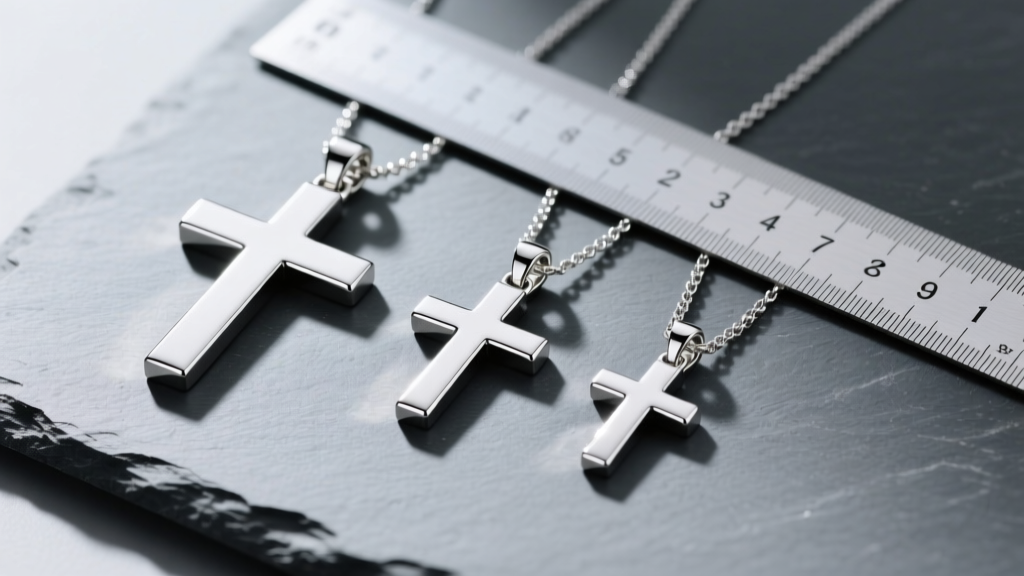
The Dimensional Framework
- Subtle/Minimalist (1.0" - 1.25" / 25mm - 32mm): Best suited for layering or wearing tucked under a collar. Ideal for leaner builds or professional environments where jewelry should remain understated.
- Standard/Classic (1.5" - 2.0" / 38mm - 50mm): The most versatile size for the average male physique (5'8" to 6'0"). This dimension provides enough visual weight to stand alone on a plain t-shirt without overwhelming the neckline.
- Statement/Oversized (2.25" - 3.0" / 57mm - 76mm): Reserved for streetwear, stage presence, or broader, taller frames. Pendants in this category require substantial depth (thickness) to avoid looking flimsy.
Depth is a critical, often overlooked metric. A high-quality men's cross pendant should have a minimum depth (thickness) of 3mm to 5mm. This ensures the piece has adequate gram weight, preventing it from flipping over or bending under minor stress. Manufacturing processes detailed by industry suppliers like Rio Grande highlight that die-struck pendants achieve higher density and superior tensile strength compared to lost-wax cast pieces, allowing for thinner profiles without sacrificing durability.
Chain Pairing Mechanics: Weight Ratios and Bail Clearances
A pendant is only as secure as the chain that supports it. The relationship between the cross pendant's weight and the chain's gauge width is governed by strict mechanical ratios. A chain that is too thin will suffer from accelerated link wear and potential snapping, while a chain that is too thick will fail to pass through the pendant's bail.
| Pendant Height | Ideal Chain Width | Max Pendant Weight | Recommended Chain Style |
|---|---|---|---|
| 1.0" - 1.5" | 2.0mm - 3.0mm | 8g - 12g | Cable, Rope, Box |
| 1.5" - 2.0" | 3.0mm - 4.0mm | 12g - 18g | Figaro, Curb, Wheat |
| 2.0" - 3.0" | 4.0mm - 5.5mm | 18g - 25g+ | Cuban, Miami, Franco |
Bail Clearance Engineering: The bail (the loop connecting the cross to the chain) must have an inner diameter (ID) that is at least 1.5mm larger than the chain's widest dimension to allow for fluid articulation. For example, if you are pairing a cross with a 4.0mm Cuban chain, the bail ID must be a minimum of 5.5mm x 8.0mm. If the clearance is too tight, the friction will cause premature wear on both the chain links and the bail interior.
Hardware and Clasp Engineering
The clasp is the most common point of failure in mens cross jewelry. Spring-ring clasps, while common on lighter chains, lack the shear strength required for heavier pendants. For any cross pendant exceeding 10 grams, a lobster clasp is mandatory. Lobster clasps utilize a spring-loaded trigger mechanism that provides a secure, self-locking closure.
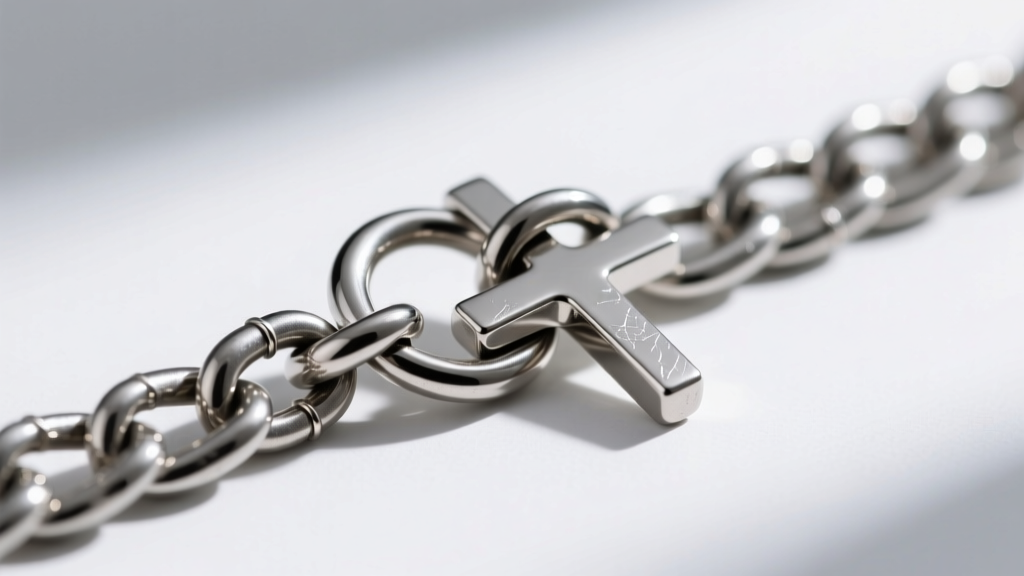
Furthermore, the jump ring connecting the clasp to the chain must be soldered closed. An unsoldered jump ring will slowly pry open under the pendulum-like swinging motion of a heavy cross pendant, eventually leading to the loss of the piece. Always inspect the jump ring for a seamless weld line before purchasing high-end mens cross jewelry.
Surface Finishes and Patina Development
The surface treatment of a cross pendant drastically alters its visual weight and maintenance requirements.
- High Polish: Achieved through progressive abrasive buffing, resulting in a mirror-like finish. While striking, high polish shows micro-scratches and fingerprints easily, requiring regular cleaning with a microfiber cloth.
- Brushed/Matte: Created by applying a unidirectional abrasive finish. This texture diffuses light, giving the cross a rugged, understated masculinity. It excels at hiding daily wear and tear.
- Oxidized/Antiqued: A chemical process utilizing liver of sulfur to intentionally darken the recessed areas of the cross. This creates high contrast, emphasizing intricate engravings or filigree work. Over time, the oxidation on the high-contact areas will naturally wear away, creating a bespoke patina unique to the wearer.
Styling Frameworks: Necklines and Layering
Integrating a cross pendant into a wardrobe requires an understanding of neckline geometry and chain length. The standard lengths for men's chains are 20, 22, and 24 inches, each serving a distinct styling purpose.
The Crew Neck (20-22 Inch Chain): A 20-inch chain will sit just below the collarbone, framing the face and resting perfectly against the collar of a standard crew neck t-shirt or a button-down shirt with the top button undone. This is the optimal length for smaller, minimalist crosses (1.0" - 1.5").
The V-Neck and Henley (22-24 Inch Chain): A 22 or 24-inch chain allows the pendant to drop into the negative space created by a V-neck or an unbuttoned henley. This deeper drop is necessary for larger statement crosses (2.0"+), ensuring the jewelry complements the garment's lines rather than clashing with the fabric's hem.
Layering Mechanics: When layering a cross pendant with other chains, adhere to a minimum 2-inch length differential to prevent the chains from tangling. For example, pair a 20-inch 2mm cable chain holding the cross pendant with a 22-inch 4mm Cuban link chain. Ensure the combined weight of the layered chains does not exceed the structural comfort threshold of your neck, typically keeping the total jewelry weight under 80 grams for all-day wearability. According to trend analysts at JCK Online, mixed-metal layering—such as combining a silver cross with a subtle gold chain—is gaining traction in contemporary men's styling, provided the textures contrast sufficiently to avoid looking like a mismatched error.


