How to Authenticate Art Deco Costume Jewelry: A Buyer's Guide
Learn how to authenticate art deco costume jewelry with our expert buyer's guide. Discover key hallmarks, materials, and pricing for 1920s and 1930s pieces.

The Allure of 1920s and 1930s Costume Pieces
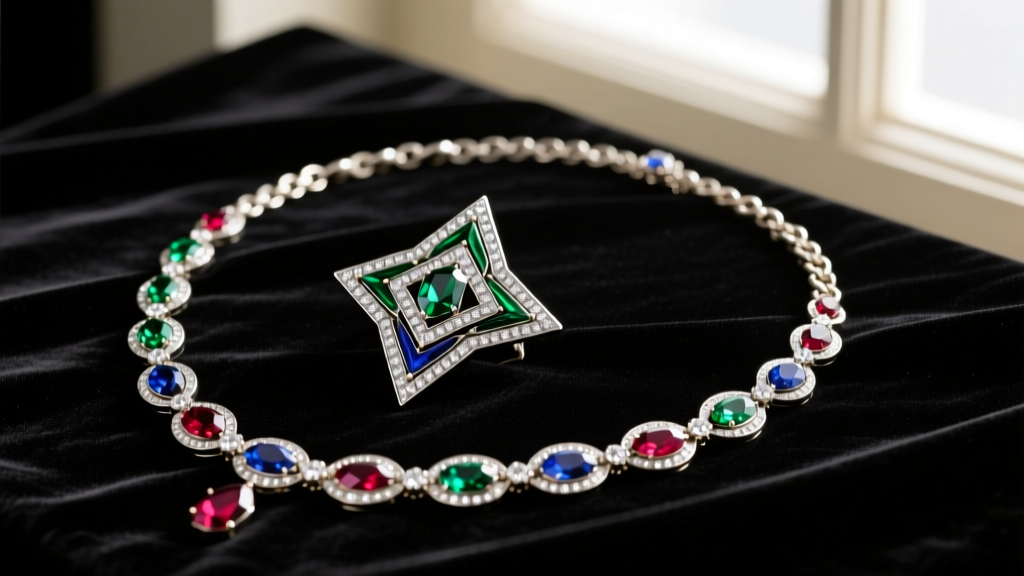
The interwar period birthed a revolution in personal adornment. As hemlines dropped and bobbed hair became the standard, the demand for bold, geometric accessories skyrocketed. Authentic art deco costume jewelry from this era represents a fascinating intersection of industrial innovation and high fashion. Unlike fine jewelry, which relied on precious metals and gems, 1920s and 1930s costume pieces utilized cutting-edge synthetic materials, base metals, and mass-production techniques to democratize luxury. For modern collectors, navigating this market requires a sharp eye for period-correct materials, maker hallmarks, and specific structural red flags. According to Lang Antiques' Antique Jewelry University, the architectural motifs and Egyptian revival themes sparked by the 1922 discovery of Tutankhamun's tomb remain the defining visual hallmarks of the era.
Key Materials: Beyond the Rhinestone
To accurately date and authenticate vintage pieces, you must look past the sparkle and examine the foundational materials. The Great Depression forced manufacturers to innovate, leading to the widespread use of specific alloys and early plastics.
Pot Metal and the "Rot" Factor
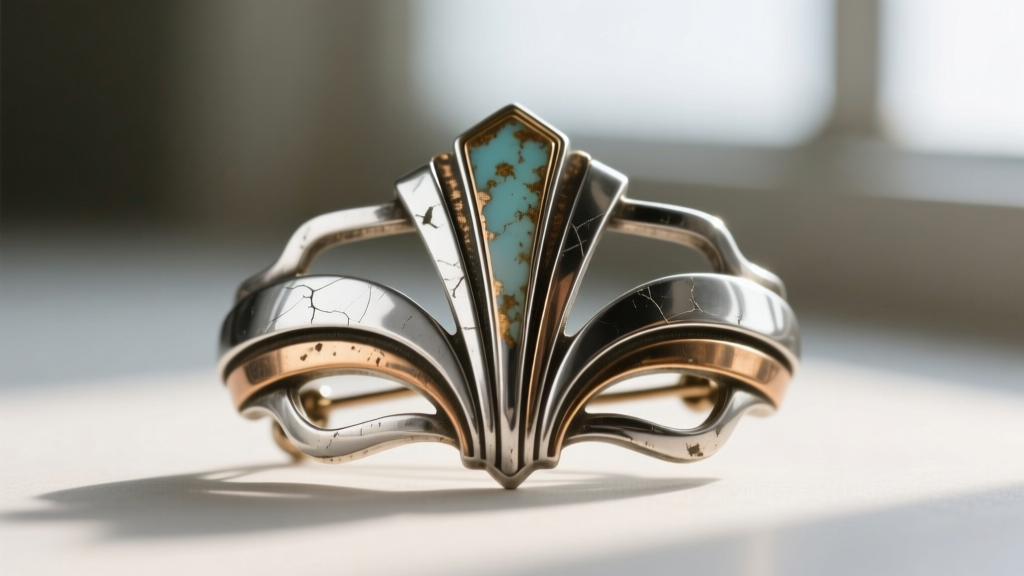
The vast majority of authentic art deco costume jewelry was cast in "pot metal," an informal term for zinc-based alloys often mixed with lead, tin, or copper. While it allowed for intricate, heavy castings that mimicked platinum and white gold, pot metal is highly susceptible to environmental degradation. Collectors refer to this as "pot metal rot" or "zinc pest." This occurs when impurities in the zinc alloy cause intergranular corrosion, leading the metal to expand, become brittle, and eventually crack the overlying chrome or rhodium plating. When inspecting a piece, look closely at the crevices for microscopic flaking or a powdery white residue. Once pot metal rot begins, it is chemically unstoppable; avoid purchasing pieces with active flaking, as structural failure is imminent.
Bakelite vs. Celluloid Plastics
Early plastics were heavily featured in Deco bangles and brooches. Bakelite (a thermosetting phenol formaldehyde resin) is highly prized for its deep, opaque colors and heavy weight. Celluloid, an earlier thermoplastic made from nitrocellulose, is lighter, more translucent, and highly flammable.
- The Simichrome Test: Apply a tiny amount of Simichrome metal polish to a cotton swab and rub an inconspicuous area of the plastic. Genuine Bakelite will turn the swab a vibrant yellow-orange.
- The Hot Water Test: Dip the piece in hot (not boiling) water for 30 seconds. Authentic Bakelite emits a distinct, sharp chemical odor reminiscent of carbolic acid or formaldehyde, while celluloid smells like camphor or old film.
Top Makers and Hallmark Identification
While many European houses produced stunning pieces, the American market was dominated by a few powerhouse manufacturers. Identifying their specific hallmarks is crucial for establishing provenance and value. The Victoria and Albert Museum notes that the transition from unmarked dress clips to heavily branded parures occurred rapidly in the early 1930s as brand loyalty took hold.
| Manufacturer | Era Peak | Key Hallmarks & Patents | Avg. Mint Condition Price (2026) |
|---|---|---|---|
| Trifari | 1920s-1940s | "KTF" (early), Crown over "Trifari" (post-1937) | $150 - $1,200 |
| Coro | 1930s | "Coro", "CoroCraft", Patent numbers (e.g., Duette clips) | $80 - $650 |
| Eisenberg | 1920s-1930s | Often unmarked (early dress clips), "E", "Eisenberg Ice" | $200 - $1,500 |
| Miriam Haskell | 1920s-1930s | Unmarked (pre-1940s), horseshoe-shaped plaques | $300 - $3,000+ |
The Dress Clip Phenomenon
Dress clips are quintessential art deco costume jewelry. Invented to adorn the lapels, cloche hats, and belt sashes of the era, they feature a heavy-duty pronged clasp mechanism. Coro patented the "Duette" mechanism in 1931, allowing two individual clips to be joined together on a single frame to form one large symmetrical brooch. Trifari followed with their "Clip-Mates." If you are examining a supposed 1920s Duette, check the back of the frame for the specific Coro patent number (e.g., Pat. No. 1,798,867). Missing the original joining frame reduces the set's value by up to 60%.
Condition Checks: Critical Red Flags
Condition dictates value in the vintage market. Beyond pot metal rot, you must scrutinize the stones and structural findings.
The Aurora Borealis Anachronism
This is the most common trap for novice buyers. The iridescent "Aurora Borealis" (AB) finish on rhinestones was patented by Swarovski in collaboration with Christian Dior in 1956. If a piece marketed as 1920s or 1930s Art Deco features AB stones, it is either a later mid-century reproduction, or the original stones have been replaced by a well-meaning but historically inaccurate jeweler. True Deco stones feature flat foil backings (silver, gold, or colored) and are typically chaton or rose-cut.
Foil Degradation and Blackening
Early rhinestones relied on delicate metallic foil glued to the back of the glass to create brilliance. Over decades, moisture seeps past the prongs, causing the foil to oxidize, blacken, or flake away entirely, resulting in "dead" stones that look gray and lifeless. While some collectors accept minor foil loss in rare pieces, widespread blackening severely impacts value. Never use ultrasonic cleaners or liquid jewelry dips on foiled stones, as the chemicals will instantly destroy the remaining foil backing.
Period-Correct Clasps and Findings
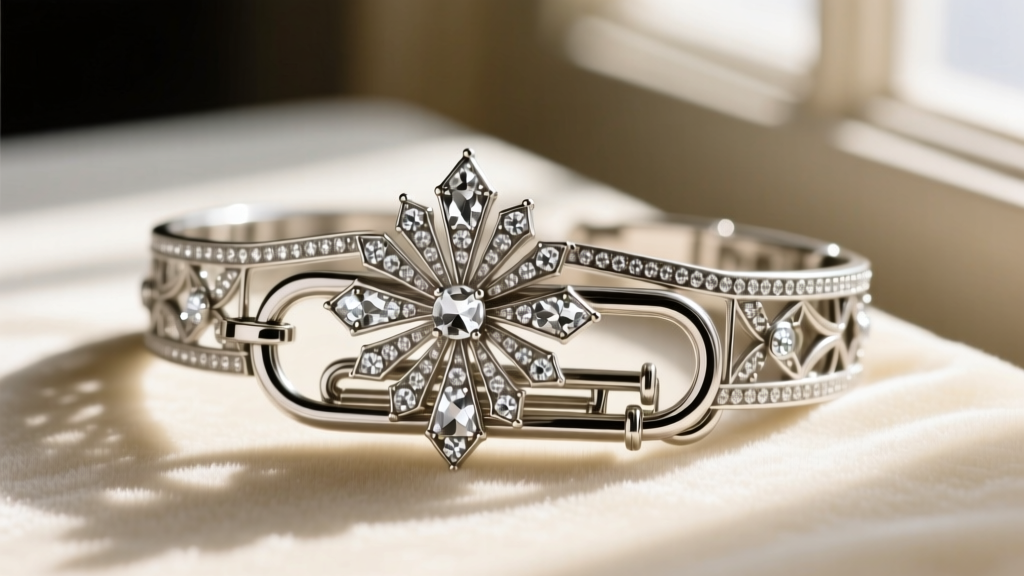
Clasps are vital for authentication. Modern lobster claws or spring-ring clasps with soldered jump rings indicate alteration.
- Trombone Clasps: Common on European and high-end American pieces of the 1920s, featuring a push-pull tube mechanism.
- C-Clasps: Standard on early brooches. The pin stem should extend slightly past the edge of the "C" catch. If the pin is short and perfectly contained within a modern safety catch, the clasp has likely been replaced.
- Barrel Clasps: Frequently used on long Deco sautoir necklaces, featuring a screw-thread or push-in friction mechanism.
Pricing Realities in the Current Market
As of the 2026 collector market, the pricing for authentic art deco costume jewelry has stratified heavily based on material and maker. Entry-level pieces, such as unmarked pot metal dress clips or single-color Bakelite bangles, typically range from $45 to $150. However, signed parures (matching sets of necklace, bracelet, earrings, and brooch) by Crown Trifari or early unmarked Miriam Haskell Russian gilt pieces command premium prices, frequently selling between $800 and $2,500 at specialized auction houses.
Pro-Tip for Buyers: Always request high-resolution macro photos of the reverse side of the piece. The back of a brooch tells the true story—look for the wear patterns on the plating, the exact construction of the pin stem hinge (tube vs. cast), and the condition of the stone settings. A pristine front with a heavily corroded back is a common sign of a "franken-piece" that has been aggressively polished to hide structural flaws.
Final Authentication Tips
Mastering the identification of art deco costume jewelry requires tactile experience. Hold the piece to feel the density of the pot metal and the specific weight of early glass stones. Use a jeweler's loupe to inspect the prong settings; hand-set stones will show slight irregularities and tool marks, whereas perfectly uniform, machine-stamped prongs often indicate a later 1950s reproduction. By focusing on period-correct metallurgy, anachronistic stone finishes, and precise patent hallmarks, you can build a historically accurate and highly valuable collection.


