The 2026 Gift Guide to Antique Costume Jewelry Brooches
Discover the perfect antique costume jewelry brooches for every occasion. Our 2026 gift guide covers eras, materials, and styling.

The Renaissance of Storied Gifting
In 2026, the art of gifting has shifted decisively away from mass-produced fast fashion toward sustainable, storied accessories. At the forefront of this movement are antique costume jewelry brooches. Far from being mere afterthoughts, these lapel accessories represent accessible art, historical craftsmanship, and a masterclass in personal styling. Whether you are shopping for a vintage-obsessed fashionista, a corporate executive looking for a subtle power accessory, or a bride seeking a unique 'something borrowed,' understanding the nuances of antique costume pieces is essential.
Unlike fine jewelry, which is valued primarily for its precious metals and gemstones, costume jewelry is valued for its design, innovation, and reflection of the cultural zeitgeist. From the mourning motifs of the Victorian era to the aerodynamic geometry of Art Deco, each piece tells a story. This guide will equip you with the material knowledge, authentication frameworks, and occasion-matching strategies needed to select the perfect antique brooch.
Decoding Eras: Matching the Brooch to the Recipient
To gift an antique brooch successfully, you must align the historical era of the piece with the recipient's personal aesthetic. Here is a breakdown of the three most prominent eras in the antique costume market.
Victorian & Edwardian (1837–1910): For the Sentimental Traditionalist
Victorian jewelry is deeply symbolic. Following the death of Prince Albert in 1861, mourning jewelry surged in popularity. According to the Victoria and Albert Museum, materials like Whitby jet, gutta-percha, and bog oak were carved into somber, intricate brooches. For the romantic, look for 'language of flowers' motifs, serpent designs (symbolizing eternity), or hairwork jewelry. These pieces are perfect for historians, gothic literature fans, or brides looking for a melancholic, romantic touch for a winter wedding.
Art Deco (1920–1935): For the Bold, Geometric Minimalist
The Art Deco era was defined by the machine age, Cubism, and the 1925 Paris Exposition. Brooches from this period feature sharp geometric lines, stepped motifs, and high-contrast color blocking. Designers utilized early plastics like Bakelite and Celluloid, alongside marcasite (iron pyrite) set in white metal potin. An Art Deco shield or arrow brooch is the ultimate gift for the modern minimalist, the architect, or the corporate leader who wants to project sharp, unyielding confidence on a lapel.
Mid-Century Retro (1940–1960): For the Glamorous Maximalist
World War II metal rationing forced designers to innovate, leading to the use of sterling silver, wood, and leather. Post-war, the mood shifted to unapologetic glamour. The introduction of Aurora Borealis (AB) rhinestones by Christian Dior and Swarovski in 1956 changed the landscape of evening wear. Brands like Trifari, Coro, and Miriam Haskell produced lush, three-dimensional floral and figural brooches. This era is ideal for the maximalist, the theater-goer, or anyone who treats getting dressed as a joyous, theatrical event.
Material Deep-Dive & Pricing Matrix
Understanding the base materials and alloys used in antique costume jewelry is critical for both authentication and valuation. The table below outlines the primary materials, their identifying traits, and current 2026 market pricing for pieces in excellent condition.
| Era | Key Materials | Identifying Traits | Est. Market Price (2026) |
|---|---|---|---|
| Victorian | Jet, Pinchbeck, Bog Oak | Lightweight (Jet), brass-like hue (Pinchbeck), carved motifs | $80 – $450 |
| Art Deco | Marcasite, Bakelite, Potin | Geometric settings, heavy white metal, early plastics | $120 – $600 |
| Mid-Century | AB Rhinestones, Enamel | Iridescent stone coatings, layered floral/figural designs | $65 – $1,500+ |
Note: Signed pieces by elite houses like Eisenberg, Haskell, or Boucher will command prices at the absolute top end of these ranges, frequently exceeding $2,000 for rare, pristine examples.
The Authentication Checklist: Avoiding Modern Reproductions
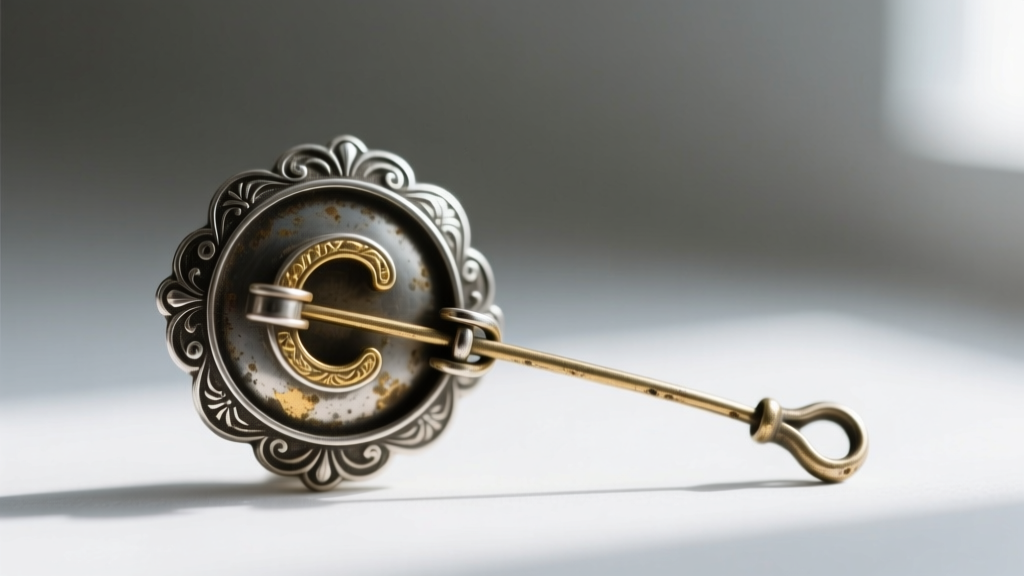
The market is flooded with modern 'vintage-style' reproductions. To ensure you are gifting a genuine antique, you must examine the hardware. The Lang Antiques University emphasizes that the clasp and pin stem are the most reliable indicators of a piece's age.
- The 'C' Clasp: Predominantly used before 1900. It is a simple 'C' shaped hook with no locking mechanism. If a brooch has a simple C-clasp, it is likely Victorian or Edwardian.
- The Trombone Clasp: A tube-like push-pull mechanism primarily used on European pieces between 1890 and 1940.
- The Roll-Over Safety Clasp: Patented in 1910 but not widely adopted until the 1930s. If a piece features a modern roll-over safety clasp but claims to be from the 1880s, it is either a reproduction or has been repaired.
- Pin Stem Length: On authentic pre-1920s brooches, the pin stem is often slightly longer than the brooch itself, extending past the edge by a quarter-inch. Modern stems are cut short to hide within the perimeter.
- The Bakelite Test: Never use the destructive 'hot pin' test. Instead, rub the plastic vigorously with your thumb until warm, then smell it. Authentic Bakelite emits a distinct formaldehyde/chemical odor. Alternatively, apply Simichrome polish with a cotton swab; if it turns yellow, it is Bakelite.
Occasion Matching & Styling Framework
A brooch is only as good as its placement. When gifting, include a styling card with these 2026-approved lapel and accessory frameworks to help the recipient integrate the antique piece into their modern wardrobe.
The Boardroom Power Play
For corporate environments, subtlety is key. Gift an Art Deco geometric bar brooch or a small, symmetrical marcasite shield. Placement: Pin it to the left lapel of a structured blazer, exactly where the lapel notch meets the collar. This draws the eye upward and projects authority without the distraction of dangling earrings or noisy bangles.
The Evening Gala & Red Carpet
For black-tie events, scale and sparkle are paramount. A Mid-Century Retro starburst or a lush Miriam Haskell floral piece featuring AB rhinestones is ideal. Placement: Move beyond the lapel. Pin the brooch to the center of a velvet choker, use it to gather the shoulder of a draped silk gown, or secure a heavy silk scarf at the collarbone.
The Wedding 'Something Borrowed'
Victorian seed pearl or carved jet floral brooches make profound wedding gifts. Placement: Attach the brooch to the bride's bouquet handle, weave it into a vintage birdcage veil, or pin it to the satin ribbon of the wedding garter for a hidden, deeply personal talisman.
'Costume jewelry is not a poor relation to fine jewelry; it is the vanguard of design. The best antique brooches capture the exact moment in history when art met industry.'
Where to Source Authentic Pieces in 2026
Sourcing requires navigating between high-end curated dealers and the wild west of online marketplaces. For verified, high-quality antique costume jewelry brooches, Ruby Lane remains the gold standard, as their vetting process for 'antique' (100+ years old) and 'vintage' (20+ years old) is strictly enforced. For museum-quality, signed pieces, 1stDibs offers unparalleled provenance, though at a premium. Avoid generic fast-fashion sites masquerading as vintage; always demand high-resolution macro photos of the clasp and pin hinge before purchasing.
Conclusion
Gifting antique costume jewelry brooches is an exercise in historical curation. By understanding the metallurgy of potin, the timeline of the safety clasp, and the stylistic language of the Art Deco and Mid-Century eras, you elevate your gift from a simple accessory to a wearable artifact. In 2026, the most meaningful gifts are those that have already survived the test of time—ready to begin a new chapter on the lapel of someone you cherish.