Anti Tragus Piercing Jewelry: 2026 Trend Analysis
Explore 2026 anti tragus piercing jewelry trends, from threadless micro-gems to chain-linked setups, plus expert sizing and material guides.

The Anatomy of the Anti-Tragus: Why Jewelry Choice Dictates Success
The anti-tragus is often considered the final boss of ear curation. Located on the small, triangular ridge of cartilage directly opposite the tragus and above the earlobe, this piercing presents a unique set of anatomical challenges. Unlike the relatively flat plane of the earlobe or the broad canvas of the conch, the anti-tragus protrudes at a sharp 45 to 60-degree angle relative to the side of the head. This extreme angulation means that standard jewelry profiles—particularly captive bead rings (CBRs) or continuous hoops—will almost always exert lateral torque on the fistula.
When a hoop is forced into an anti-tragus piercing, the natural curvature of the metal fights the straight, angled channel of the cartilage. According to the Association of Professional Piercers, this continuous pressure leads to migration, rejection, and severe hypertrophic scarring (irritation bumps). Therefore, the golden rule of anti-tragus jewelry is absolute: only flat-back labrets or straight barbells should be used during the initial healing phase, which typically spans 9 to 12 months for dense cartilage.
The anti-tragus is a high-movement, high-friction zone. Treating it like a standard lobe piercing with a seamless ring is a guaranteed path to hypertrophic scarring and migration.
Metallurgical Standards: What to Demand in 2026
As the body modification industry matures, the tolerance for subpar alloys has vanished. In 2026, reputable piercing studios strictly adhere to implant-grade standards. For your anti-tragus, you must demand ASTM F136 implant-grade titanium. Do not settle for ASTM F67 (commercially pure titanium), which lacks the structural tensile strength and polished surface finish required to minimize bacterial adhesion in a cartilage fistula.
If you prefer gold, the standard has shifted. While 18k gold offers a richer color, its softer alloy makes it prone to micro-scratches that can harbor bacteria during the healing process. Consequently, high-end manufacturers like BVLA and NeoMetal heavily recommend solid 14k gold for initial piercings, provided it is nickel-free and alloyed with palladium or silver rather than zinc or copper, which can cause contact dermatitis in high-sweat areas like the inner ear.
2026 Style Forecast: What’s Dominating the Anti-Tragus Space
With the structural necessity of flat-back labrets established, the aesthetic frontier of anti-tragus jewelry has exploded. The 2026 trend cycle is defined by hyper-minimalism, bespoke textures, and interconnected ear constellations.
1. Threadless Micro-Gems and Floating Opals
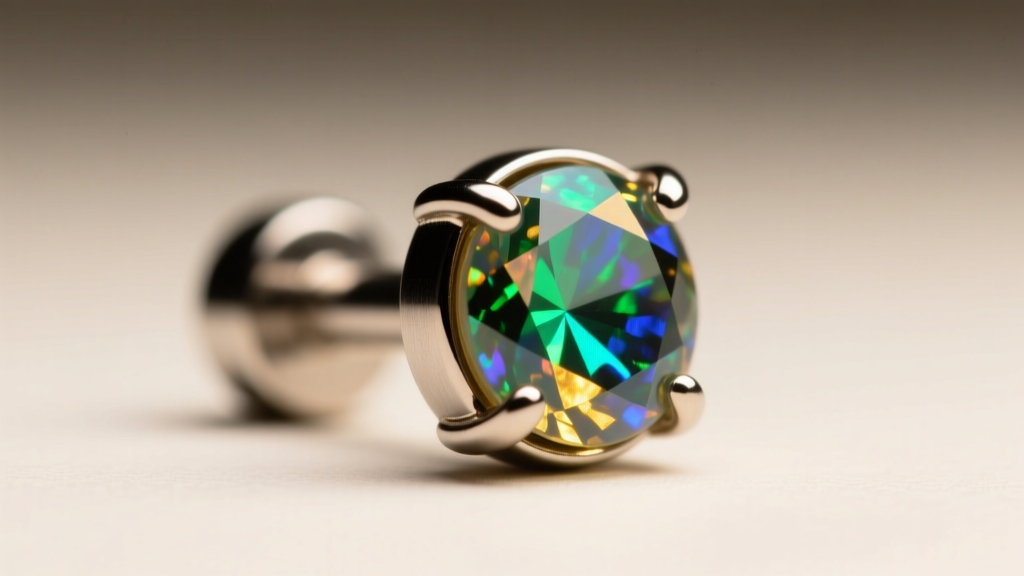
The era of bulky, prong-set stones catching on hair and headphones is over. The dominant trend for 2026 is the bezel-set micro-gem. Threadless flat-backs topped with 2mm or 3mm bezel-set diamonds, sapphires, or Australian opals provide a flush, snag-free profile. The bezel setting acts as a smooth dome, allowing the jewelry to sit discreetly in the anti-tragus fold while catching the light. Threadless systems (where a slightly bent pin creates tension inside the shaft) are vastly superior to internally threaded options here, as they eliminate the micro-threads that can tear delicate healing cartilage tissue during insertion.
2. The Artisan Texture: Hammered and Matte Gold Discs
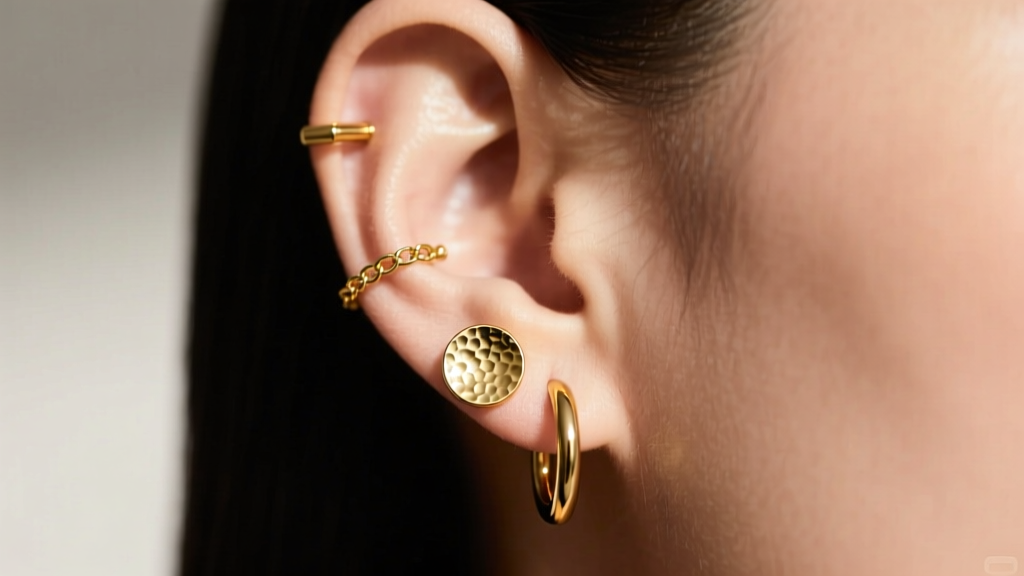
For healed anti-tragus piercings, the "quiet luxury" movement has translated into textured metals. Matte-finished and hand-hammered 14k gold discs (ranging from 3mm to 5mm in diameter) are highly sought after. These ends diffuse light rather than reflecting it sharply, offering an organic, vintage aesthetic that pairs beautifully with ear curation styles focused on raw, unpolished gemstones like turquoise or lapis lazuli.
3. The Constellation Link: Chain-Connected Setups
Pioneered by high-end celebrity piercers, the chain-linked setup connects the anti-tragus to the earlobe or the lower conch using a delicate, solid-gold curb or cable chain. This requires two fully healed piercings and custom-measured chain lengths. It transforms the anti-tragus from a solitary accent point into a structural anchor for a larger, interconnected ear constellation.
Material & Style Matrix: The 2026 Standard
Use this matrix to align your aesthetic goals with the correct material and budget expectations for the current market.
| 2026 Trend | Jewelry Type | Best Material | Avg. Price Range | Healing Stage |
|---|---|---|---|---|
| Micro-Gem Minimalist | Threadless Flat-Back | ASTM F136 Titanium | $45 - $85 | Initial & Healed |
| Artisan Texture | Hammered Disc Stud | Solid 14k Gold | $110 - $180 | Healed Only |
| Constellation Link | Chain-Linked Barbell | Solid 18k Gold | $250 - $400 | Healed Only |
| Neo-Classic Opal | Bezel-Set Cabochon | Niobium / Titanium | $60 - $120 | Initial & Healed |
Sizing Specifics: Avoiding the "Cheese-Cutter" Effect
Gauge and post length are not arbitrary; they are biomechanical necessities. The National Library of Medicine notes that cartilage lacks a direct blood supply, relying on the perichondrium for healing. Excessive movement or pressure from ill-fitting jewelry cuts off this micro-circulation, leading to necrosis or the dreaded "cheese-cutter effect," where a too-thin wire slowly slices through the cartilage ridge.
- Gauge: 16-gauge (1.2mm) is the absolute minimum standard for an anti-tragus piercing to ensure structural stability. 14-gauge (1.6mm) is highly preferred by elite piercers to prevent migration and provide a wider surface area for the fistula to heal against.
- Initial Post Length: To accommodate the notorious swelling of cartilage piercings, initial flat-back posts should be 5/16" (8mm) or 3/8" (10mm).
- The Downsizing Timeline: You must return to your piercer for a post downsizing. At weeks 4 to 6, the post is typically reduced to 1/4" (6mm). By month 4, a final downsize to 3/16" (5mm) or 5/32" (4mm) ensures the back of the jewelry sits flush against the skin, preventing it from snagging on masks, pillows, or hair.

Curating the Ear: Integrating the Anti-Tragus into Your Constellation
From a style analysis perspective, the anti-tragus serves as a vital visual anchor in the lower third of the ear. In 2026, ear curation is less about filling every available space and more about creating deliberate negative space and geometric balance. If your upper ear is heavily curated with an industrial barbell and a stacked conch, the anti-tragus provides a necessary counterweight at the bottom of the auricle.
For a cohesive look, match the metal tone and gemstone cut of your anti-tragus jewelry to your tragus and lobe pieces. If you are utilizing a threadless 2mm bezel-set diamond in your anti-tragus, echoing that exact same end in a forward helix or flat piercing creates a sophisticated, diagonal line of light across the ear. Ultimately, respecting the anatomy of the anti-tragus with proper flat-back titanium during healing is the only way to earn the right to wear the bespoke, high-end gold constellations that define the current era of fine body jewelry.