2026 Forward Helix Piercing Jewelry Trends & Curation Guide
Discover 2026 forward helix piercing jewelry trends. Expert curation guides, threadless micro-gem sizing, and anatomical spacing for perfect ear stacks.

The 2026 Shift: From Chunky to Micro-Curation
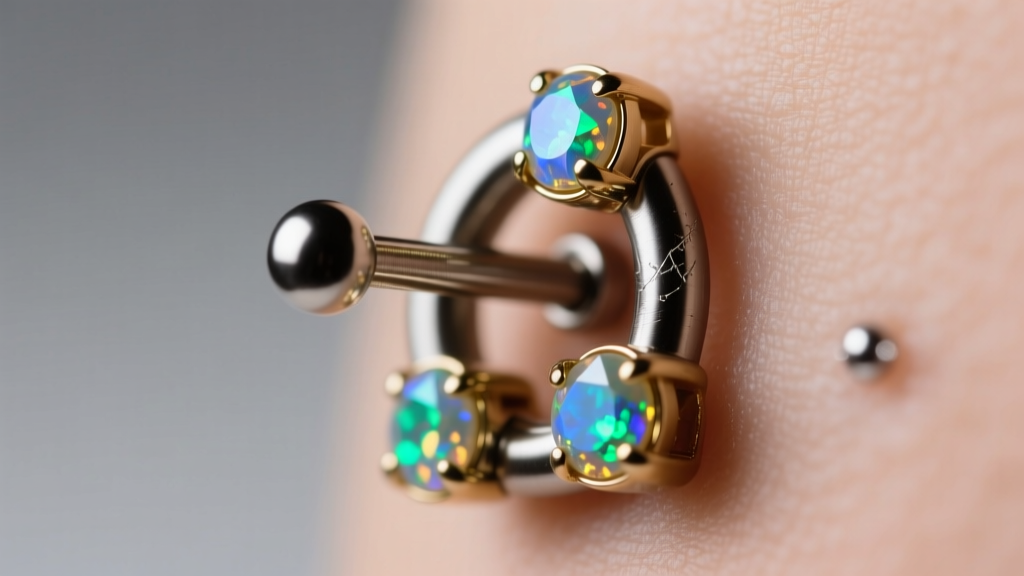
The landscape of ear curation has undergone a radical transformation as we move through 2026. Nowhere is this more evident than in the evolution of forward helix piercing jewelry. Historically treated as a secondary cartilage piercing adorned with standard 3mm or 4mm captive bead rings or chunky prong-set gems, the forward helix has now become the focal point of high-end, precision micro-curation. Today’s collectors and piercing enthusiasts are prioritizing anatomical harmony, ultra-dainty gemstone profiles, and seamless threadless mechanics over loud, isolated statement pieces.
This shift is driven by a deeper understanding of ear anatomy and advanced jewelry manufacturing. The crus of the helix—the small, folded ridge of cartilage situated just above the tragus and rook—is notoriously narrow, typically measuring only 4mm to 6mm in width. Attempting to stack multiple traditional-sized studs in this confined space inevitably leads to a cluttered, 'clumped' aesthetic and severe healing complications. In 2026, the gold standard for forward helix curation relies on 1.5mm to 2.5mm micro-gems, flat-back threadless posts, and meticulous spatial planning.
Anatomy & Spacing: The Math Behind the Stack
A successful forward helix stack is less about random placement and more about applied geometry. Whether you are planning a single statement stud, a balanced double, or a highly coveted triple forward helix setup, understanding the mathematical constraints of your specific anatomy is critical to avoid migration and tissue rejection.
Single vs. Double vs. Triple Setups
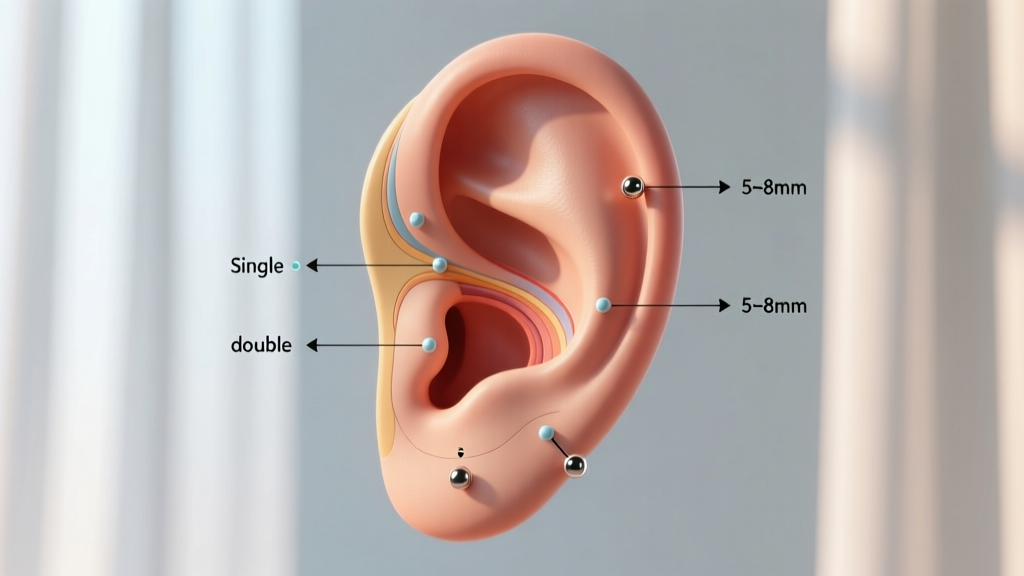
- The Single Forward Helix: Best placed in the upper-middle third of the crus. A 2.5mm to 3mm gemstone is ideal here, providing enough visual weight to stand alone without overwhelming the delicate cartilage fold. Standard 16-gauge (1.2mm) jewelry provides the necessary structural support to prevent the 'cheese-cutter effect' if the jewelry is accidentally snagged.
- The Double Stack: Requires a minimum crus length of 12mm to maintain proper breathing room between fistulas. The 2026 trend dictates using a 2.5mm gem for the lower placement and a slightly smaller 2.0mm or 1.5mm gem for the upper placement, creating a subtle, tapering gradient that draws the eye upward.
- The Triple Stack: The ultimate test of anatomical real estate. A triple setup requires a crus length of at least 16mm. To avoid the jewelry bases pressing against each other under the skin (which causes chronic inflammation), piercers are exclusively using 1.5mm micro-gems spaced exactly 1.5mm apart. The angle of insertion must be perfectly perpendicular to the tissue plane; even a 5-degree deviation can cause the posts to cross paths internally, leading to immediate rejection.
Material & Mechanism: Threadless Titanium Dominance
When selecting forward helix piercing jewelry, the mechanism of the jewelry is just as important as the aesthetic. The forward helix is a high-movement, high-friction zone that interacts with hair, headphones, and pillows daily. Because of this, internally threaded jewelry and captive bead rings have largely been abandoned for initial piercings and long-term curation in this specific area.
The undisputed champion of 2026 is the threadless flat-back labret, pioneered by brands like Neometal and BVLA (Body Vision Los Angeles). Threadless jewelry utilizes a pin with a slight bend that creates tension against the inside of the hollow post, locking the decorative end securely in place without the need to twist or rotate the base.
| Jewelry Mechanism | Forward Helix Viability | Pros & Cons for Curation |
|---|---|---|
| Threadless Flat-Back | Excellent (Gold Standard) | Pros: No twisting required to remove; ultra-low profile; secure tension fit. Cons: Requires a specific tool or technique to pop the pin out safely. |
| Internally Threaded | Moderate (Healed Only) | Pros: Secure screw mechanism; vast design options. Cons: Twisting the decorative end to unscrew it agitates the delicate forward helix fistula, risking hypertrophic scarring. |
| Externally Threaded | Poor (Avoid Completely) | Pros: Cheap. Cons: Threads tear through the fistula upon insertion; harbors bacteria. Banned by reputable piercers. |
| Clickers / Hinged Rings | Poor (Not Recommended) | Pros: Easy to close. Cons: The hinge and clasp create bulky pressure points against the tight crus of the helix, causing localized necrosis and migration. |
For materials, the Association of Professional Piercers (APP) strictly recommends ASTM F136 implant-grade titanium for all initial piercings. For healed stacks in 2026, solid 14k or 18k gold remains highly sought after, but collectors must ensure the gold is alloyed with palladium rather than nickel, as nickel allergies frequently manifest as chronic contact dermatitis in the tight, moisture-trapping folds of the forward helix.
Gemstone & Metal Finish Trends for 2026
The aesthetic direction of forward helix jewelry this year leans heavily into subtle luxury and organic textures. The era of the massive, high-prong-set diamond is being replaced by low-profile, bezel-set stones that minimize snagging.
- Champagne & Salt-and-Pepper Diamonds: Collectors are moving away from stark white diamonds in favor of champagne and heavily included 'salt-and-pepper' diamonds. These stones catch the light in a more subdued, moody way that complements the natural shadows of the ear's anatomy.
- Matte & Brushed Finishes: High-polish metals are sharing the stage with brushed and sandblasted titanium and gold finishes. A matte 14k yellow gold threadless end offers a vintage, understated look that contrasts beautifully with the natural sheen of healed skin.
- Bezel over Prong: Prong settings, while brilliant, are notorious for catching on hair and口罩 (masks). In 2026, precision-machined bezel settings—where a smooth rim of metal completely encircles the gemstone—are the preferred choice for forward helix stacks to ensure a completely snag-free profile.
Expert Troubleshooting: Snagging, Headphones & Migration
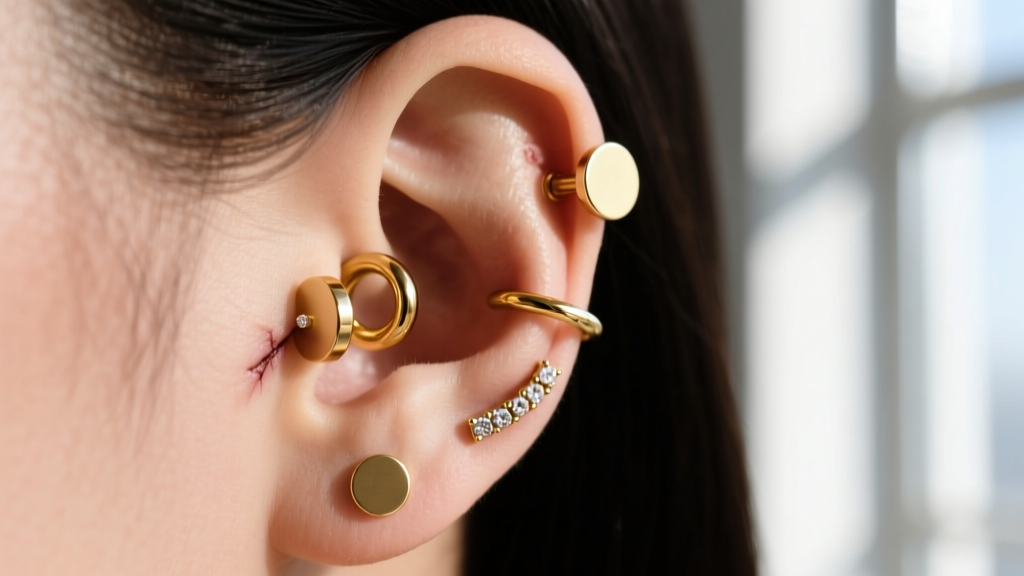
Despite the best curation plans, the forward helix is a notoriously difficult piercing to heal and maintain due to its location. The most common failure mode for forward helix jewelry is not infection, but pressure-induced migration caused by external compression.
'The forward helix sits exactly where over-ear headphones and tight beanies rest. If a client wears over-ear headphones for 8 hours a day while working from home, the constant compression pushes the flat disc back into the fistula. This restricts blood flow, causes localized tissue necrosis, and forces the body to reject the jewelry outward. We now mandate the use of in-ear monitors or open-back headsets during the 6-to-9-month healing window.' — Senior Piercer & APP Member
Furthermore, managing post length is a critical, often overlooked step. Initial piercings require a longer post—typically 5/16' (8mm) or 1/4' (6mm)—to accommodate the inevitable swelling that peaks around days 3 through 7. However, leaving this long post in place after the swelling subsides creates a lever arm. Every time hair brushes against the protruding gem, it multiplies the torque on the internal fistula. According to professional aftercare guidelines, clients must return to their piercer between weeks 4 and 8 to downsize to a snug 3/16' (5mm) or 5/32' (4mm) post. This downsizing is non-negotiable for long-term stability and prevents the dreaded 'headphone dent' migration.
Final Curation Framework
Building the perfect forward helix stack in 2026 requires patience, precision, and a willingness to invest in high-quality, anatomically appropriate jewelry. Ditch the bulky captive bead rings and oversized prong-set stones. Embrace the micro-curation movement by opting for 1.5mm to 2.5mm bezel-set gems, utilize ASTM F136 titanium or palladium-alloyed gold threadless flat-backs, and respect the mathematical limits of your crus anatomy. By prioritizing low-profile mechanics and meticulous downsizing schedules, your forward helix curation will not only look breathtaking but will heal securely to become a permanent, hassle-free fixture of your ear project.