Helix Earring Metallurgy & Biomechanics: An Expert Guide
Discover the technical specs behind the perfect helix earring. We analyze ASTM titanium, threading types, and gauge tolerances for optimal healing.

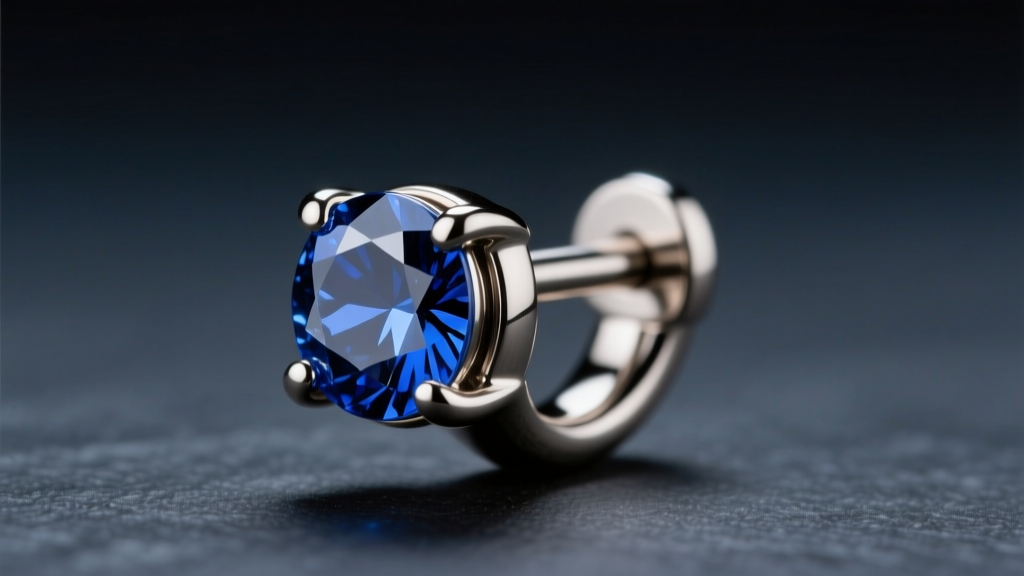
The Metallurgical Standard: Beyond Surgical Steel
When evaluating a helix earring for long-term wear or initial healing, the metallurgical composition of the jewelry is the single most critical variable. The term "surgical steel" is largely a marketing misnomer. Most commercial stainless steel jewelry is crafted from 316L or 316L VM (Vacuum Melted) alloys. While these alloys are highly corrosion-resistant, they inherently contain between 8% and 10% nickel. In the presence of bodily fluids, sebum, and saline solutions, nickel ions can leach from the surface, triggering allergic contact dermatitis and delaying the healing of the cartilaginous fistula.
For a technically sound helix setup, the industry gold standard is ASTM F-136 Ti-6Al-4V ELI (Extra Low Interstitial) titanium. This specific alloy is devoid of nickel and possesses a high strength-to-weight ratio, minimizing the gravitational drag on the delicate helix rim. Furthermore, the surface finish is just as vital as the base metal. According to the Association of Professional Piercers (APP), implant-grade jewelry must feature a mirror finish with a surface roughness (Ra) of less than 0.8 micrometers. This micro-smooth surface prevents the mechanical adhesion of biofilms and bacterial colonies, which are primary culprits in localized helix infections.
- ASTM F-136 Titanium: The baseline for healing. Hypoallergenic, lightweight, and anodizable for custom colors without compromising biocompatibility.
- Niobium (99.9% Pure): An excellent alternative for those seeking darker, anodized gunmetal tones, though slightly heavier than titanium.
- 14k or 18k Solid Gold: Must be alloyed with palladium or silver rather than nickel or zinc. Expect to pay between $150 and $350+ for a single, high-quality gold helix end.
Threading Mechanics: Why the Connection Matters
The connection point between the decorative end and the post or barbell dictates both the security of the jewelry and the trauma inflicted upon the helix tissue during insertion. Externally threaded jewelry—where the screw pattern is cut into the post that passes through the piercing—acts like a microscopic file, tearing the fragile epithelial lining of the fistula. This mechanical trauma frequently leads to hypertrophic scarring (irritation bumps) along the helix ridge.
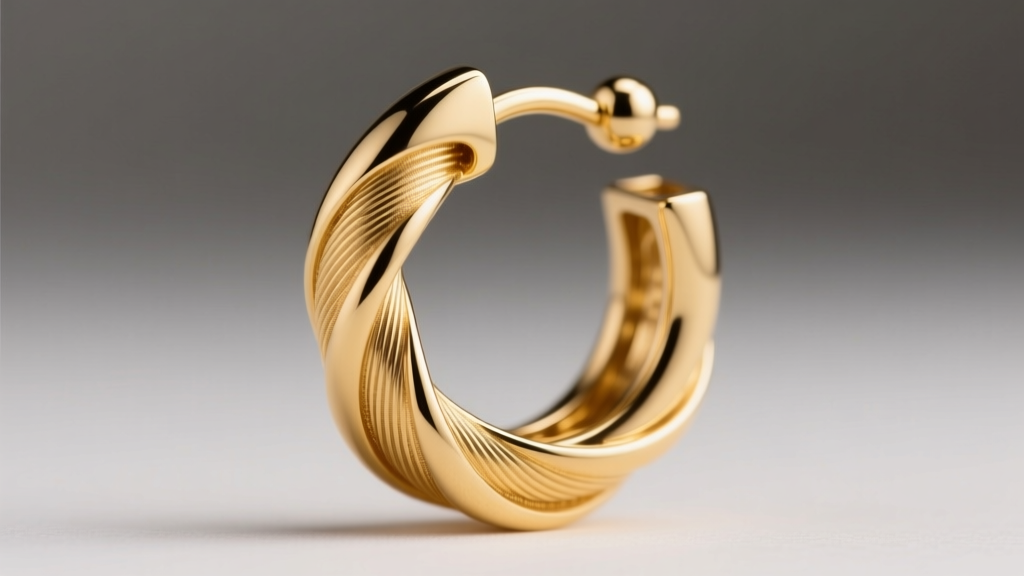
Threadless (Press-Fit) Systems
Threadless systems utilize a tension-fit mechanism. The pin on the decorative end is slightly bent by the wearer or piercer before being inserted into the hollow post. The natural springback of the metal creates outward tension against the inner wall of the post. A standard 16-gauge threadless post typically accepts an 18-gauge or 19-gauge pin. The holding force of a properly bent threadless pin routinely exceeds 15 pounds of pull-out resistance, making it vastly superior for securing expensive gemstone ends in high-snag areas like the forward helix.
Internal Threading
In internally threaded jewelry, the screw pattern is tapped into the decorative end or the bead, while the post remains perfectly smooth. This allows the post to glide through the helix fistula without causing micro-abrasions. While highly secure, internal threading requires precise alignment to avoid cross-threading, which can permanently damage the tapped components.
Dimensional Tolerances: Gauge, Rise, and Hoop Diameter
Selecting the correct dimensions for a helix earring requires an understanding of tissue swelling and anatomical curvature. The helix is typically pierced at 16-gauge (1.2mm) or 14-gauge (1.6mm). While 16G is the modern standard for standard and flat helix placements, 14G is often preferred for industrial scaffolds or rook-helix combinations to provide structural rigidity.
| Dimension Variable | Initial Healing Spec | Healed / Long-Term Spec | Technical Rationale |
|---|---|---|---|
| Post Length (Rise) | 5/16" (8mm) to 3/8" (10mm) | 1/4" (6mm) to 5/16" (8mm) | Accommodates initial lymphatic swelling; downsizing prevents snagging and angular migration. |
| Hoop Inner Diameter | N/A (Hoops not recommended) | 5/16" (8mm) to 3/8" (10mm) | Must clear the curvature of the helical rim without compressing the tissue or causing ischemia. |
| Gauge Thickness | 16G (1.2mm) | 16G (1.2mm) or 18G (1.0mm) | 16G provides optimal stability; 18G may be used for delicate, healed secondary helix placements. |
Biomechanics and Failure Modes in Helix Piercings
The biomechanical environment of the helix is uniquely hostile to healing. Unlike the earlobe, which is highly vascularized soft tissue, the helix consists of dense avascular cartilage covered by a thin layer of skin. Nutrient delivery and waste removal rely entirely on the perichondrium and localized lymphatic drainage. Consequently, any mechanical disruption severely prolongs the healing timeline, which typically spans 9 to 12 months.
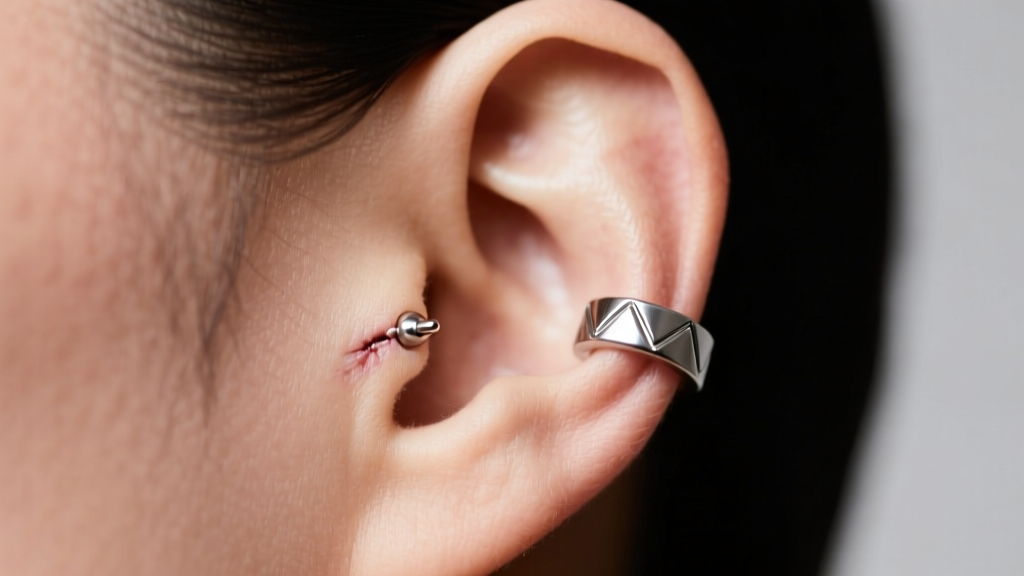
"The most common failure mode in helix piercings is not infection, but mechanical irritation leading to granuloma formation. This is almost exclusively driven by premature hoop insertion and the resulting rotational friction." — Clinical observations in body modification dermatology.
When a captive bead ring or seamless hoop is worn before the fistula is fully mature, the natural curvature of the hoop forces the jewelry to rotate every time the ear is bumped or slept on. This rotation acts as a conveyor belt, dragging external bacteria, hair products, and dead skin cells directly into the healing wound. Furthermore, the Mayo Clinic notes that repeated friction combined with trace metal exposure exponentially increases the risk of localized contact dermatitis.
To engineer a successful helix setup, flat-back labrets (threadless or internally threaded) must be worn until the piercing is completely asymptomatic. The flat disc rests flush against the posterior scapha, distributing pressure evenly and eliminating the rotational vectors inherent in hoop-style jewelry. Only after the tissue has fully epithelialized should a clicker or captive ring be introduced, ensuring the inner diameter is wide enough (minimum 8mm) to accommodate the natural convexity of the helical rim without pinching.
Conclusion: Engineering Your Setup
Achieving a flawless helix piercing requires treating the jewelry selection as an engineering problem rather than a purely aesthetic one. By mandating ASTM F-136 titanium or palladium-alloyed gold, insisting on threadless or internal threading, and strictly adhering to anatomical dimensional tolerances, you eliminate the vast majority of variables that lead to cartilage complications. For further reading on metal biocompatibility and contact dermatitis in body jewelry, refer to the National Center for Biotechnology Information database. Precision in your initial jewelry choice dictates the longevity, comfort, and ultimate success of your helix modification.