Engineering 60mm Hoop Earrings: Gauge, Weight & Lobe Health
Discover the technical specs behind 60mm hoop earrings. Learn about gauge thickness, weight distribution, closure types, and lobe health.

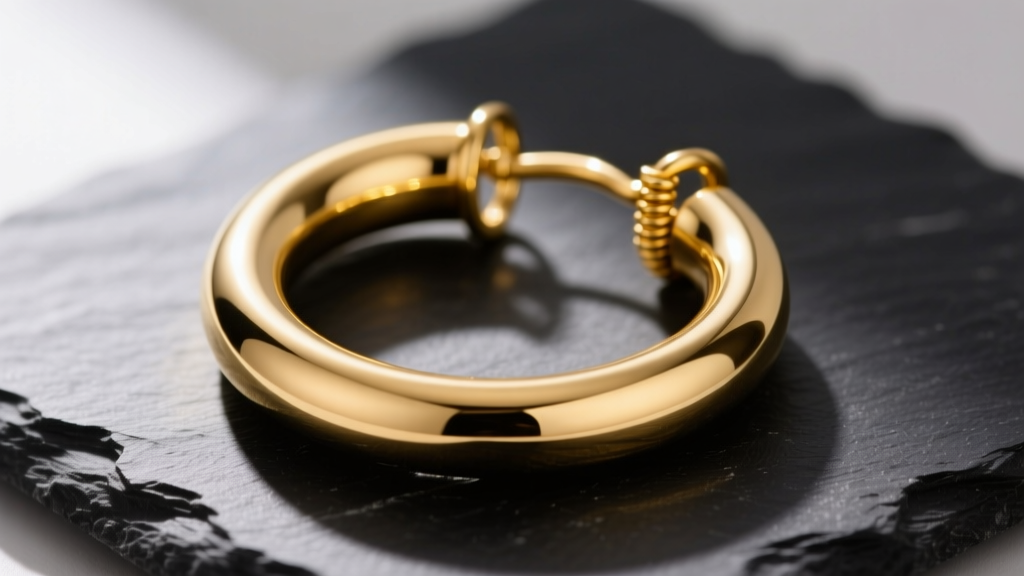
The Physics of Large Hoops: Why 60mm Demands Specific Engineering
When transitioning from standard 20mm or 30mm hoops to statement-making 60mm hoop earrings, you are not simply scaling up a design; you are fundamentally altering the physics of how the jewelry interacts with human anatomy. A 60mm diameter translates to roughly 2.36 inches, meaning the bottom of the hoop sits a full 30mm (1.18 inches) below the piercing fistula. This creates a pronounced pendulum effect.
Every time the wearer turns their head, walks, or speaks, the kinetic energy transfers to the earlobe. If the structural engineering of the hoop—specifically the wire gauge, material density, and closure mechanism—is not calibrated for this leverage, the result is accelerated lobe elongation, piercing migration, or catastrophic hardware failure. In 2026, advanced jewelry manufacturing has introduced new lightweight alloys and electroformed hollow tubing, but the foundational rules of biomechanics and metallurgy remain absolute.
Gauge Thickness and the 'Cheese-Cutter' Effect
The most critical failure point in large hoop earrings is the intersection of the wire and the earlobe. The 'cheese-cutter effect' occurs when a thin wire under tension slices through soft tissue. For 60mm hoops, the leverage multiplier makes this a severe risk if the gauge is inadequate.
According to the Association of Professional Piercers (APP), jewelry that is too thin can cause tissue necrosis and irreversible lobe splitting, especially when subjected to the swinging momentum of large-diameter hoops.
To mitigate this, expert jewelers mandate specific minimum gauges based on the hoop's overall mass and construction method.
| Wire Gauge | Millimeter (mm) | Best Use Case for 60mm Hoops | Lobe Stress Risk |
|---|---|---|---|
| 20-Gauge | 0.81mm | Strictly forbidden for 60mm drops | Extreme (High tearing risk) |
| 18-Gauge | 1.02mm | Hollow tubing or lightweight titanium | Moderate (Acceptable for <4g hoops) |
| 16-Gauge | 1.29mm | Solid wire, standard gold/silver hoops | Low (Industry standard for safety) |
| 14-Gauge | 1.63mm | Heavy solid hoops, statement pieces | Minimal (Distributes weight optimally) |
For everyday wear, a 16-gauge (1.29mm) wire offers the perfect synthesis of structural integrity and tissue comfort. It provides enough surface area to distribute the pendulum weight across the fistula without causing localized pressure points.
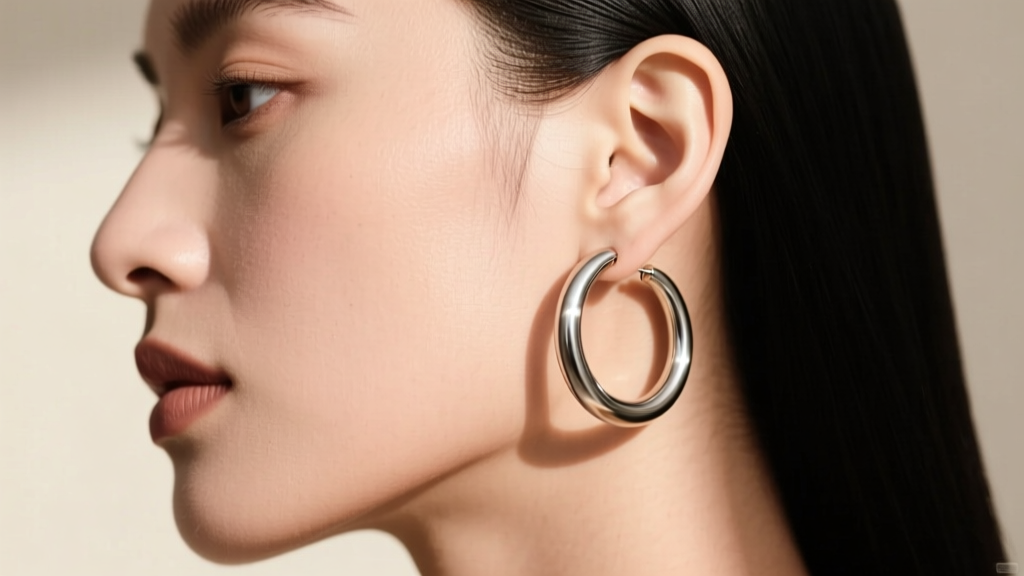
Material Science: Hollow Tubing vs. Solid Wire
The weight of a 60mm hoop is dictated by its volume and the density of its metal. A solid 18k yellow gold hoop at 60mm in diameter and 2.0mm thick can easily exceed 14 grams per earring. While this provides a luxurious, heavy drape, it will inevitably stretch the earlobe over time. To solve this, high-end manufacturers utilize hollow tubing.
The Hollow Tubing Advantage
Hollow hoops are created by drawing metal over a resin core or using advanced electroforming techniques. This reduces the weight of a 60mm gold hoop from 14 grams down to an incredibly light 3.5 grams, while maintaining the visual thickness (e.g., 3.0mm) that consumers desire. However, hollow hoops introduce a new vulnerability: compression denting. If a hollow 18k gold hoop is dropped on a hard surface or slept in, the thin metal shell can permanently dent. Therefore, hollow 60mm hoops require meticulous care and are best reserved for occasional or evening wear.
Solid Wire and Titanium Alloys
For daily wear, solid wire is vastly superior in durability. To keep solid 60mm hoops lightweight without sacrificing structural integrity, expert jewelers are increasingly turning to ASTM F136 Grade 23 Titanium. Titanium boasts a strength-to-weight ratio that outperforms 316L surgical steel and traditional brass alloys. A solid 16-gauge titanium 60mm hoop weighs roughly 40% less than its stainless steel counterpart, completely eliminating lobe fatigue while remaining impervious to bending or warping.
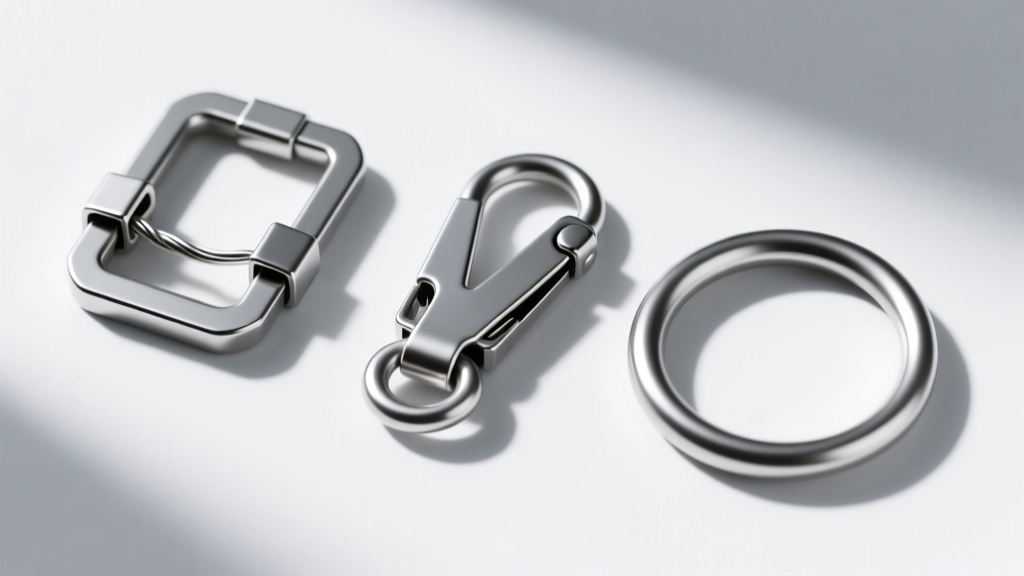
Closure Mechanisms Rated for 60mm Hoops
The closure is the mechanical weak point of any hoop. At 60mm, the torque applied to the closure during insertion, removal, and accidental snagging is significant. Choosing the wrong clasp guarantees loss or breakage.
- V-Wire Latch-Back (Saddleback): The gold standard for heavy or large hoops. A V-shaped wire snaps securely into a hinged catch. The geometry of the V-wire prevents lateral shifting, and the tension lock is highly resistant to accidental openings. Expert Verdict: Mandatory for solid gold 60mm hoops over 6 grams.
- Hinged Snap Clasp: Features a straight post that clicks into a hollow receiver. While easy to insert, the straight post offers zero lateral stability. If the 60mm hoop is bumped upward, the torque can pry the post out of the receiver. Expert Verdict: Acceptable only for ultra-lightweight hollow tubing or rigid huggie-style thick hoops.
- Continuous (Endless) Hoop: A thin wire that threads entirely through the fistula and snaps into the opposite end. For a 60mm diameter, threading a continuous wire is incredibly frustrating and risks bending the hoop out of its perfect circular geometry. Repeated bending causes work hardening and eventual metal fatigue. Expert Verdict: Avoid entirely for diameters over 40mm.
Metallurgical Fatigue and Warping
Large hoops are prone to going 'out of round.' When a 60mm hoop is squeezed, the metal undergoes plastic deformation. According to metallurgical principles taught by institutions like the Gemological Institute of America (GIA), precious metals like 14k and 18k gold have specific yield strengths. If a hollow 60mm hoop is crushed, it cannot simply be bent back into a perfect circle; the metal lattice has been stretched and compressed, leading to microscopic stress fractures.
To combat warping, structural engineers design 60mm hoops with a slightly oval resting tension, or they utilize work-hardened alloys like platinum or palladium white gold, which possess a much higher modulus of elasticity than yellow gold. If you frequently experience warped hoops, upgrading to a platinum or titanium alloy will provide the necessary 'memory' to resist permanent deformation.
Proportional Scaling: Matching 60mm Hoops to Face Geometry
While the engineering ensures safety, the visual impact of 60mm hoops relies on proportional scaling. A 2.36-inch drop is a dominant facial feature.
- Angular and Square Jawlines: The perfect circle of a 60mm hoop provides excellent contrast, softening sharp mandibular angles. Opt for a thinner wire profile (16g or 14g solid) to maintain visual lightness.
- Round and Heart Face Shapes: A standard circular 60mm hoop can emphasize facial width. To counteract this, look for 60mm hoops that feature a slight oval elongation or a teardrop geometric modification, which draws the eye downward and elongates the neck.
- Neck Length Consideration: Because 60mm hoops drop significantly, they will rest near the collarbone on individuals with shorter necks. Ensure the closure mechanism is completely smooth to prevent snagging on high-collared garments or scarves.
Expert Maintenance and Lobe Care Protocol
Wearing 60mm hoop earrings requires a proactive maintenance routine to preserve both the jewelry and your anatomy. Never sleep in hoops of this diameter; the leverage of your head against a pillow can easily snap a V-wire or permanently warp the metal. Furthermore, practice the 'one-finger support' technique when putting on heavy solid hoops: use your index finger behind the earlobe to support the tissue while threading the 16-gauge wire, preventing the initial micro-tears that lead to long-term lobe sagging. By respecting the physics and material limits of large-scale jewelry, you ensure your statement pieces remain safe, comfortable, and structurally flawless for years to come.


