Scarab Earrings: Technical Anatomy, Materials & Sizing Guide
Explore the technical anatomy of scarab earrings. Learn about enamel inlay techniques, metal alloys, gauge sizing, and structural durability.

The Structural Anatomy of Scarab Earrings
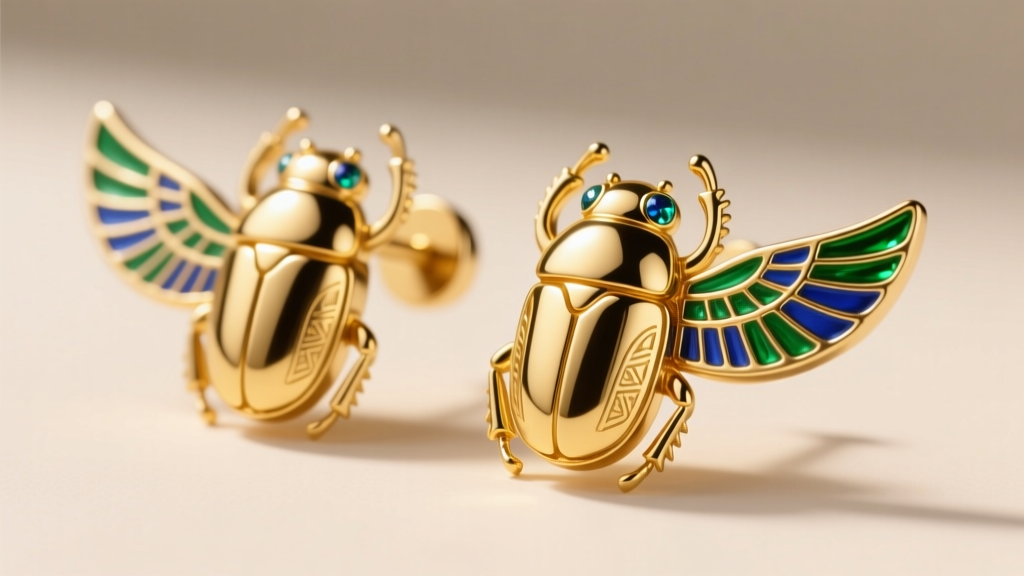
The scarab beetle motif, rooted in ancient Egyptian iconography representing Khepri and solar rebirth, presents unique structural challenges in modern earring design. Unlike simple geometric studs, a technically accurate scarab earring requires a complex three-dimensional topography. The anatomy of the piece is divided into three primary zones: the clypeus (head), the pronotum (thorax), and the elytra (wing cases). In high-end artisan jewelry, the elytra are rarely cast as a single solid dome. Instead, they are engineered with a subtle center-line striation to mimic the beetle's natural wing separation, requiring precise CAD modeling or advanced wax carving techniques to ensure the metal borders are thick enough to hold enamel but thin enough to maintain a delicate aesthetic.
Modern 2026 manufacturing techniques often utilize electroforming for large, dangle-style scarab earrings. This process allows jewelers to create a hollow, lightweight 18k gold shell that retains the intricate surface texture of the beetle's carapace without the prohibitive weight of solid cast gold. However, hollow-form scarabs are highly susceptible to crushing if dropped on a hard surface, necessitating careful structural ribbing on the underside of the earring to maintain rigidity.
Material Science: Enamel vs. Gemstone Inlay
The elytra of a scarab earring serve as the primary canvas for color, achieved through either vitreous enamel or lapidary stone inlay. Understanding the material science behind these techniques is critical for assessing durability and value.
Vitreous Enamel and Champlevé Technique
Authentic vitreous enamel is essentially crushed glass fused to a metal substrate at temperatures exceeding 1400°F (760°C). For scarab earrings, the champlevé technique is the industry standard. The jeweler carves or casts recessed cells into the gold or silver base, fills them with enamel powder, and fires the piece. The remaining metal borders mimic the natural striations of the beetle's wings. Unlike cold enamel (epoxy resin), which yellows under UV exposure and degrades within a few years, vitreous enamel is impervious to light and skin oils, maintaining its vibrant lapis-blue or malachite-green hue for centuries.
Gemstone Inlay and Mohs Hardness
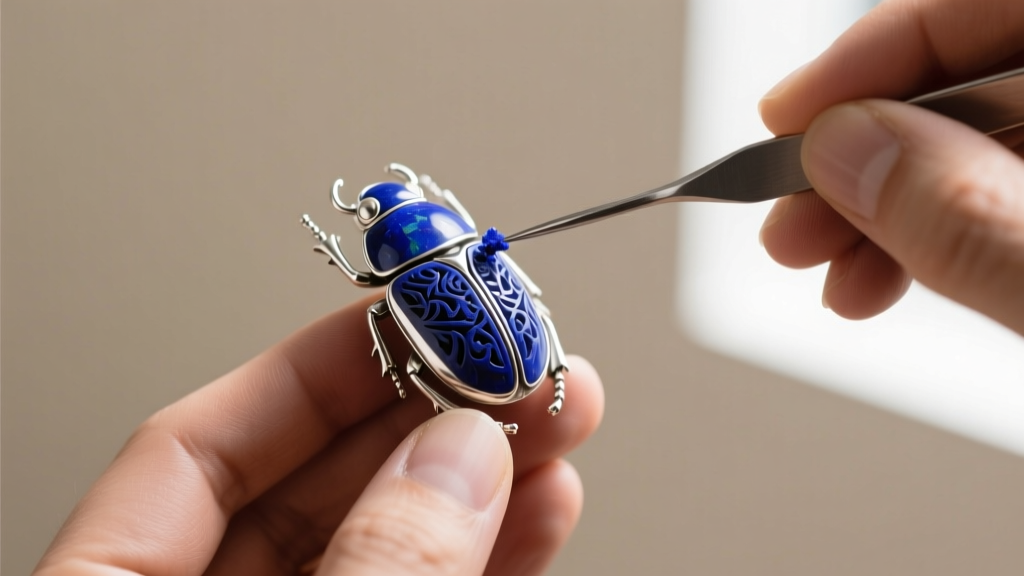
When gemstones are used instead of enamel, the lapidary must slice and shape the stone to fit precisely into the metal bezels of the elytra. According to the GIA Gem Encyclopedia, the Mohs hardness of the chosen stone dictates the earring's longevity. Lapis lazuli (Mohs 5-6) and turquoise (Mohs 5-6) are traditional choices, but turquoise is highly porous. In modern scarab earrings, turquoise is almost always stabilized with a clear resin to prevent cracking and color shifts from contact with cosmetics. Malachite (Mohs 3.5-4) is prized for its concentric banding, which lapidaries carefully orient to mirror the curved texture of the beetle's wings, though its softness makes it highly prone to scratching if the metal bezel sits below the stone's surface.
Gauge Sizing, Posts, and Ear Lobe Ergonomics
The most frequent point of failure in scarab earrings is not the decorative face, but the post and backing system. Because scarabs are inherently top-heavy and often feature protruding elements like carved legs or extended antennae, their center of gravity pulls downward, creating torque on the earlobe.
Standard stud earrings typically utilize a 20-gauge (0.81mm) or 18-gauge (1.02mm) post. However, a solid 18k gold scarab stud measuring just 15mm x 10mm can easily weigh between 4 and 7 grams. When the weight exceeds 5 grams, a 20-gauge wire will gradually bend under the dynamic load of daily movement, causing the earring to droop. For solid gold or heavy stone-inlay scarabs, a 16-gauge (1.29mm) post is the technical minimum required to maintain a forward-facing orientation.
Furthermore, the clutch or backing must distribute this weight across a wider surface area of the earlobe to prevent the 'cheese-cutter effect,' where a thin wire slowly migrates downward through the piercing tissue. Jumbo silicone friction backs (10mm to 14mm in diameter) or hinged Omega backs are mandatory for scarab drops and heavy studs. Screw-back mechanisms, while secure against loss, concentrate the pressure on a single point and are less ideal for heavy, top-heavy scarab designs unless paired with a wide, flat disc.
Durability and Failure Modes in Vintage & Modern Pieces
Whether you are collecting Egyptian Revival pieces from the Art Deco era or purchasing contemporary artisan designs, understanding common structural failure modes is essential for maintenance and authentication.
| Component | Material Options | Technical Consideration & Failure Mode |
|---|---|---|
| Elytra (Wings) | Vitreous Enamel, Malachite, Lapis | Enamel can craze or chip if the gold substrate flexes. Malachite scratches easily; requires a raised bezel lip for protection. |
| Pronotum (Thorax) | Solid Gold, Gemstone Cabochon | High profile area prone to impact damage. Prong settings here frequently catch on textiles; bezel settings are structurally superior. |
| Post / Wire | 18k Gold, Platinum, Titanium | Posts thinner than 18G will shear or bend under the weight of solid cast pieces exceeding 6 grams. |
| Legs / Antennae | Wire appliqué, Cast metal | Soldered wire legs are the first to snap during cleaning. Modern cast-integrated legs offer superior shear strength. |
One specific failure mode to watch for in vintage scarab earrings is the degradation of the adhesive used in early 20th-century stone inlays. Before modern cyanoacrylates and epoxies, shellac or early synthetic resins were used. Over decades, these adhesives become brittle, and a slight tap to the turquoise or lapis inlay can cause the stone to pop out of its cell. Always inspect the perimeter of the inlay under a 10x loupe for micro-gaps or resin degradation before purchasing vintage pieces.
Pricing Tiers and Authentication Markers
The market for scarab earrings spans from mass-market costume jewelry to high-end artisan and antique pieces. Authenticating the metal and the origin requires a keen eye for hallmarks and manufacturing evidence.
- Mass-Market / Fashion ($30 - $150): Typically cast in brass or sterling silver with cold enamel (resin) or dyed howlite masquerading as turquoise. Posts are usually 20G and soldered with lead-free soft solder, which appears as a dull, matte silver blob at the base of the post.
- Artisan / Fine Jewelry ($400 - $2,500): Crafted in 14k or 18k gold, featuring vitreous enamel or genuine, stabilized lapis and malachite. Look for laser-welded posts (which leave no visible solder seam) and proper precious metal hallmarks stamped on the earring's flat backing plate, not just the post.
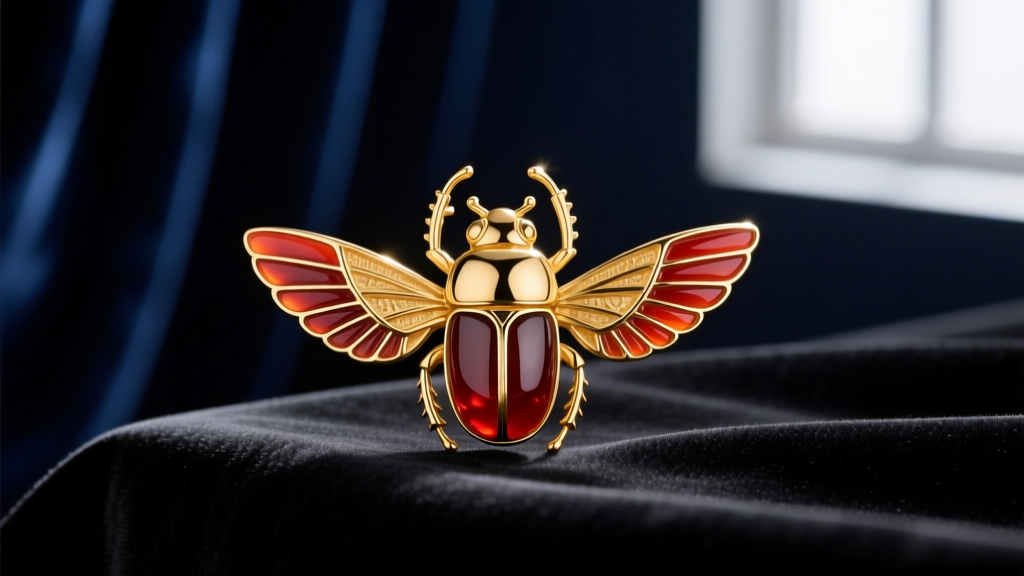
- Antique / Egyptian Revival ($3,000 - $15,000+): Pieces from the 1920s discovery of Tutankhamun's tomb often feature 14k or 18k gold with guilloché enamel (enamel applied over an engine-turned, geometrically engraved metal base). Authentication requires verifying the patina, the specific alloy composition (early 20th-century gold alloys often contain higher copper content, giving a slightly rosier hue), and the cut of any accent diamonds, which should be single-cut or early European-cut rather than modern brilliant.
Care Protocols for Inlaid Scarab Jewelry
The complex topography and mixed materials of scarab earrings demand specialized care protocols. The most common mistake owners make is using ultrasonic cleaners. The high-frequency cavitation bubbles generated by ultrasonic machines will shatter vitreous enamel, fracture porous stones like turquoise, and strip the stabilization resin from malachite.
For routine cleaning, use a soft-bristled makeup brush and a mild, phosphate-free dish soap diluted in lukewarm water. Gently agitate the brush over the metal borders and the stone inlay, taking care not to press hard enough to flex the metal substrate. Rinse with distilled water to prevent hard water spots on the enamel, and dry immediately with a microfiber cloth. For the underside of the earring, where skin oils and dead skin cells accumulate in the recessed casting details, a wooden toothpick is the safest tool for scraping out debris without risking micro-scratches on the gold or silver.
When storing scarab earrings, they must be kept in individual, soft-lined compartments. The protroding legs and antennae of one scarab will easily scratch the polished enamel or soft malachite wings of another if they are allowed to tumble together in a shared jewelry box. By understanding the structural anatomy and material limitations of these intricate pieces, collectors and enthusiasts can ensure their scarab earrings remain pristine for generations.


