Why 8mm Earrings Dominate 2026 Cartilage & Lobe Trends
Discover why 8mm earrings are the ultimate 2026 trend for cartilage and lobe piercings. Explore gauge pairings, materials, and styling.


In the ever-evolving landscape of body jewelry, sizing is just as critical as the material or the gemstone. As we move through 2026, the industry has seen a massive shift away from oversized, statement-making hoops toward precision-engineered micro-silhouettes. At the absolute center of this movement are 8mm earrings. Once considered a niche size reserved strictly for specific cartilage placements, the 8mm inner diameter (ID) has become the Goldilocks standard for modern ear curation. It is large enough to dangle elegantly from a standard lobe, yet compact enough to hug the anatomy of a helix or tragus without catching on hair, clothing, or headphones.
This comprehensive style and trend analysis breaks down the biomechanics, material science, and styling frameworks that have elevated 8mm earrings to the top of the 2026 jewelry hierarchy. Whether you are a collector of fine body jewelry or a curator looking to refine your aesthetic, understanding the nuances of this specific diameter is essential.
The Anatomy of an 8mm Hoop: Why This Size is the 2026 Standard
To understand the trend, we must first define the measurements. When jewelers and professional piercers refer to an 8mm earring, they are specifically citing the inner diameter (ID). The outer diameter (OD) will vary depending on the wire thickness (gauge) and any decorative elements. For instance, an 8mm ID hoop crafted from 1.2mm (16-gauge) wire will have an actual outer footprint of roughly 10.4mm.
The dominance of the 8mm size in 2026 is deeply tied to the "Quiet Luxury" and "Micro-Curation" trends. Consumers are prioritizing jewelry that integrates seamlessly into active, professional lifestyles. An 8mm hoop provides a subtle, continuous line of metal that highlights the natural folds of the ear without extending past the anatomical boundaries of the conch or scapha. This minimizes the "snag factor"—the leading cause of traumatic tearing and migration in cartilage piercings.
"The shift toward smaller, anatomically flush inner diameters like 8mm represents a maturation in body jewelry design. We are moving past the 'bigger is better' era into an age of bespoke, placement-specific engineering." — 2026 Body Jewelry Trend Report
Material Grades & Gauge Pairings: The Data Matrix
Pairing the correct wire thickness (gauge) with an 8mm inner diameter is a matter of both aesthetics and tissue health. A wire that is too thin on a small-diameter hoop creates a high-pressure vector on the fistula (the piercing channel), leading to the dreaded "cheese-cutter effect," where the jewelry slowly slices through the tissue over time.
| Piercing Location | Optimal Gauge | 8mm ID Fit Profile | Snag & Migration Risk |
|---|---|---|---|
| Standard Lobe | 18G (1.0mm) - 20G (0.8mm) | Loose Dangle / Drop | Moderate (Sleeping risk) |
| Upper Lobe | 18G (1.0mm) | Snug Huggie | Low |
| Helix | 16G (1.2mm) | Perfect Flush Hoop | Very Low |
| Tragus | 16G (1.2mm) - 18G (1.0mm) | Snug Contour Hoop | Low |
| Conch | 14G (1.6mm) - 16G (1.2mm) | Tight Huggie (Edge) | Very Low |
For 2026, the gold standard for 8mm earrings is 16-gauge (1.2mm). This thickness provides enough structural integrity to prevent the hoop from warping when opened or closed, while distributing the weight of the jewelry evenly across the fistula. According to the Association of Professional Piercers (APP), ensuring proper gauge-to-diameter ratios is vital for long-term tissue health, especially in cartilage where blood flow is limited.
Cartilage vs. Lobe: Placement Strategies for 8mm Earrings
The versatility of the 8mm silhouette is unmatched, but its behavior changes drastically depending on the tissue thickness and angle of the piercing channel.
The Helix and Forward Helix
In the helix, an 8mm earring acts as a classic "huggie." Because the helix cartilage ridge is relatively thin, an 8mm ID will wrap tightly around the edge of the ear. Crucial Warning: An 8mm hoop should never be inserted into a fresh, healing helix piercing. Fresh cartilage swells significantly, and an 8mm ring will choke the tissue, leading to hypertrophic scarring or piercing rejection. Always wait until the piercing is fully healed (typically 9 to 12 months) and downsized by a professional before switching to an 8mm hoop.
The Tragus and Conch
The tragus requires jewelry that clears the ear canal and doesn't interfere with earbuds or over-ear headphones. The 8mm hoop is the ultimate 2026 solution for the tragus, sitting flush against the small flap of cartilage. For the conch, an 8mm earring will only work if the piercing is placed very close to the outer rim (the anti-helix); otherwise, the hoop will pull at an awkward angle, causing irritation.
The Mechanics of the Hinge: Clickers vs. Seamless Rings
As 8mm earrings have surged in popularity, the engineering of the closure mechanism has become a major focal point for high-end jewelry brands like BVLA (Body Vision Los Angeles) and Anatometal.
- Seamless Rings: Traditional seamless rings require the wearer to twist the metal laterally to open and close it. Over time, this twisting warps the circular geometry of an 8mm ring, turning it into an oval. When inserted back into the piercing, this warped shape acts like a file against the delicate fistula.
- CNC-Machined Clickers: The 2026 trend heavily favors hinged clickers. These feature a precision-machined hinge on one side and a secure clasp on the other. They open vertically without distorting the 8mm circle, ensuring the jewelry remains perfectly round and gentle on the tissue. High-end 14k or 18k gold 8mm clickers typically range from $110 to $250, reflecting the cost of precision micro-engineering.
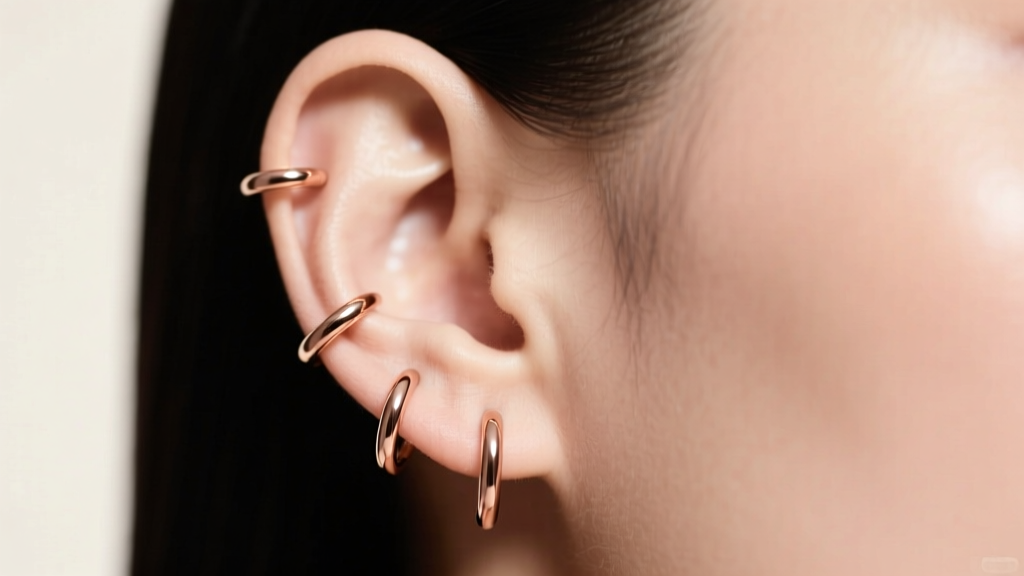
Styling the "Micro-Curated" Ear: 2026 Trend Forecast
The aesthetic of 2026 is defined by intentionality. The "ear party" trend of the late 2010s—which involved clustering dozens of mismatched studs—has evolved into the "Micro-Curated" ear. This style relies on uniform metal tones and repeating geometric shapes.
Stacking three 8mm hoops in a vertical line (e.g., upper lobe, mid-helix, and lower helix) creates a sleek, architectural look that draws the eye upward. Mixing textures is also highly prevalent; pairing a high-polish 18-karat yellow gold 8mm clicker in the tragus with a matte-finished titanium 8mm hoop in the helix creates a sophisticated, tonal contrast. For those seeking a touch of brilliance, 8mm clickers featuring a single, bezel-set 1.5mm diamond or sapphire on the clasp offer a subtle flash of light without the bulk of a traditional dangle earring.
Troubleshooting Fit: When 8mm Fails and How to Fix It
Despite its popularity, the 8mm size is not a universal panacea. Here are the most common failure modes and their actionable solutions:
- The "Pinch" Effect: If the 8mm hoop feels like it is pinching the bottom of your lobe or helix, the inner diameter is too small for your specific tissue thickness. Solution: Size up to a 9mm or 10mm ID. Even a 1mm increase drastically changes the drape and comfort of the jewelry.
- Angle Irritation: If the piercing was done at a steep angle, a rigid 8mm hoop will force the fistula into an unnatural curve, causing chronic soreness. Solution: Switch to an 8mm flat-back labret stud with a decorative end, or consult a piercer about a custom-bent continuous ring that matches your unique piercing angle.
- Tarnish and Buildup: Because 8mm hoops sit so close to the skin, they are prone to trapping sebum and dead skin cells in the hinge mechanism. Solution: Clean the hinge weekly using a soft-bristled toothbrush and sterile saline solution. Avoid harsh chemicals like rubbing alcohol, which can degrade the O-rings or tension springs inside premium clickers.
Final Verdict on the 8mm Silhouette
The ascent of 8mm earrings in 2026 is not a fleeting fad; it is a fundamental correction in how we approach body jewelry. By prioritizing anatomical harmony, tissue health, and precision engineering, the 8mm hoop has secured its place as a permanent staple in the modern jewelry wardrobe. Whether crafted from implant-grade ASTM F136 titanium for a minimalist edge or forged from 18-karat gold for everyday luxury, the 8mm earring proves that true style lies in the perfect measurement.


