Arrow Earrings Engineering: Metallurgy and Piercing Fit
Explore the engineering of arrow earrings. We analyze implant-grade metals, gauge tolerances, and weight distribution for secure cartilage and lobe fits.

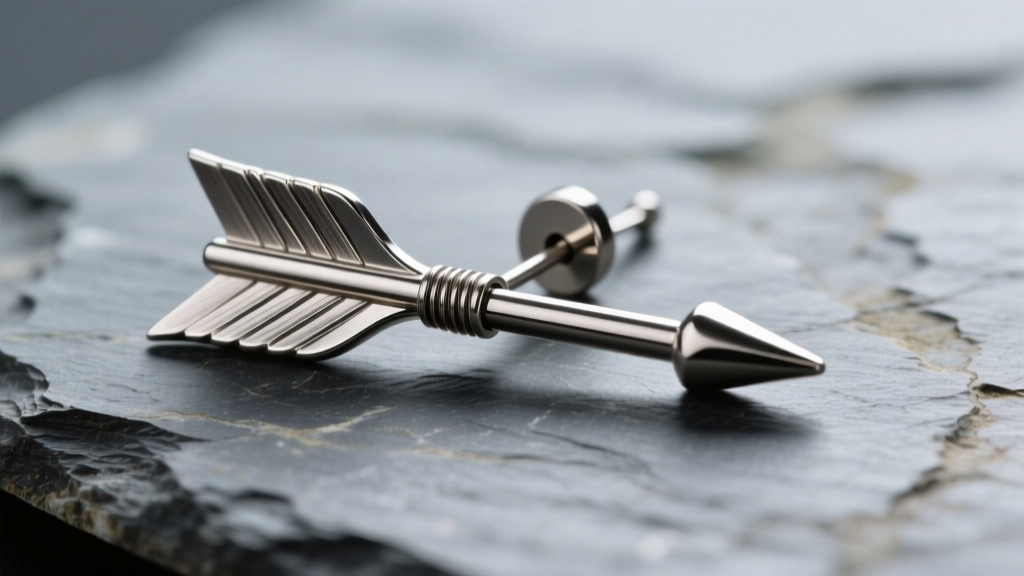
The Biomechanics of Directional Motifs
Arrow earrings are highly sought after for their symbolic representation of direction, momentum, and forward progress. However, from a jewelry manufacturing and piercing mechanics perspective, the arrow motif presents a unique structural challenge. Unlike symmetrical round studs or evenly balanced hoops, an arrow is inherently asymmetrical. The fletching (the back of the arrow) is typically wider, more intricate, and heavier than the arrowhead tip. This creates a cantilever effect on the earlobe or cartilage fistula.
When an arrow earring is inserted, the center of gravity rarely aligns perfectly with the central axis of the post. This introduces Z-axis and Y-axis torque. If the post is soldered even 0.5 millimeters off-center, or if the backing lacks sufficient surface area to counteract the rotational force, the arrow will inevitably succumb to the "6 o'clock droop." This sagging not only ruins the aesthetic alignment of the directional motif but can also place uneven pressure on the piercing channel, leading to irritation or migration over time. Understanding the physics of this torque is the first step in selecting high-quality arrow earrings that maintain a strict horizontal or vertical orientation throughout the day.
Metallurgy: Implant-Grade Titanium vs. Base Alloys
Because the shaft of an arrow earring must support the uneven weight distribution of the motif, the metallurgical properties of the metal are paramount. Mass-market arrow earrings are frequently stamped or cast from brass, copper alloys, or low-karat gold-plated base metals. These materials possess a low yield strength and are highly susceptible to structural fatigue. When subjected to the constant rotational torque of an asymmetrical motif, a brass shaft will slowly bend, permanently warping the earring.
For fine jewelry and body-safe applications, manufacturers must rely on high-tensile metals. According to the Association of Professional Piercers (APP), implant-grade materials are essential for any jewelry that sits within a piercing channel, particularly for fresh or sensitive cartilage piercings. ASTM F136 Implant-Grade Titanium is the gold standard for arrow earring shafts. It offers exceptional tensile strength, meaning the shaft can be machined to a slender, elegant profile without sacrificing its ability to resist bending. Furthermore, titanium is entirely nickel-free and biocompatible, preventing the contact dermatitis that base-metal alloys frequently cause when the heavy fletching pulls the post against the skin.
The Jewelers Vigilance Committee (JVC) also mandates strict alloy disclosures for precious metals. When opting for gold arrow earrings, 14k or 18k nickel-free white or yellow gold provides the necessary Vickers hardness to maintain shaft integrity, provided the alloy is properly work-hardened during the manufacturing process.
Material Stress Test Comparison
| Material Grade | Approx. Yield Strength | Torque Resistance | Biocompatibility |
|---|---|---|---|
| ASTM F136 Titanium | 895 MPa | Exceptional | Implant-Grade (Hypoallergenic) |
| 14k Gold Alloy (Nickel-Free) | 400 - 500 MPa | High | Excellent (if alloyed correctly) |
| Sterling Silver (925) | 250 - 300 MPa | Moderate (Prone to bending) | Poor for fresh piercings (Tarnish/Copper) |
| Brass / Base Metal | 200 - 250 MPa | Low (High failure rate) | Poor (Nickel/Lead risks) |
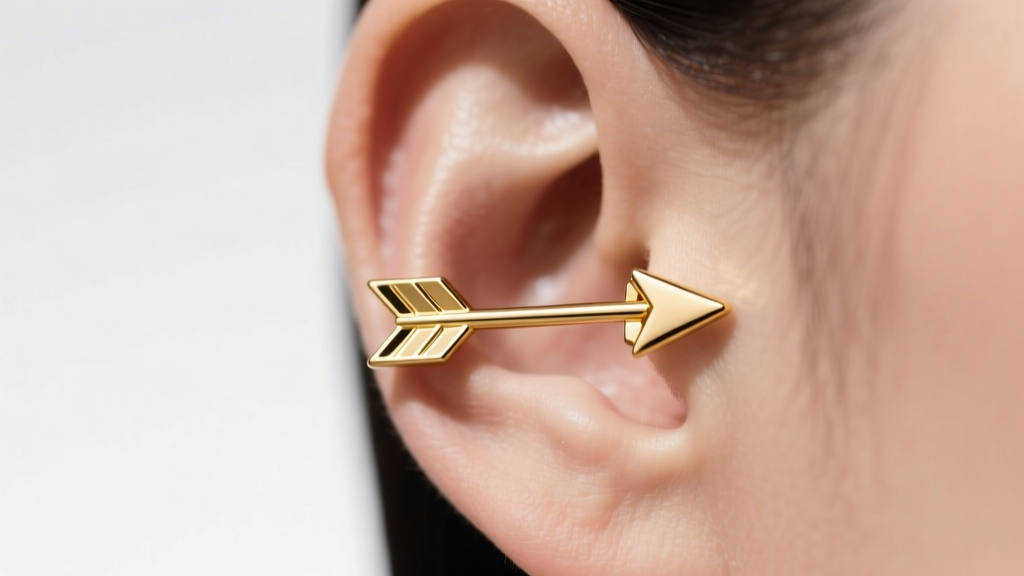
Gauge Tolerances and Threading Standards
The thickness of the earring post—measured in gauge—dictates how well the arrow earring will sit in the ear. A standard 20-gauge (0.8mm) post is entirely insufficient for an asymmetrical motif like an arrow. The thin wire will act as a pivot point, allowing the heavy fletching to drag the earring downward. For standard earlobe piercings, an 18-gauge (1.0mm) shaft is the absolute minimum required to provide the rigidity needed to keep the arrow pointing true.
For cartilage placements, such as a helix, tragus, or conch, where the arrow motif is often designed as a directional barbell or flat-back stud, a 16-gauge (1.2mm) or 14-gauge (1.6mm) shaft is mandatory. Using a thin post with a heavy arrow motif in cartilage can trigger the "cheese-cutter effect," where the localized pressure slowly slices through the dense fistula tissue, leading to severe migration and rejection.
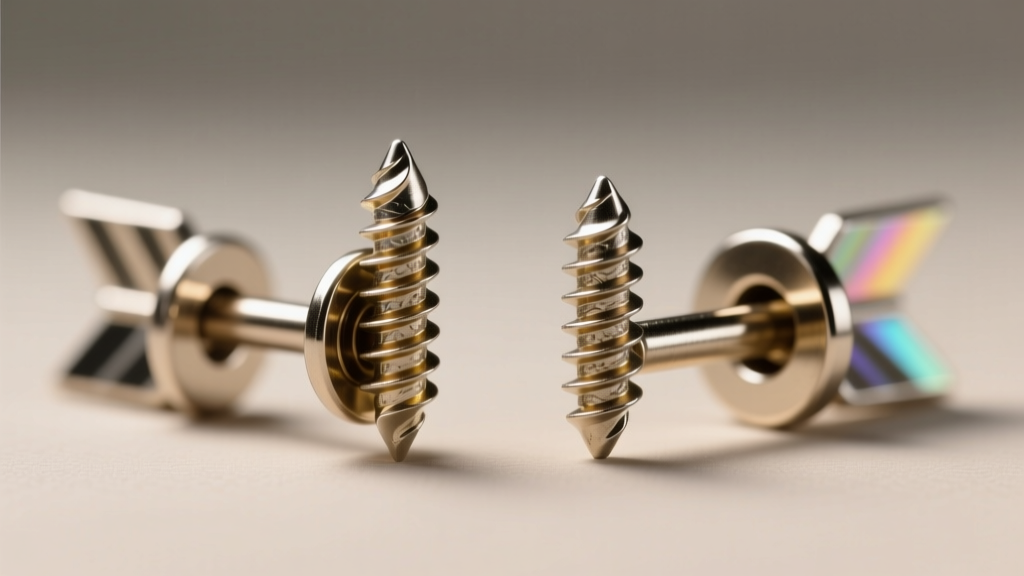
Equally critical is the threading standard. High-end arrow earrings utilize internal threading or threadless (push-pin) tension systems. In an internally threaded earring, the screw is located on the backing or the arrowhead itself, while the shaft that passes through the ear remains perfectly smooth. Conversely, externally threaded arrow earrings feature the screw directly on the shaft. This not only weakens the structural integrity of an already thin metal post but also causes micro-tears in the fistula upon insertion, introducing bacteria and delaying healing. ASTMs F136 standard for body jewelry heavily favors internally threaded or threadless designs to preserve both the metal's strength and the tissue's health.
Advanced Welding: Laser vs. Torch Soldering
The point where the arrow motif attaches to the post is the most common failure point in directional earrings. Traditional torch soldering requires heating the entire piece of jewelry to flow the solder alloy. This widespread heat exposure can anneal (soften) the gold or titanium shaft, destroying the work-hardening achieved during the drawing process and leaving the shaft vulnerable to bending under the arrow's cantilevered weight.
Expert manufacturers utilize laser welding to attach the fletching and arrowhead to the post. Laser welding is highly localized, delivering a concentrated pulse of energy that fuses the metals without transferring heat to the surrounding shaft. This preserves the tensile strength and rigidity of the post. When inspecting luxury arrow earrings, look for a seamless, flush joint at the base of the motif, which indicates precision laser welding rather than a bulky, heat-affected torch solder joint.
Expert Troubleshooting: Securing the Alignment
If you already own arrow earrings that suffer from the dreaded 6 o'clock droop, there are technical solutions to correct the alignment without replacing the jewelry entirely. The issue is almost always a lack of friction on the posterior side of the earlobe, allowing the heavy fletching to rotate the post downward.
- Silicone O-Rings and Discs: Replacing standard metal butterfly backs with medical-grade silicone flat discs or O-rings provides a high-friction grip against the skin and the post, locking the arrow into a horizontal position.
- Threadless Flat-Back Labrets: For cartilage arrow earrings, converting the piece to a threadless flat-back labret system allows you to manually bend the pin of the arrowhead to create custom tension inside the shaft, completely eliminating rotational slippage.
- Post Re-Centering: If the droop is caused by an off-center solder joint, a skilled bench jeweler can use a laser welder to detach the post, re-align it to the exact geometric center of the fletching, and reattach it, permanently solving the torque imbalance.
By prioritizing implant-grade metallurgy, appropriate gauge thickness, and precision internal threading, you can ensure your arrow earrings remain a structurally sound and perfectly aligned staple in your jewelry rotation.


