Aurora Earrings: Technical Guide to Iridescent Coatings
Discover the metallurgy, PVD coating science, and gauge specs behind aurora earrings. An expert 2026 guide to AB crystals and aurora opals.

The Physics of Iridescence: AB Coatings vs. Aurora Opals
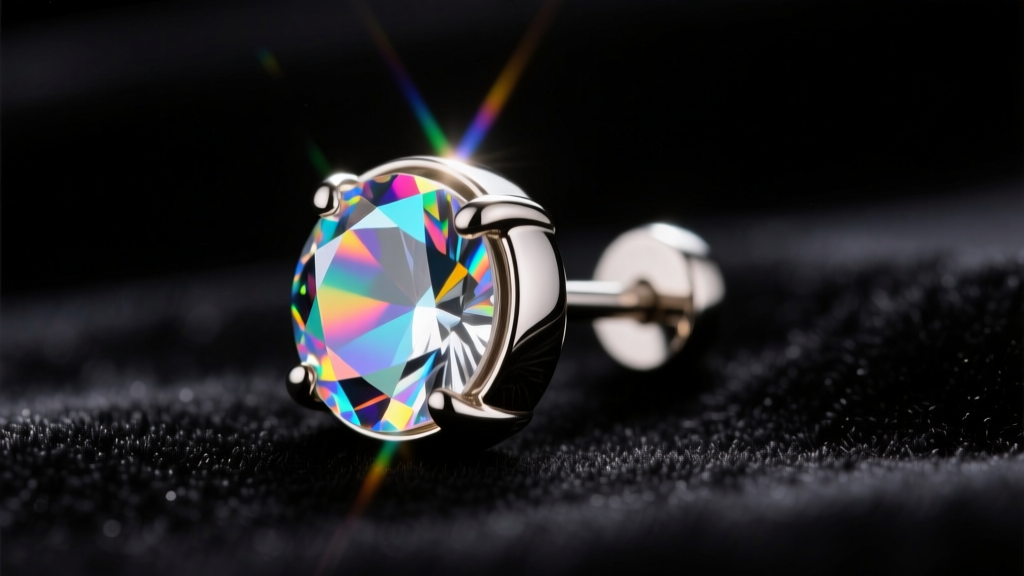
When jewelry enthusiasts and professional piercers discuss aurora earrings, they are typically referring to one of two distinct optical phenomena: the Aurora Borealis (AB) Physical Vapor Deposition (PVD) coating on glass or crystal, or the structural diffraction found in lab-grown aurora opals. As of 2026, the manufacturing processes behind both have reached unprecedented levels of precision, but their underlying physics and material requirements differ vastly.
The classic AB finish, originally pioneered in the mid-20th century, relies on thin-film interference. Modern high-end aurora earrings utilize advanced PVD chambers to vaporize alternating nanolayers of titanium dioxide (TiO2) and silicon dioxide (SiO2). These layers, often measuring between 100 and 300 nanometers in thickness, are applied to the pavilion (back) of precision-cut crystals. When light enters the crystal and hits these nanolayers, specific wavelengths are amplified while others are canceled out, resulting in the signature iridescent rainbow flash. According to the Gemological Institute of America (GIA), structural iridescence in opals functions on a similar principle of light diffraction, though it occurs naturally through the microscopic stacking of silica spheres rather than synthetic metallic vapor.
Aurora opals, specifically engineered for body jewelry, are lab-grown using a controlled precipitation process that introduces trace dopants to shift the play-of-color toward vivid blues, greens, and magentas. Unlike AB coatings, which are surface-level treatments, the iridescence in an aurora opal is structural and extends throughout the entire volume of the gemstone.
Metallurgy and Base Alloys: What Lies Beneath the Shine
The longevity of aurora earrings is not solely determined by the crystal or opal; it is heavily dependent on the base metal housing the stone. The Association of Professional Piercers (APP) strictly outlines how different alloys interact with human biology and environmental stressors. When dealing with iridescent finishes, the base metal must provide a flawless, highly polished surface for PVD adhesion, while simultaneously resisting galvanic corrosion.
| Base Metal Alloy | PVD Coating Adhesion | Galvanic Corrosion Risk | Average Price Range (18g End) |
|---|---|---|---|
| ASTM F136 Implant-Grade Titanium | Exceptional (Micro-porous bonding) | Negligible (Highly biocompatible) | $35 - $85 |
| 14k Solid Gold (Nickel-Free) | High (Requires rhodium flash first) | Low (Stable in sebum) | $90 - $250+ |
| 316L Surgical Stainless Steel | Moderate (Prone to micro-pitting) | Moderate (Nickel leaching potential) | $15 - $30 |
| Brass with Silver Plating | Poor (Sub-surface oxidation) | High (Rapid tarnishing ruins coating) | $5 - $15 |
For premium aurora earrings, ASTM F136 titanium is the undisputed industry standard. Titanium's natural oxide layer provides a stable, non-reactive foundation that prevents the sub-surface oxidation which causes AB coatings to flake or cloud over time. Conversely, brass or low-grade steel alloys will inevitably oxidize beneath the PVD layer when exposed to the slightly acidic pH of human sebum (typically ranging from 4.5 to 6.0), causing the iridescent finish to delaminate from the inside out.
Gauge Specifications and Threadless Mechanics
The structural integrity of aurora earrings is heavily tied to their gauge and threading mechanism, particularly for cartilage piercings like the helix, conch, or tragus. The industry standard for aurora crystal ends ranges from 18-gauge (1.0mm) to 16-gauge (1.2mm). While 18g is standard for lobes and delicate helix placements, 16g is strictly recommended for high-movement areas like the daith or rook to prevent the jewelry from acting as a cheese-cutter through the tissue.
Threadless Push-Pin Tension Systems
In 2026, internally threaded and threadless (push-pin) designs have entirely replaced externally threaded jewelry in reputable studios. For aurora earrings featuring delicate PVD coatings, threadless tension-fit ends are vastly superior. As detailed in the NeoMetal Fitting Instructions, a threadless system relies on the tension of a slightly bent metal pin against the inner wall of the hollow post.
- The Bend Angle: For 18g titanium pins, a bend of 10 to 15 degrees roughly 1mm from the tip provides optimal retention without warping the metal.
- Coating Protection: Because threadless ends require no twisting or screwing, there is zero friction applied to the aurora crystal's pavilion or the metal setting's prongs during insertion and removal.
- Prong Integrity: Repeated twisting of threaded ends can slowly loosen the micro-prongs holding the AB crystal, leading to stone loss. Threadless tension eliminates this rotational torque.
Real-World Failure Modes and Chemical Degradation
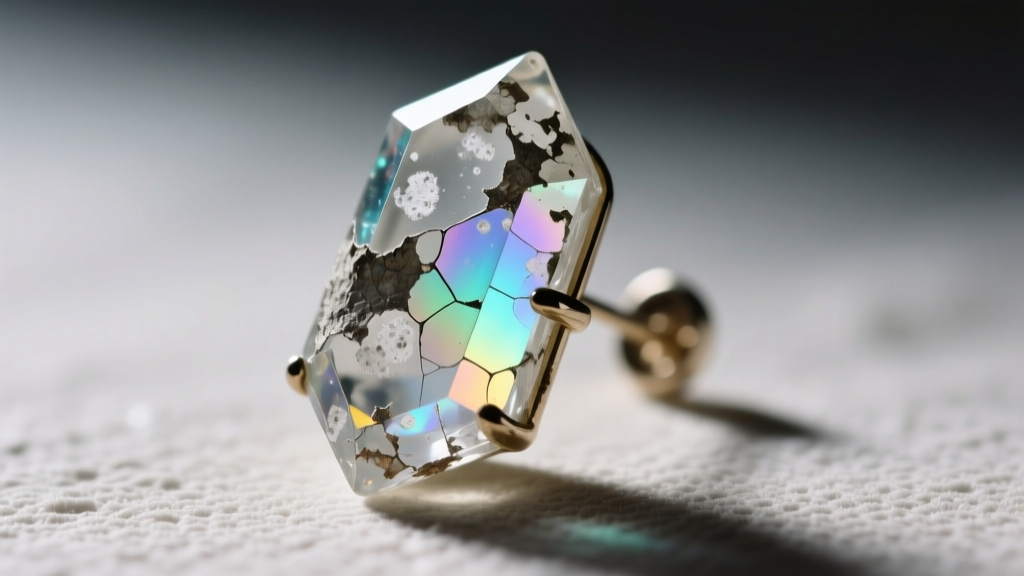
Despite their breathtaking optical properties, aurora earrings require meticulous care. The nanometer-thin PVD layers are highly susceptible to specific chemical and mechanical failure modes. Understanding these degradation vectors is critical for both jewelers and consumers.
Ultrasonic Cavitation Damage
Never place aurora earrings in an ultrasonic cleaner. The high-frequency sound waves create microscopic vacuum bubbles in the cleaning solution that implode against the jewelry surface (cavitation). While this is excellent for removing debris from raw diamonds, the localized shockwaves and micro-jets of liquid will physically strip the delicate TiO2/SiO2 nanolayers right off the crystal, leaving a dull, patchy gray finish.
Chlorine and Bromine Pitting
Exposure to heavily chlorinated pool water or brominated hot tubs is catastrophic for aurora earrings. Halogens aggressively attack the metallic bonding agents used in some lower-tier AB coatings. Furthermore, chlorine ions will penetrate microscopic fissures in the metal setting, causing localized pitting in the base alloy. As the metal corrodes and expands, it creates outward pressure that shatters the rigid AB coating or forces the crystal out of its bezel.
Sebum and Cosmetic Buildup
The play-of-color in aurora earrings requires light to pass unimpeded through the crown of the crystal and reflect off the coated pavilion. Buildup of sebum, lotions, or silicone-based hair products on the back of the earring creates an opaque barrier that completely neutralizes the iridescent effect. Routine cleaning with a mild, phosphate-free dish soap and a soft-bristled baby toothbrush is the only safe method for maintaining optical clarity.
2026 Pricing Matrix and Authenticity Markers
The market for aurora earrings is heavily saturated with mass-produced imitations. Distinguishing between genuine precision-cut PVD crystals and cheap stamped-glass knockoffs requires an understanding of current pricing matrices and visual authenticity markers.
- Tier 1: Fine Jewelry & Premium Body Brands ($80 - $300+): Utilizes genuine Preciosa or Swarovski lead-free crystals, or high-grade synthetic aurora opals set in solid 14k/18k gold or ASTM F136 titanium. The PVD coating is applied in a vacuum chamber with strict quality control, ensuring edge-to-edge iridescence without pinpoint bare spots.
- Tier 2: Professional Studio Grade ($35 - $75): Features high-quality machine-cut glass or synthetic spinel with reliable PVD coatings, set in implant-grade titanium. These offer the best balance of biocompatibility and optical brilliance for everyday cartilage wear.
- Tier 3: Fast Fashion & Mall Kiosks ($5 - $25): Often uses acrylic or low-grade glass with a surface-level spray coating rather than true vacuum PVD. These coatings rub off within weeks of wear and are frequently set in nickel-heavy alloys that trigger contact dermatitis.
To verify authenticity, examine the pavilion of the crystal under a 10x jeweler's loupe. A genuine vacuum-deposited aurora finish will appear perfectly smooth and integrated into the glass surface, whereas cheap spray coatings will show uneven pooling, microscopic bubbles, and a distinct plastic-like texture. By prioritizing advanced PVD technology and biocompatible base metals, you can ensure your aurora earrings remain as structurally sound as they are visually spectacular.


