Expert Guide to Buying Gold Turquoise Hoop Earrings
Discover how to spot authentic gold turquoise hoop earrings. Learn about stone grades, gold karats, and hoop mechanics in our expert buying guide.

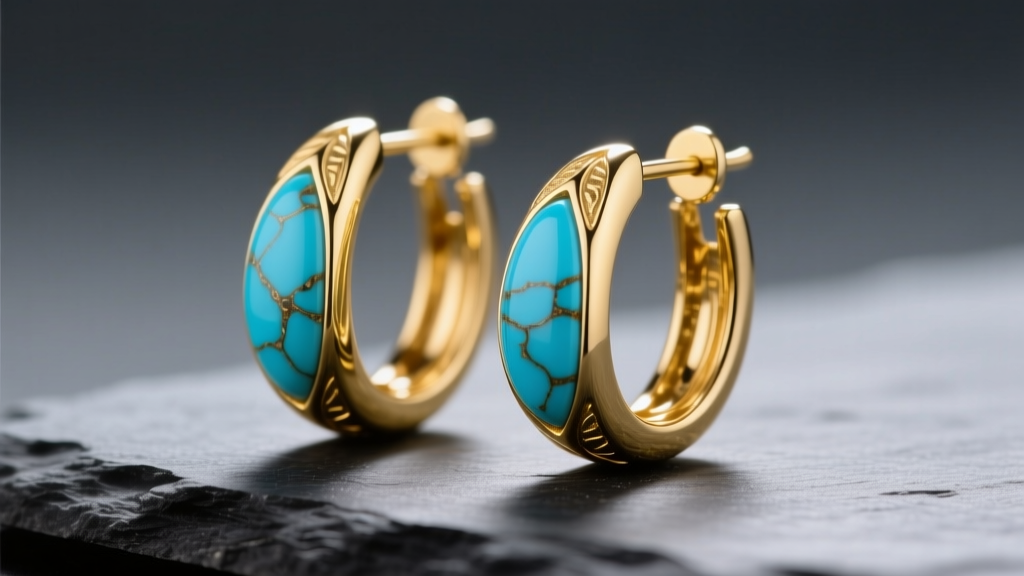
The 2026 Market for Turquoise Hoops: Natural vs. Treated
The allure of gold turquoise hoop earrings lies in their perfect balance of earthy bohemian charm and refined metallic elegance. However, as we navigate the jewelry market in 2026, buyers must be more vigilant than ever. The scarcity of high-grade, naturally occurring turquoise has led to a surge in hyper-realistic dyed alternatives and heavily treated stones. When investing in fine jewelry, understanding the distinction between natural, stabilized, and reconstituted turquoise is the first critical step in making an informed purchase.
According to the Gemological Institute of America (GIA), natural turquoise is inherently porous, ranking between 5 and 6 on the Mohs hardness scale. Because of this, a significant portion of turquoise used in modern jewelry undergoes 'stabilization'—a process where colorless epoxy resin is introduced to harden the stone and enhance its color. While stabilization is an accepted industry practice, it must be disclosed. The real danger for buyers lies in undocumented 'reconstituted' turquoise (turquoise dust mixed with resin and dye) or dyed howlite and magnesite masquerading as the real thing.
Decoding the Stone: Turquoise Grades & Origins
When evaluating gold turquoise hoop earrings, the origin of the stone heavily dictates its value, durability, and visual profile. The matrix—the host rock or webbing visible within the stone—is a primary indicator of origin and authenticity.
Sleeping Beauty vs. Kingman vs. Mojave
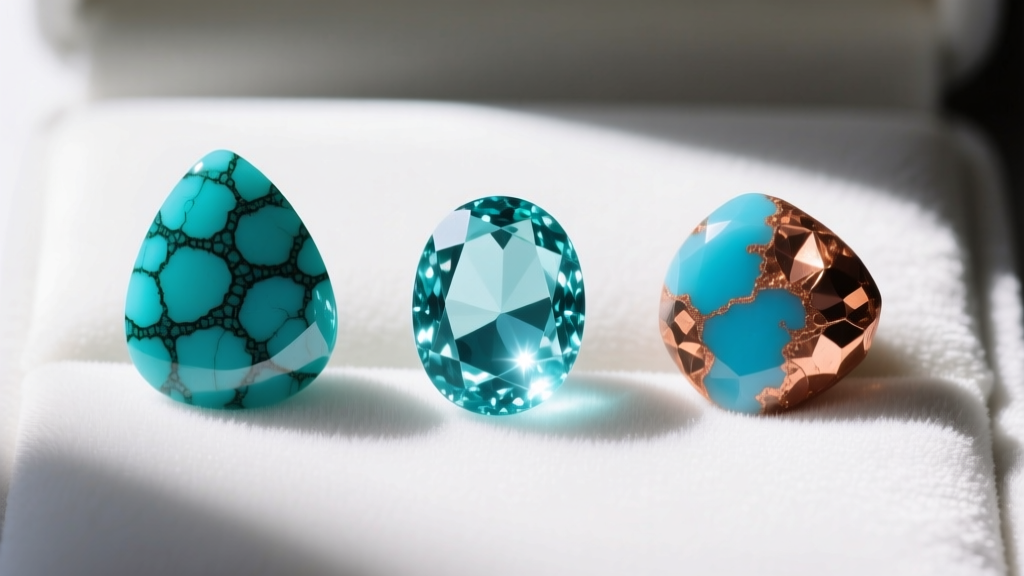
The Sleeping Beauty mine in Arizona, though closed since 2012, remains the gold standard for clear, sky-blue turquoise without matrix. Because of its scarcity, genuine Sleeping Beauty commands a premium. Kingman turquoise, also from Arizona, is celebrated for its striking black or brown spiderweb matrix. Mojave turquoise, on the other hand, is a relatively modern creation; it involves taking genuine turquoise nuggets, infusing them with copper and other metals, and stabilizing them to create vibrant, metallic-webbed stones that are highly durable but fundamentally altered.
| Origin / Type | Visual Profile | Treatment Status | Relative Value |
|---|---|---|---|
| Sleeping Beauty | Clear sky blue, no matrix | Often stabilized for durability | Premium / High |
| Kingman | Blue to green, black/brown webbed matrix | Stabilized or natural | High / Collector |
| Mojave | Vibrant colors, metallic copper webbing | Heavily treated / Infused | Mid-Range |
| Dyed Howlite | Uniform blue, artificial grey veining | Dyed completely through | Low / Costume |
Gold Purity & Plating: What Holds the Stone?
The structural integrity of your hoops is just as important as the gemstone they carry. Turquoise inlays and cabochons add weight, meaning the gold must possess adequate tensile strength to prevent warping.
14k vs. 18k Solid Gold
While 18k gold (75% pure gold) offers a richer, deeper yellow hue, it is a relatively soft metal. For delicate hoop earrings holding heavy turquoise elements, 18k wire can easily bend out of shape during daily wear. 14k gold (58.5% pure gold) is the industry sweet spot for gold turquoise hoop earrings. The alloyed metals (usually copper, silver, or zinc) provide the necessary rigidity to maintain the hoop's circular tension and securely grip the stone settings over decades of use.
The Vermeil Warning
If you are shopping for budget-friendly options, you will encounter 'gold vermeil'. The Federal Trade Commission (FTC) strictly regulates this term: to be classified as vermeil, the base must be sterling silver, and the gold plating must be at least 10k purity and a minimum of 2.5 microns thick. Avoid 'gold-plated brass' or 'gold-filled' claims that lack micron disclosures, as the friction of inserting and removing hoop earrings will quickly wear away thin plating, exposing base metals that can cause contact dermatitis or turn the skin green.
Hoop Mechanics & Gauge Sizing
A beautiful stone set in a poorly engineered hoop will result in lost jewelry and frustrated wearers. Understanding gauge thickness and closure mechanisms is vital for both comfort and security.
Lobe vs. Cartilage Sizing
The thickness of the wire, measured in gauge (g), determines how the earring interacts with your piercing.
- 20-Gauge (0.8mm): The standard size for most traditional lobe piercings. Ideal for lightweight, small-diameter huggie hoops with tiny turquoise accents.
- 18-Gauge (1.0mm): Slightly thicker, offering better structural support for medium-sized hoops. Common in standard lobe piercings and some healed cartilage piercings.
- 16-Gauge (1.2mm): The standard for helix, tragus, and conch piercings. If you plan to wear your turquoise hoops in upper cartilage, you must ensure the wire is 16g to prevent the 'cheese-cutter effect,' where a wire that is too thin migrates through the tissue.
Closure Types
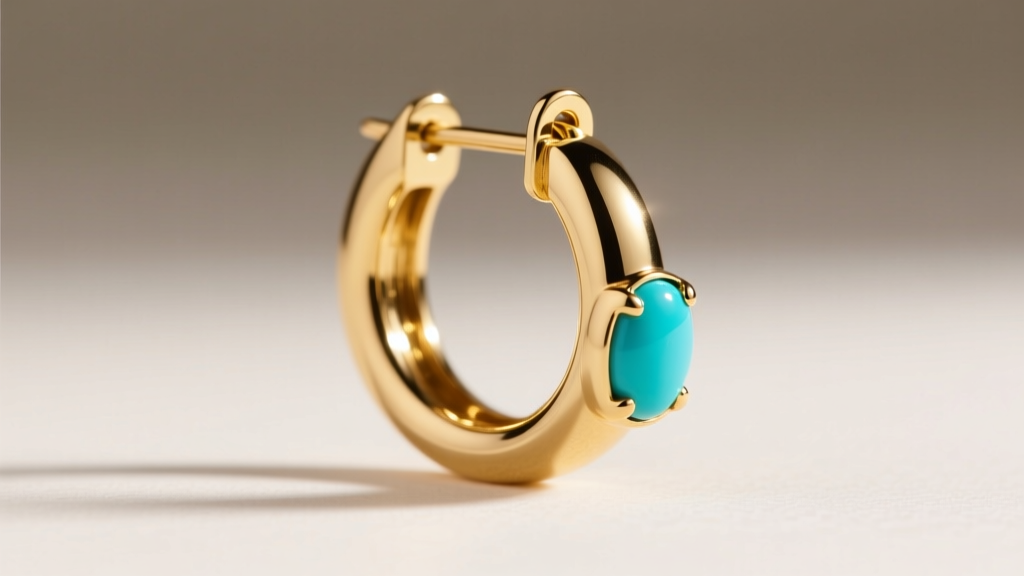
For gold turquoise hoop earrings, the closure mechanism must account for the weight of the stone. Hinged snap closures are vastly superior for hoops featuring turquoise inlays or heavy dangling charms, as the mechanical click ensures the earring remains locked in place. Continuous wire hoops (endless hoops) are highly secure but can be frustrating to open and close, often requiring bending that weakens the metal over time. Clicker rings are excellent for cartilage but generally feature smaller, more delicate segments that limit the size of the turquoise stone that can be incorporated into the design.
Red Flags: How to Spot Fakes & Overpriced Pieces
When shopping for gold turquoise hoop earrings, be highly skeptical of stones that look 'too perfect.' Natural turquoise is formed through complex geological processes involving copper, aluminum, and iron. As a result, genuine stones exhibit slight color variations, natural pitting, and organic matrix patterns.
Expert Insight: If you see a strand of turquoise hoops where every single stone has the exact same shade of robin's egg blue with perfectly symmetrical, uniform grey veining, you are almost certainly looking at dyed howlite or synthetic block turquoise. Genuine stones are as unique as fingerprints.
Furthermore, be wary of the price-to-size ratio. A pair of large, 30mm diameter solid 14k gold hoops featuring thick, untreated Kingman turquoise cabochons should retail well into the high hundreds or thousands of dollars. If you find them for under $80, the gold is likely a thin flash-plate over brass, and the stone is likely dyed magnesite.
Care & Maintenance for Porous Stones
Turquoise is notoriously sensitive to chemicals, heat, and prolonged exposure to moisture. To preserve the vibrant color and structural integrity of your gold turquoise hoop earrings, you must adapt your cleaning routine.
Never use ultrasonic cleaners or steam cleaners. The high-frequency vibrations and intense heat can shatter stabilized turquoise or strip the dyes from treated stones. Similarly, avoid commercial silver or gold polishing dips, as the harsh acids will permanently discolor the porous gemstone.
Instead, clean the gold components with a soft, untreated jeweler's cloth. If the turquoise becomes dull from skin oils and lotions, gently wipe it with a barely damp microfiber cloth and dry it immediately. Always store your hoops in a soft pouch away from direct sunlight and harder gemstones (like diamonds or sapphires) that could easily scratch the turquoise's relatively soft surface.


