Authenticating Antique Gold and Turquoise Earrings: An Expert Guide
Master the technical details of antique gold and turquoise earrings. Learn to identify gold hallmarks, turquoise matrix grades, and structural integrity.

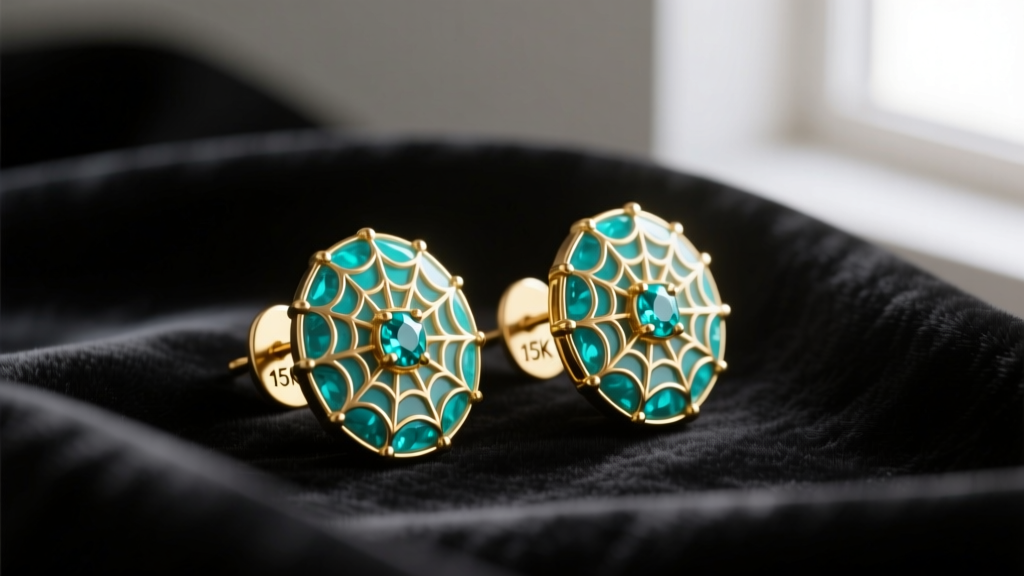
The secondary market for antique gold and turquoise earrings is fraught with sophisticated reproductions, composite franken-jewelry, and misidentified gemstones. For serious collectors and horologists, evaluating these pieces requires moving beyond superficial aesthetic appraisals. True authentication demands a rigorous understanding of historical metallurgy, gemological treatment matrices, and the mechanical evolution of earring findings. In this expert deep dive, we deconstruct the technical specifications that separate genuine Victorian, Edwardian, and Art Deco artifacts from modern pastiches.
The Metallurgy of Antique Gold: Karats, Alloys, and Hallmarks
The gold used in antique earrings provides the most reliable chronological and geographic markers for authentication. Modern jewelers typically work in 14K or 18K, but historical standards varied wildly by region and era. Understanding these alloy compositions is critical when evaluating antique gold and turquoise earrings.
The 15K Gold Anomaly and British Hallmarks
If you are examining a piece purported to be Victorian (1837-1901), you must look for 15K gold. Introduced in Britain in 1854 and abolished in 1932, 15K gold (62.5% pure gold) was a standard unique to the UK and its territories. According to the London Assay Office, a genuine British antique from this era will often bear a crown and the number '15' or '625'. If a supposedly Victorian piece is stamped 14K, it is either an American reproduction, a later modification, or an outright forgery.
Alloy Oxidation and the 'Antique Rose' Hue
Antique gold was frequently alloyed with higher copper content than modern equivalents to increase tensile strength for intricate repoussé and granulation work. Over a century, this copper oxidizes, creating a distinct surface patina. Under 10x loupe magnification, genuine antique 18K yellow gold will show micro-pitting and a warm, almost rosé undertone in the recessed areas where polishing cloths cannot reach. Modern cast reproductions lack this deep, cellular oxidation.
Turquoise Grading: Natural, Stabilized, and Imitation Matrices
Turquoise is a porous, hydrous phosphate of copper and aluminum, ranking between 5 and 6 on the Mohs hardness scale. Because high-grade, gem-quality turquoise is exceptionally rare, historical and modern jewelers have employed various treatments. Identifying these treatments is paramount when valuing antique gold and turquoise earrings.
Decoding the Spiderweb Matrix
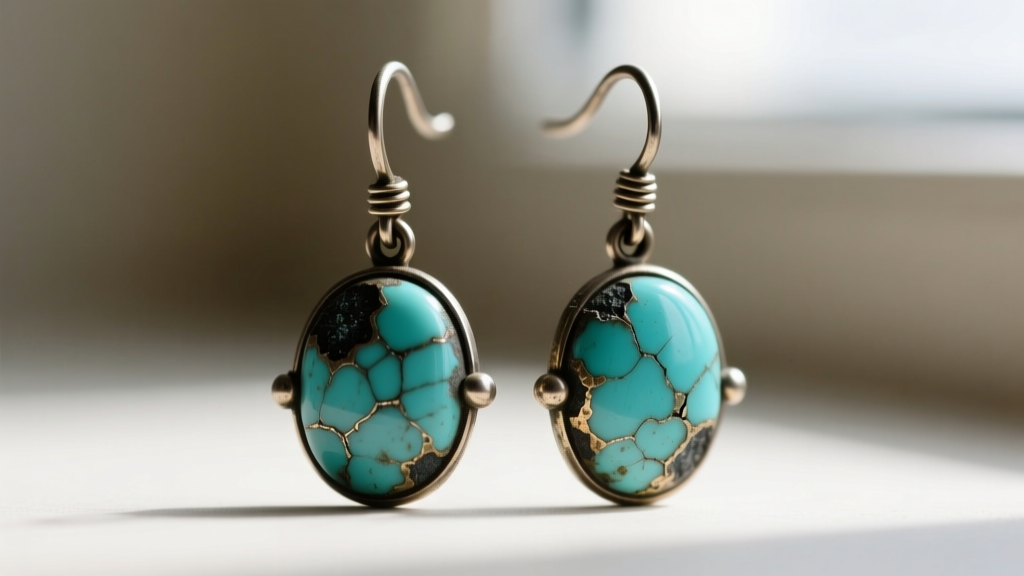
The 'matrix' refers to the host rock visible within the turquoise. In genuine Persian or high-grade American (such as Lander Blue or Lone Mountain) turquoise, the matrix is typically composed of limonite (brown/black) or rhyolite. Under magnification, a natural matrix will show sharp, distinct boundaries with the turquoise material. In dyed howlite or magnesite imitations, the 'matrix' is merely ink drawn into surface fractures, which will appear blurry and shallow under a gemological microscope.
Treatment Identification Matrix
| Treatment Type | Chemical Process | Identification Method | Market Impact |
|---|---|---|---|
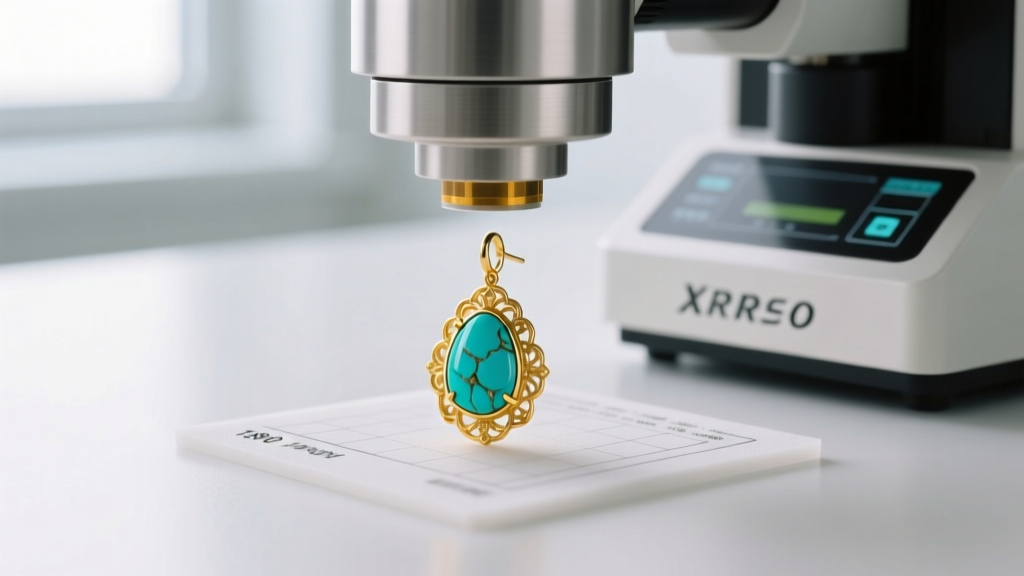
| Natural (Untreated) | None; cut and polished only | UV Fluorescence (inert), XRF analysis | Highest premium; museum grade |
| Wax/Oil Coated | Paraffin wax or cedar oil | Hot-point test (smells of burning wax) | Acceptable in true antiques; minimal value loss |
| Epoxy Stabilized | Opticon or clear epoxy resin | Acetone swab, UV fluorescence (chalky blue) | Significant value reduction; considered modern |
| Zachery Treated | Potassium silicate solution | EDXRF (detects elevated potassium levels) | Moderate reduction; difficult to detect visually |
| Reconstituted | Turquoise dust bound in polymer | 10x Loupe (shows granular 'cornflake' texture) | Severely devalues the piece; not collectible |
For a comprehensive breakdown of gemstone treatments, the Gemological Institute of America (GIA) remains the definitive authority on spectroscopic identification of treated turquoise.
Structural Analysis: Ear Wires, Clasps, and Failure Modes
The mechanical findings of antique earrings offer vital clues regarding their age and structural integrity. The transition from simple wire hooks to complex mechanical clasps maps directly onto patent histories from the late 19th and early 20th centuries.
Identifying Period-Correct Findings
- Kidney Wires and Shepherd Hooks (Pre-1890s): Early Victorian earrings relied on simple, hand-drawn wire loops. These wires were drawn through a draw plate, meaning they will show microscopic longitudinal striations under magnification, unlike the perfectly smooth, machine-extruded wires used today.
- Early Screw Backs (1894-1920s): Patented in 1894, early screw backs featured flat, paddle-like pressure plates. If an earring features a modern, cupped screw back but claims to be Edwardian, the finding has been replaced, compromising the piece's historical integrity.
- Leverbacks and Tube Hinges (1900s+): Examine the hinge mechanism. Antique tube hinges were hand-soldered and will show slight asymmetry and excess solder flow. Modern stamped hinges are perfectly uniform and laser-welded.
Solder Joints and Metallurgical Failure Modes
Historical jewelers frequently used lead-tin solders for low-temperature repairs, which oxidize to a dull, chalky gray over time. Modern cadmium-free or gold solders melt at higher temperatures and retain a bright, metallic luster. When inspecting the solder joints where the ear wire meets the earring body, a dark, oxidized joint that matches the patina of the surrounding gold indicates original period construction. A bright, shiny joint on an otherwise oxidized piece is a glaring red flag for a modern repair or a complete fabrication.
Red Flags in Composite 'Frankenstein' Earrings
One of the most common deceits in the antique market is the 'Frankenstein' earring—a piece cobbled together from genuine antique scrap. To protect your investment, scrutinize the piece for these structural anomalies:
- Mismatched Patina: The ear wire exhibits heavy oxidation, but the decorative bezel holding the turquoise is bright and unoxidized.
- Bezel Wall Thickness: Victorian bezels were typically hand-raised and very thin (0.15mm - 0.20mm). Thick, cast bezel walls (0.5mm+) indicate modern lost-wax casting.
- Asymmetrical Wear Patterns: Genuine antique drop earrings will show symmetrical wear on the bottom edges where they have brushed against the neck and clothing over a century. Pristine edges on a supposedly 120-year-old drop earring suggest a modern reproduction.
Expert Maintenance: Preventing Chemical Degradation
Owning authentic antique gold and turquoise earrings requires specialized conservation techniques. The most catastrophic mistake a collector can make is placing these earrings in an ultrasonic cleaner. The high-frequency cavitation will shatter natural turquoise, while the heat and chemical solvents will dissolve historical wax treatments and melt fragile lead-tin solder joints.
Instead, clean the gold components using a soft, untreated microfiber cloth and a mild, non-ionic surfactant (such as conservation-grade Orvus WA Paste) applied with a cotton swab, strictly avoiding the turquoise cabochon. Store the earrings in a climate-controlled environment with a relative humidity below 50% to prevent the hydration and subsequent spalling of the turquoise matrix. By respecting the material science of these historical artifacts, collectors can preserve both the financial value and the horological legacy of their pieces for future generations.


