2026 Trend Analysis: Avant-Garde Hoop Earrings Designs & Styling
Discover the top architectural hoop earrings designs for 2026. Explore mixed-metal trends, gauge sizing, and ergonomic styling for every ear shape.


The Shift from Classic to Architectural Hoops
The landscape of ear styling has undergone a radical transformation as we move through 2026. While the classic circular gold hoop will always hold a revered place in jewelry history, the contemporary market is dominated by avant-garde, architectural silhouettes. Today's hoop earrings designs are no longer defined merely by their diameter; they are defined by their spatial geometry, mixed-metal textures, and structural negative space. Designers are moving away from fragile, thin wire hoops toward substantial, sculptural forms that interact dynamically with the wearer's jawline and neck.
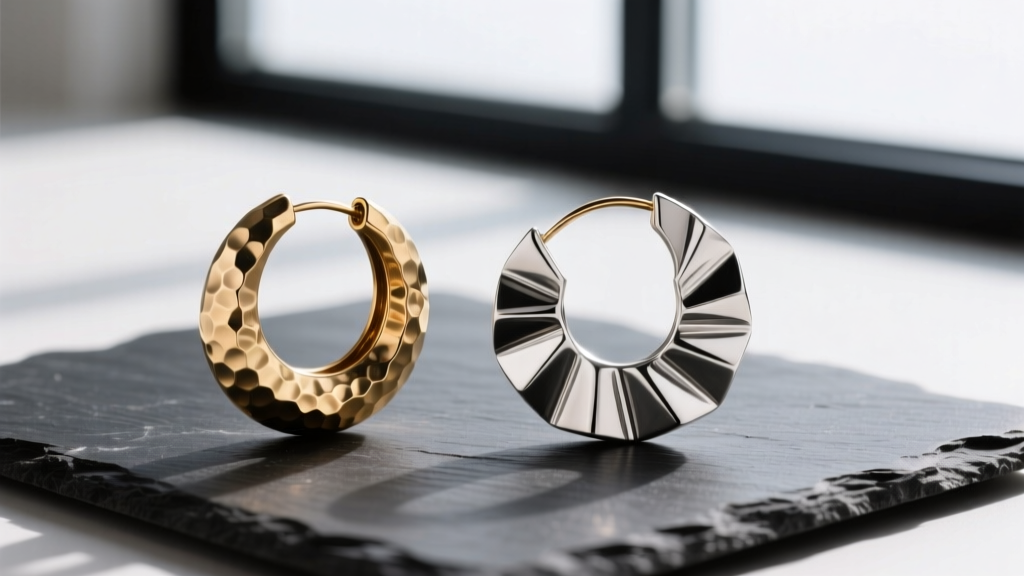
This shift is heavily influenced by the broader 'quiet luxury' movement evolving into 'structural maximalism'—a trend where the volume of the jewelry is replaced by the complexity of its form. We are seeing fluted edges, hammered brass finishes, and asymmetrical hexagons replacing the traditional seamless circles. For the modern collector, understanding the technical and aesthetic nuances of these new designs is crucial for building a curated, forward-thinking ear stack.
Material Innovations: Titanium and Recycled Brass
In 2026, material choice is just as important as the silhouette. Implant-grade titanium (ASTM F136) has crossed over from the piercing studio into high fashion, offering a lightweight, hypoallergenic base for complex geometric hoops that would be too heavy in solid gold. Meanwhile, recycled brass with PVD (Physical Vapor Deposition) coatings is providing a sustainable, tarnish-resistant alternative for entry-level luxury, allowing for bold, oversized architectural shapes without the prohibitive weight or cost of solid precious metals.
2026 Trend Matrix: Hoop Earrings Designs by Face Shape
Choosing the right architectural hoop requires an understanding of facial geometry. The goal is to create balance, either by contrasting the natural angles of the face or by echoing them for a harmonious look. Below is our definitive 2026 styling matrix for pairing avant-garde hoop earrings designs with specific face shapes.
| Face Shape | Recommended 2026 Design | Ideal Dimensions | Material & Finish Focus |
|---|---|---|---|
| Round | Elongated Rectangular Drop | 45mm x 15mm | High-polish 14k Gold (adds sharp contrast) |
| Square | Softened Fluted Circle | 35mm diameter | Hammered Recycled Brass (softens jawline) |
| Heart | Bottom-Weighted Teardrop | 40mm x 25mm | Oxidized Sterling Silver (balances chin) |
| Oval | Asymmetric Hexagon | 30mm x 30mm | Matte Titanium (adds structural edge) |
Ergonomics and Gauge Sizing: The Technical Breakdown
The most common failure point when investing in statement hoops is ignoring the physics of ear tissue. The 'cheese cutter' effect occurs when a heavy earring rests on a thin wire, slowly migrating through the lobe tissue over time. According to the Association of Professional Piercers (APP), standard lobe piercings are typically done at 20-gauge (0.81mm) or 18-gauge (1.0mm). However, these gauges are entirely insufficient for the bold, architectural hoops trending in 2026.
Preventing Lobe Tear-Out with Weight Distribution
If you are purchasing structural hoops that exceed 12 grams per earring, you must evaluate the wire thickness. For heavy geometric designs, a minimum of 16-gauge (1.2mm) or 14-gauge (1.6mm) wire is mandatory to distribute the weight across a wider surface area of the fistula. If your current piercings are 20g, consider having a professional piercer gently taper them to 16g to accommodate high-fashion structural hoops safely. Furthermore, the Gemological Institute of America (GIA) notes that 14k gold is significantly more durable and resistant to bending than 18k or 24k gold, making it the superior metallurgical choice for thin, load-bearing architectural joints in hoop designs.
Clasp Mechanics: Hinges, Clickers, and Saddle Backs
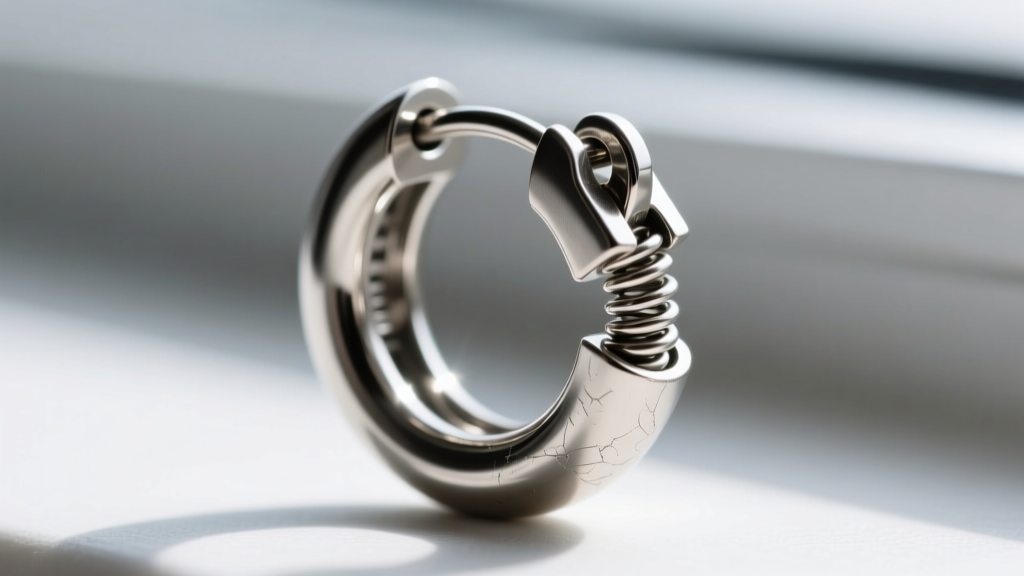
The clasp is the unsung hero of the hoop earring. In avant-garde designs, the closure mechanism must support irregular weight distribution. Here is a breakdown of clasp types and their failure modes:
- Friction Post / Butterfly Back: Completely obsolete for heavy hoops. The friction grip will fail under the pendulum motion of a walking stride, leading to lost jewelry.
- Traditional Latch-Back: Suitable only for lightweight, hollow-tube hoops. Under the stress of heavy solid-metal geometric shapes, the thin latch wire will bend and warp.
- Saddle Clasp: Excellent for thick, 12g to 8g wires. The saddle distributes pressure evenly and locks securely, making it ideal for heavy, tribal-inspired architectural hoops.
- Hinged Clicker: The gold standard for huggies and medium-weight geometric hoops (16g-14g). The internal snapping mechanism provides auditory feedback and a flush, seamless closure that maintains the visual integrity of the design.
Curating Your Ear: Pairing Hoops with Cartilage Studs
When styling bold, architectural hoop earrings designs, the surrounding ear curation must act as a supporting cast, not a competing focal point. The 2026 approach to ear stacking relies on the 'Anchor and Orbit' methodology. Your statement hoop in the primary lobe piercing acts as the anchor.
'Let the hoop dictate the narrative. If you are wearing a complex, mixed-metal geometric hoop in the lobe, your helix, tragus, and conch piercings should feature minimalist, bezel-set stones or simple titanium balls no larger than 3mm. Visual clutter destroys the impact of structural jewelry.'
— Lead Ear Curator, Jewel Style Radar
For those with multiple lobe piercings, pair the primary architectural hoop with a flush-fitting 14g huggie in the second hole, and a simple 2mm threadless stud in the third. This creates a gradient of visual weight that draws the eye upward toward the cartilage without overwhelming the ear's natural anatomy.
Maintenance and Patina: Caring for Textured Metals
Avant-garde hoops frequently feature deep texturing, such as hammered divots, fluted ridges, and intentional oxidation in sterling silver. These design elements trap oils, lotions, and environmental debris. Avoid ultrasonic cleaners for any hoop featuring tension-set stones or intentional chemical patinas, as the high-frequency vibrations can shatter gemstones and strip the oxidized contrast from the metal's crevices.
Instead, use a soft-bristled baby toothbrush with a mild, phosphate-free dish soap and warm water to gently agitate debris from the textured surfaces. For high-polish 14k gold sections, a microfiber polishing cloth will restore the mirror finish without scratching the metal. By treating your structural hoops as wearable art rather than disposable accessories, you ensure their architectural integrity remains pristine for decades.
Final Verdict: Investing in Statement Hoops
The 2026 landscape of hoop earrings designs demands a higher level of technical literacy from the consumer. By prioritizing ergonomic gauge sizing, understanding clasp mechanics, and selecting face-balancing geometries, you can confidently invest in structural pieces that elevate your personal style. Whether you opt for a matte titanium hexagon or a hammered brass teardrop, the modern hoop is a testament to the intersection of engineering and high fashion.


