Bali Hoop Earrings: A Technical Guide to Silver Craftsmanship
Discover the technical anatomy of authentic Bali hoop earrings. Explore silver grades, wire gauges, granulation techniques, and buying metrics.

The Micro-Metallurgy of Balinese Silver
When jewelry collectors and metallurgists discuss Bali hoop earrings, they are rarely just talking about a decorative accessory. Authentic Balinese silverwork represents a centuries-old mastery of micro-metallurgy, specifically in the manipulation of sterling silver alloys, oxidation chemistry, and eutectic fusing. Unlike mass-produced stamped hoops, genuine Balinese craftsmanship relies on a precise understanding of metal memory, tensile strength, and thermal dynamics.
At the core of this craft is the alloy itself. While the global standard for sterling silver is 92.5% pure silver and 7.5% copper, Balinese silversmiths often manipulate this ratio slightly depending on the component of the earring. The copper content is not merely a filler; it provides the necessary structural memory for the hoop's base wire to withstand repeated bending and clasping without suffering from metal fatigue. According to the Gemological Institute of America (GIA), the copper alloy is also what allows for the deep, rich oxidation that defines the Balinese aesthetic, as pure silver does not oxidize in the same manner at room temperature.
The Oxidation and Antiquing Process
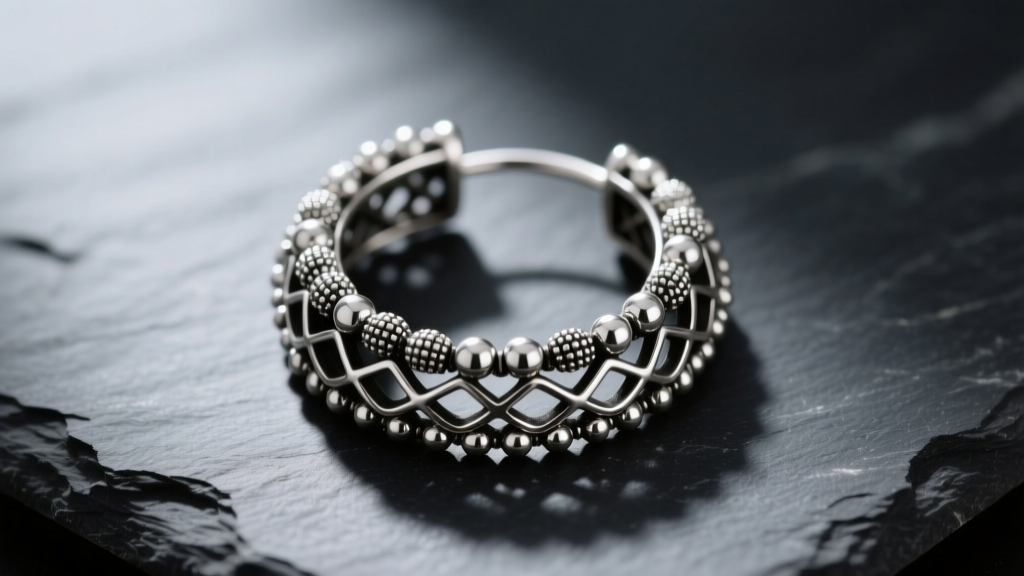
The signature high-contrast look of Bali hoop earrings is achieved through a controlled chemical reaction using Liver of Sulfur (potassium sulfide). The finished hoop is submerged in a heated, diluted liver of sulfur solution, which rapidly accelerates the tarnishing of the copper within the sterling alloy, turning the entire piece black. Master silversmiths then use abrasive polishing wheels and fine steel wool to selectively remove the oxidation from the high points and raised filigree, leaving the recessed granulation and background wire in deep, dark contrast. This is not a surface plating; it is a permanent chemical alteration of the metal's outermost molecular layer.
Wire Gauges and Structural Architecture
A critical failure point in lower-quality hoop earrings is the mismatch of wire gauges, leading to warped circles or broken solder joints. In authentic Balinese manufacturing, the architecture of a Bali hoop earring is engineered using a strict hierarchy of wire thicknesses. The structural integrity of the hoop relies on a heavy-gauge base, while the decorative elements utilize ultra-fine wires that would collapse under structural stress.
| Component | Standard Wire Gauge (AWG) | Diameter (mm) | Technical Function |
|---|---|---|---|
| Main Hoop Base | 14G - 12G | 1.62mm - 2.05mm | Provides rigid structural memory; prevents the hoop from ovaling under its own weight. |
| Filigree Wire | 26G - 28G | 0.40mm - 0.32mm | Used for intricate scrolling and weaving; highly malleable for tight radius bends. |
| Ear Wire / Post | 18G - 20G | 1.02mm - 0.81mm | Balances piercing comfort with shear strength to support the heavy decorative face. |
| Granulation Spheres | N/A (Drawn & Melted) | 0.50mm - 1.50mm | Created by melting fine silver clippings; surface tension forms perfect micro-spheres. |
This gauge hierarchy ensures that the earring remains lightweight enough for the earlobe while maintaining the geometric perfection of the hoop's circumference. If a hoop feels unusually light or bends easily when unclasped, it is likely drawn from a thinner, cheaper 18G or 20G base wire rather than the traditional 14G foundation.
The Science of Granulation and Eutectic Fusing
The most technically demanding aspect of Bali hoop earrings is granulation—the application of hundreds of microscopic silver spheres onto the hoop's surface. To the untrained eye, these look like simple soldered dots. However, traditional Balinese granulation does not use standard silver solder, which would leave visible, messy seams and potentially melt the delicate 26G filigree wire beneath it.
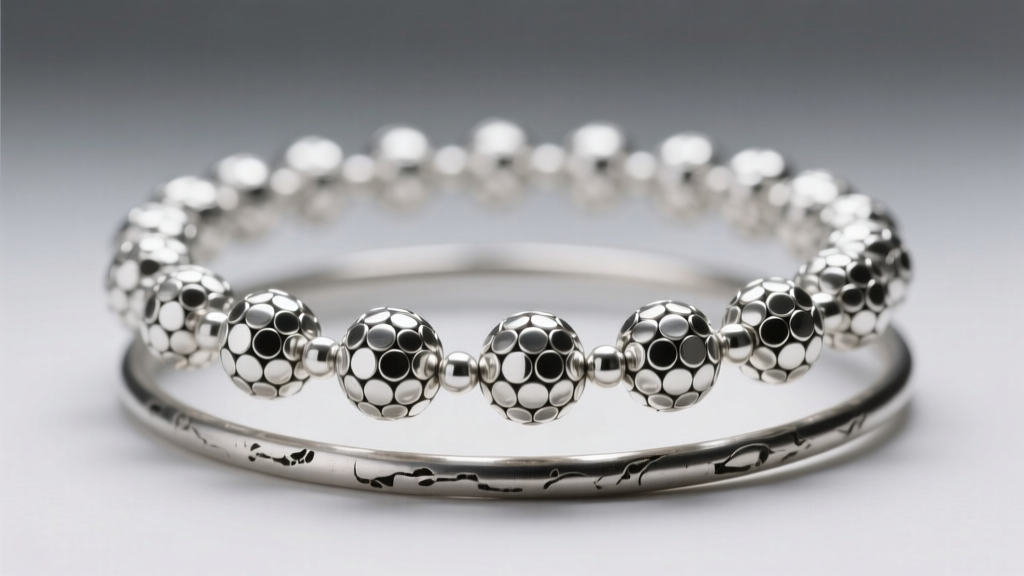
Instead, artisans utilize a process rooted in ancient eutectic fusing. The granules and the base hoop are painted with a colloidal flux mixture, typically composed of copper salts and an organic binder like hide glue. When the piece is heated in a reducing flame, the organic binder burns away, and the copper salts reduce to pure metallic copper. This creates a localized eutectic alloy at the exact point where the sphere touches the base. Because a eutectic alloy has a lower melting point than either pure silver or the 925 sterling base, the joint fuses instantly without the surrounding wire losing its temper or melting. The Santa Fe Symposium on Jewelry Manufacturing Technology frequently highlights this eutectic reaction as one of the most difficult thermal balancing acts in traditional bench jewelry, requiring the smith to judge the exact moment of fusion purely by the color of the glowing metal.
Tension and Thermal Shock
Because the hoop is a continuous circle, heating a localized section for granulation introduces severe thermal stress. If the heat is not distributed evenly using a large, bushy flame rather than a pinpoint torch tip, the rapid expansion and contraction will warp the hoop into an ellipse or cause the metal to crack along the crystalline grain boundaries. Master smiths constantly rotate the hoop during the fusing process to maintain an even thermal equilibrium.
Clasp Mechanisms and Weight Distribution
The technical design of a Bali hoop earring extends to how it interfaces with the human ear. Because the dense granulation and heavy-gauge base wire add significant mass, standard friction posts or thin French wires are mechanically insufficient. They create a pendulum effect that can stretch the earlobe piercing over time.
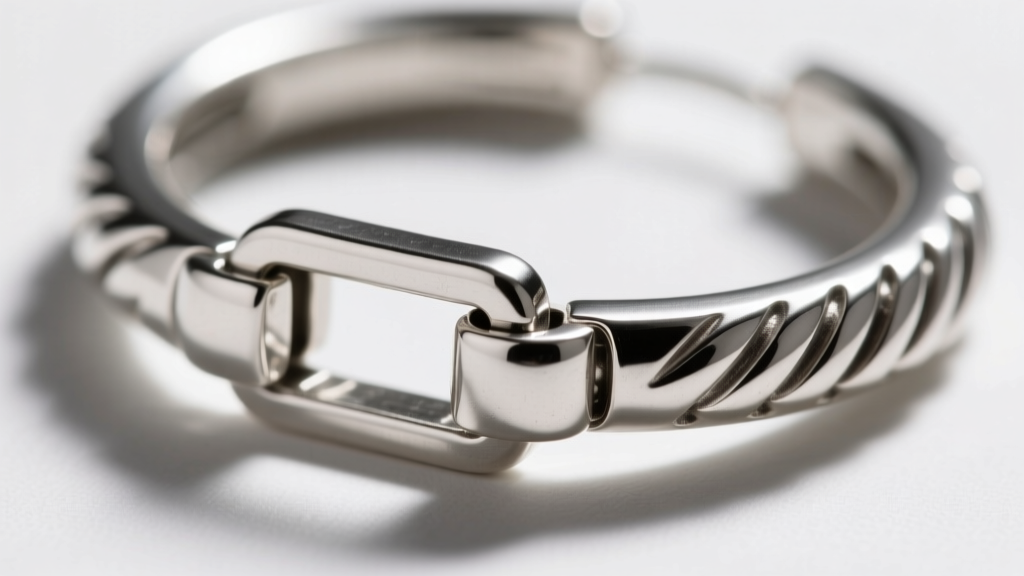
Authentic, high-end Balinese hoops utilize a heavy-duty latch-back or a continuous hinged sleeper mechanism. The engineering of the latch-back requires a precision-machined hinge pin (usually 1mm thick) and a tensioned catch wire. The ear wire itself is typically forged from 18-gauge half-hard sterling silver. The 'half-hard' temper is crucial: it is stiff enough to support the weight of the hoop without drooping, but possesses enough ductility to be adjusted by the wearer for a custom fit behind the earlobe. When evaluating a pair, test the clasp by applying lateral pressure; a properly engineered Balinese latch will exhibit zero side-to-side play in the hinge.
Authenticity Matrix: Cast vs. Handcrafted
As the demand for Bali hoop earrings has surged, the market has been flooded with cast imitations. Casting involves creating a rubber mold of an original handmade piece and injecting it with wax, which is then burned out and replaced with molten silver. While this mimics the visual design, it fundamentally alters the metallurgical properties and structural integrity of the earring.
Identifying Cast Fakes
- Porosity and Pitting: Cast silver often traps microscopic gas bubbles during the cooling phase. Use a 10x jeweler's loupe to inspect the recessed areas between the granules. Cast fakes will show tiny, shallow pits or a slightly 'orange peel' texture on the metal surface.
- Seam Lines and Sprue Marks: Look for a faint, raised line running along the inner edge of the hoop. This is a mold parting line. Additionally, check the bottom of the hoop for a slightly irregular, polished flat spot—this is where the casting sprue (the channel for molten metal) was cut off.
- Weight and Density: Hand-fabricated hoops are work-hardened through hammering and drawing, making them denser and more rigid. Cast hoops are softer and often feel strangely light or 'dead' when tapped against a hard surface, lacking the high-pitch resonance of work-hardened sterling.
- Pricing Metrics: Genuine hand-fabricated Bali hoops are priced by weight and complexity. As of current precious metal markets, expect to pay a minimum of $4 to $8 per gram for authentic, intricate Balinese work. If a heavy, 15-gram pair of highly granulated hoops is selling for $30, it is unequivocally a mass-produced cast import, likely manufactured outside of Indonesia.
Understanding the technical anatomy of Bali hoop earrings transforms them from simple fashion accessories into wearable feats of engineering. By scrutinizing the alloy composition, gauge hierarchy, and eutectic fusing techniques, collectors can ensure they are investing in true metallurgical artistry rather than a hollow, cast imitation.


