Bamboo Earrings 90s Revival: A Technical & Style Guide
Explore the technical anatomy, metallurgy, and styling of iconic 90s bamboo earrings. Learn about hinges, gold weights, and lobe health.

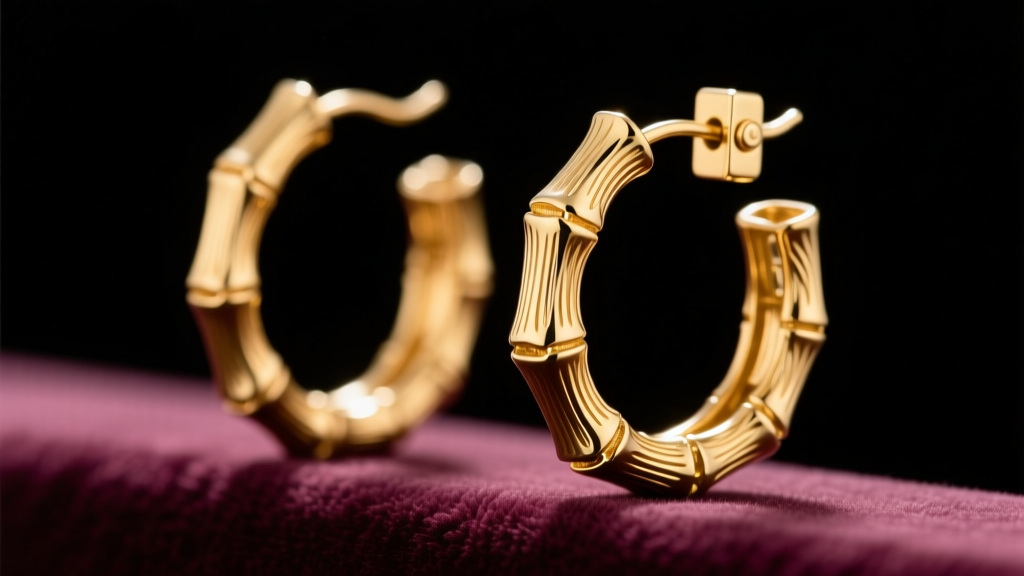
The iconic "bamboo earrings" of the 1990s—immortalized in hip-hop and R&B culture by artists like Lil' Kim, Mary J. Blige, and The Notorious B.I.G.—are far more than a nostalgic fashion statement. From a jewelry manufacturing perspective, these textured hoops represent a specific era of die-striking, electroforming, and goldsmithing. As we navigate the 2026 vintage revival, understanding the technical anatomy, metallurgy, and biomechanical impact of these pieces is crucial for collectors, jewelers, and stylists. According to the National Museum of African American History and Culture, hip-hop jewelry of this era was not merely decorative; it was a profound cultural artifact signifying resilience, success, and community identity.
The Anatomy of the 90s Bamboo Node Hoop
Unlike standard smooth tubing hoops, bamboo earrings are characterized by their segmented "node" and "internode" texture, mimicking the natural joints of bamboo stalks. In the 1990s, mass-market pairs were often produced using rubber mold casting or basic die-striking, which resulted in heavy, solid pieces that frequently caused earlobe damage. Premium pairs from iconic NYC jewelers utilized hand-engraved master models to create the bamboo texture before vulcanizing rubber molds for centrifugal casting.
The defining feature of a true 90s bamboo hoop is the depth of the node engraving. Modern 2026 CNC-milled reproductions often feature shallow, uniform nodes that lack the organic, asymmetrical tapering of vintage hand-finished pieces. The undercuts in vintage molds created deep shadows that gave the gold a high-contrast, three-dimensional appearance that modern flat-milling struggles to replicate.
Metallurgy: Karat Alloys and Structural Integrity
The vast majority of authentic 90s bamboo hoops were cast in 10k or 14k yellow gold. The choice of alloy was not merely aesthetic; it was a structural necessity. Pure 24k gold is far too malleable to support the pendulum weight of a 25mm-40mm hoop without bending at the hinge or post. The World Gold Council notes that alloying gold with copper and silver drastically alters its tensile strength, which was vital for the structural integrity of heavy streetwear jewelry.
| Alloy | Purity | Vickers Hardness (HV) | 90s Usage Context |
|---|---|---|---|
| 10k Gold | 41.7% | ~130 HV | High durability, resistant to hinge warping, paler hue. |
| 14k Gold | 58.3% | ~150 HV | Industry standard, optimal tensile strength and rich color. |
| 18k Gold | 75.0% | ~125 HV | Rare for large hoops due to post bending risks. |
The Electroforming Revolution: Hollow vs. Solid
To mitigate the earlobe damage caused by solid cast bamboo hoops, late-90s manufacturers adopted electroforming. This process involves depositing gold onto a wax or resin mandrel shaped like a bamboo stalk, then melting out the core. The result was a hollow, lightweight hoop that retained the massive visual footprint of a 40mm bamboo hoop but weighed a mere 3 to 4 grams.
However, electroformed 90s hoops have a distinct failure mode: denting. Because the gold shell is often less than 0.3mm thick, accidental drops or clamping in a vice during post repair will easily crush the bamboo nodes. When sourcing vintage pieces today, a gentle squeeze test can reveal whether a pair is solid cast or electroformed.
Weight Distribution and Earlobe Biomechanics
A solid 14k gold bamboo hoop with a 30mm diameter and 5mm thickness can weigh between 9 and 14 grams per earring. This concentrated mass exerts significant downward shear force on the earlobe piercing. Over time, this leads to earlobe ptosis (sagging) and piercing elongation. To combat this, 90s jewelers often utilized thicker posts—typically 12-gauge (2.0mm) or 10-gauge (2.5mm) wire—rather than the standard 20-gauge (0.8mm) wire used in lightweight studs.
For modern wearers styling vintage pairs, utilizing silicone earring support patches is highly recommended to distribute the shear force across a wider surface area of the dermal tissue. Furthermore, bamboo hoops should strictly be worn in fully healed lobe piercings; their pendulum motion creates severe irritation and migration risks if placed in cartilage piercings like the helix or tragus.
Hinge Mechanisms and Common Failure Modes
The most critical failure point on any vintage bamboo hoop is the hinge and latch assembly. According to Rio Grande's earring findings catalog, the mechanics of a hoop hinge dictate its lifespan under heavy loads.
- Saddle Hinge: Common in early 90s pieces. Features a U-shaped saddle that straddles the post. Prone to wearing down the post over time due to friction.
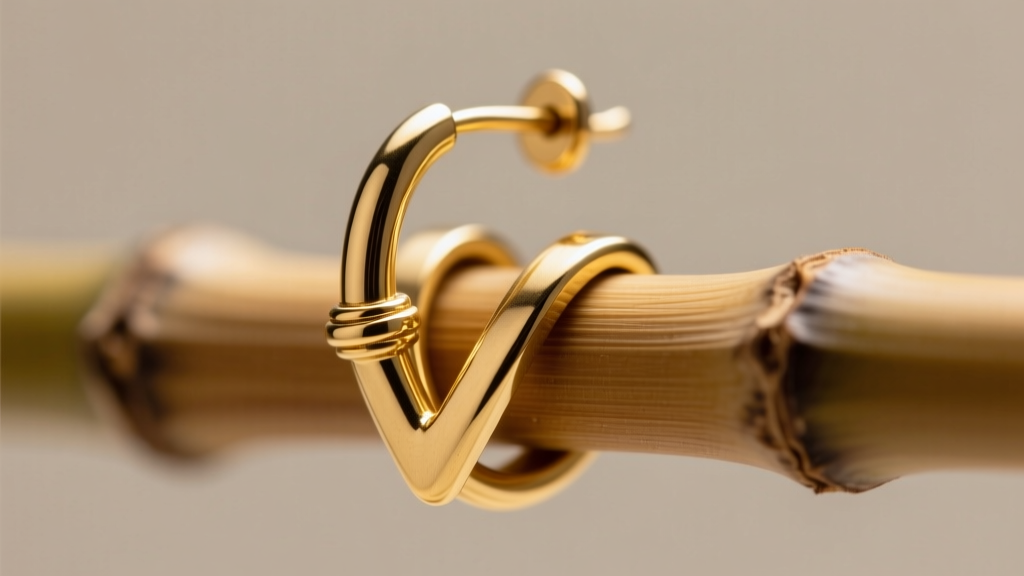
- Snap Hinge with V-Latch: The gold standard for mid-to-late 90s hoops. The hollow tubing of the hoop snaps into a V-shaped groove on the post barrel, providing a secure, audible click.
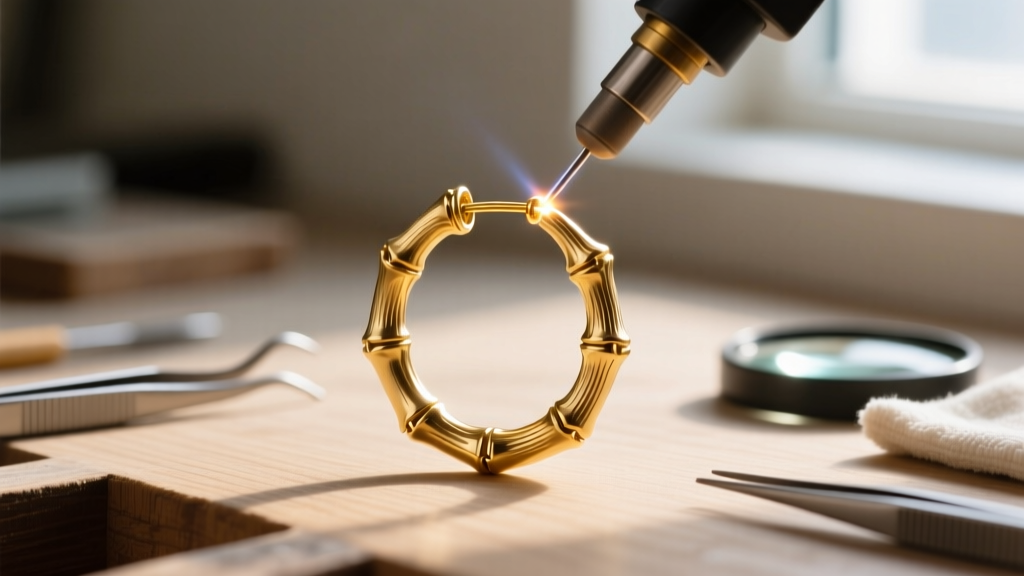
Failure Mode: The solder joint connecting the post to the hoop barrel is subjected to extreme torque when the earring is put on or taken off. In 90s pairs, lead-based or low-temperature gold solders were sometimes used, leading to brittle fractures. Modern laser welding is required to repair these vintage joints without melting the intricate bamboo node engravings nearby.
Ultrasonic Cleaning and Groove Maintenance
The deep crevices of the bamboo nodes trap sebum, dead skin cells, and environmental pollutants. Standard polishing cloths cannot reach these recesses. Professional jewelers recommend using an ultrasonic cleaner operating at 40 kHz with a mild, ammonia-free alkaline solution to agitate debris from the internode grooves.
Caution: If the vintage bamboo hoops feature any glued-in accent stones—a common late-90s modification involving cubic zirconia or rhinestones along the nodes—ultrasonic vibrations will shatter the adhesive bond. These modified pairs must be cleaned manually with a soft-bristled brush and isopropyl alcohol to preserve the stone settings.
Sourcing and Verifying Vintage Pairs in 2026
When sourcing authentic 90s bamboo earrings in today's market, hallmarks are your first line of verification. Look for stamped "10K" or "14K" alongside maker's marks from defunct 90s jewelry manufacturers. Beware of modern gold-plated brass replicas marketed as "vintage." A simple specific gravity test or X-ray fluorescence (XRF) scan can verify the karat purity and base metal.
True vintage pairs will also exhibit a specific patina in the recessed "internode" areas of the bamboo texture—a buildup of skin oils, soap, and oxidation that cannot be artificially replicated without looking forced. By understanding these technical nuances, collectors and stylists can properly preserve and wear these monumental pieces of jewelry history.


